Two from the Old World

As I recall, I was going to pick up my wine club selections from the Fine Wine Source in Livonia and believe it or not, I got waylaid in a wine shop.  Some times I can make stops anywhere longer if I get into a conversation about wines, or some of the other hobbies that I enjoy.  After totally enjoying a glass of a Volnay Premier Cru Champans, I was kind of like putty in their hands or a fly in a web.   I guess a great glass of wine will do that to me, but this was going to be an interesting respite from my other mundane duties that I was trying to accomplish that day.
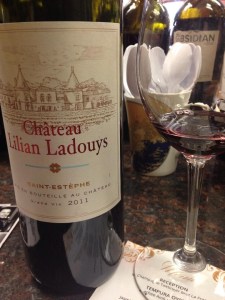
I was escorted to the back of the shop where the wine tastings usually occur and I was poured some Chateau Lillian Ladouys Saint-Estephe 2011.  I have not encountered many wines from the commune of Saint-Estephe in the Medoc, but every bottle that I have encountered, no matter the vintage was totally enjoyable and interesting and distinct from the two communes that I find much more often, that is Pauillac and Margaux.  This winery was listed as a Cru Bourgeois Supereiur in 1932 and again in 2003, before this classification was annulled in 2007.  Another one of those old Medoc estates that goes back to the middle of the 16’th Century and was originally known as LaDoys.  The winery and its fame suffered during the two world wars and had some changes in ownership, and the last two owners were interested in returning the estate back to its glory.   The winery is now owned by the same people that have Chateau Pedesclaux and Chateau D’Issan.  There are fifty hectares planted with Cabernet Sauvignon, Merlot and Cabernet Franc.  The wine is aged for fifteen months in French Oak, of which thirty-five percent is always new.  This wine had a great Medoc nose, a really chewy wine with terroir to spare and a very long aftertaste.  After I finished this wine, the owner had me taste the wine a second time, after they attached an aerator spout to the Coravin system that they were using and the wine was even more memorable after this “decanting.”  The one member of the staff that was doing the honors of pouring for me, was trying to sell me a Coravin and the owner of the shop was laughing and was joking with him, telling him that when I open a wine, it is not for tasting, but for drinking, so he negated the sales pitch for me.
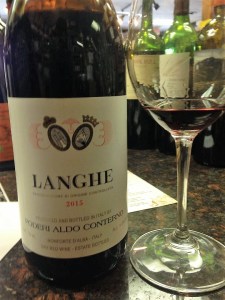
Now after having two wonderful French wines under my belt, you can say they poured me an Italian wine.  Almost from day one, when I started my tutelage of wines Italy was always right there, it also helped that back then it was much more affordable compared to the Medoc and that was important to a young student.  The Poderi Aldo Conterno Langhe 2015 was a wonderful follow-up.  Aldo Conterno was considered by many as the greatest of all Barolo makers, and he founded his own winery in 1969 after leaving as the manager of his brother’s estate.  Since his relatively recent death, his three sons have taken over the reigns and they are the fifth generation of winemakers in the family.  The Langhe DOC is very large and encompasses some famous other famous designations like Barolo, Barbaresco and Asti.  The Langhe DOC was established in 1994 and allows for the experimentation by the winemakers to use different varietals, akin to what occurred in Tuscany and the “Super Tuscan” wines.   This wine is a blend of Fresia, Cabernet Sauvignon and Merlot.  If you are like me, you may never have heard of Fresia, another reason that I may flunk the Century Club, but it is a long and respected, but seldom used, except for the most part in the Langhe.   There are two almost twin versions of this grape, depending on the size of the fruit, and it is known for its big tannins and residual sugar content.  It was more popular in the end of the 19’th Century and has bounced around a bit more, because it is naturally resistant to Phylloxera.  In a land with very strict rules governing Barolo, Aldo Conterno was considered a “modernist” and I guess that covers even this wine as all I could find out was that this wine came from some of the different vineyards of his in the Bussia, then the wine spends “a few months in Stainless Steel and a few months in oak casks.”  After a couple of wonderful French wines this Italian nose took me into another direction, and brought me another big chewy wine with plenty of terroir along with the tannin, and a very long count on the aftertaste.  I was just a very happy camper with all of these wines just making my day so much better.
Posted in Wine | Tagged , , , , , , , , , , , , | Leave a comment

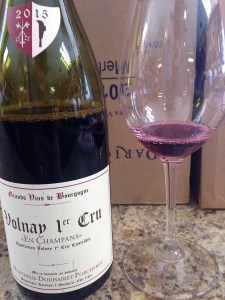
Volnay Premier Cru En Champans

I am sure that most people that belong to a wine club, show up to the shop, give their name and pick up their allotted parcel of wines.  At the Fine Wine Source in Livonia, I find that I have to select my time judiciously, because I can be there longer than the time required to pick up two wines, and you don’t hear me complaining.  I know that they have now figured out, that the strange guy with the sport coat and a fedora loves to talk about wines, and I do.  As soon as I walked in I was greeted with open arms and the conversation began with a discussion of a restaurant.  I hadn’t even got to the part of the shop where the tastings usually occur and one member of the staff had brought me a glass of wine and the bottles sans the Coravin apparatus, so that I may take my customary photo, even before tasting the wine.

With almost no fan-fare I was handed a glass of Domaine Monthelie-Douhairet-Porcheret Volnay 1er Cru En Champans 2015.  Volnay is one of the heralded regions within the Cote de Beaune and there are thirty-five Premier Cru Vineyards that have stood the test of time in Volnay.  Champans is located in the heart of Volnay and if one looks at the map of the region with all the vineyards penciled in, one wonders how anyone can keep it all in order and make sense of it.  I think because of this quirk, the entire area of Burgundy is sometimes avoided by some wine lovers, who feel that they can find Pinot Noir wines in more easily understood areas.  My experience is in retail (not wine) and I can appreciate and take the time to try to decipher the chaos of Burgundy; by the way the wines of Volnay have always been described as delicate with vibrant tannins and that is so true, and until one actually tries a true Burgundian wine, the idea that all Pinot Noir wines are the same is quickly shattered.

The Domaine has a storied three-hundred-year history in the region and like some family business there have been disagreements and changes and the addition of new blood.  This Domaine I would consider quite affordable for the grade of wines that they produce and considering that we are talking about Burgundy.  Champans is a perfect example of how most of the wine producers own their plots of vines, as they tend to stretch up the hillside and the terrain and soil as they go up the hill changes quite considerably, so most utilize this blended terroir to showcase the wines.  They use the same work ethic and concept to produce all of their assorted wines.  The fruit is hand picked and placed in small crates to avoid compressing the crops, and all the grapes are de-stemmed.  The wines are aged for eighteen months in the classic Burgundy barrels and ten percent is always new.  To immediately start off with this wine was wonderful and all I could do was marvel at the dirt, my way of admiring the terroir that was instantly picked up from the nose, the taste and that wonderful lingering aftertaste.  It is probably a good thing that they took the Coravin away from the bottle, otherwise I may have been tempted to just pour myself another tasting or even a third.  In fact, I would have been perfectly happy if that was the only wine I taste on this particular trip.

Posted in Wine | Tagged , , , , , | 2 Comments

Two New Club Wines

Writing a wine blog and belonging to a wine club can be a very expensive combination, especially when my local club is Fine Wine Source in Livonia.  I do not mean to imply that they only sell expensive wines, but I always think that I should be adding to the cellar, when I really don’t have to.  My other wine club is a bit easier to side step at times, because they send me the wines and more than often the wines may wait anywhere from a couple of months to a couple of years before the wine is tried, and then most of the time the wine has long left the horizon.   On the other hand, my local club is an adventure of waiting to be discovered gems.  With the creation of the Coravin system, local wine shops must have found their Nirvana.  With very little fuss or effort, a wine can be sampled for a customer without a lot of waste, or the concern that the wine may go bad in a short period of time, because in reality the wine has not been opened.  I can be potentially looking at ten to twenty wines that are waiting for me to sample.  For openers, I guess I shall look at the wines I actually went and picked up, when I got the notice.

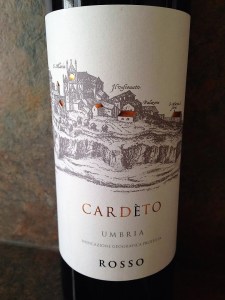
The first wine is from Umbria, Italy and Umbria is known as the only wine district in Italy that has neither a coastline or an international border that it abuts up to.  The first wine of the evening was from the Wine Cooperative of the Orvieto Community, one of the oldest cooperatives in that particular area of Italy. The cooperative began in 1949 and had thirteen vineyards and it now has one-hundred-fifty vineyards as members. The cooperative also has their own aging and bottling facility and have received official sanction for their wine.  Cantina Cardeto Umbria IGT Rosso 2016 is one of their wines from their Town Series.  The label is a reproduction of an old print of Orvieto, one of the towns in Umbria and famous in its own right, and if you had the proper sequence of labels then you can recreate the panoramic view of Orvieto from that print.  This particular red wine (Rosso) is a blend of seventy percent Cabernet Sauvignon, twenty-five percent Merlot and the balance is Sangiovese.  The vines for this series of wines are young with most between ten and twenty years of age.  The grapes are harvested in September, macerated and fermented in Stainless Steel and then aged for two weeks, and then aged another two months in bottle before release.  This wine is designed to be consumed early and I would venture to say would be fruit forward.  The owner of the shop said it will have a nice purple color with a good finish with balance tannins.  I would say a good pasta or pizza wine, since it should hold it own against a tomato-based sauce.


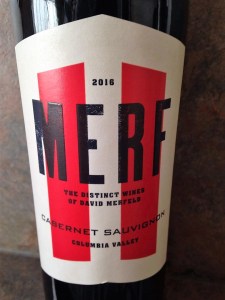
The second wine is from the Columbia Valley in Washington state, and one of the largest AVA areas in the country, as it basically has all the smaller AVA districts within its huge district.  The MERF Cabernet Sauvignon 2018 is from the hands of David (MERF) Merfeld who grew up on a family owned farm in Greene, Iowa.  David ended up moving to Seattle and was employed by a construction inspection company and started brewing beer as a hobby.  In 1996 he quit his day job and went into brewing full time while attending beer school and in 1997 was hired at Bert Grant’s Ales as a brewer, which was owned at that time by Ste. Michelle Wine Estates.  It didn’t take long before he was working for Ste. Michelle as a winemaker.  He now makes his own wines which are cellared and bottled at MERF Wines in Paterson, Washington.  This particular wine is eighty percent Cabernet Sauvignon, nineteen percent Merlot and a whopping one percent of Cabernet Franc.  Seventy-five percent of the juice was aged for twelve months in a combination of French and American Oak, with the remainder aged in Stainless Steel for more of the fruit and when blended back together the wine is said to have character and complexity.  The owner of the shop opined that the wine is rich and opulent and loaded with flavors of blackberry and currant, and has a long finish that he thinks makes it perfect for Ribeye or fatty steaks, and is even suggested to be great with a slice or two of Chocolate cake.  I am sure that here are a couple of wines that will not stay in the cellar for long and then I can give my notes on them.

Posted in Wine | Tagged , , , , , , , , | Leave a comment

My September Club Meeting

I have belonged to a dinner club since 1989, which may sound like a long time, but the club has been in existence for about 125 years.  In fact, when the City of Detroit was celebrating their 300’th birthday, we were one of the few organizations in Detroit that were over one-hundred years old and I remember that day vividly because I represented the club at the breakfast, since that year I was the president of the club.  The club began with some of the elite business and social figures in Detroit at the time, there was an uncle of a former President of the United States, and many titans of the business and commerce of Detroit, before there were automobiles that gave Detroit a new nickname.  The club used to meet and dine at a member’s home, which back then, those gentlemen had staffs and homes that could seat comfortably forty or more members for dinner, then a meeting, and cigars and cognac afterwards.  The club survived the Great Depression, and due to necessity of the times, the meetings were held at a residential hotel’s dining room for a couple of decades.  Finally, as the members were no longer residing within the confines of the city, it was decided that groups of three would be the benefactor for the evening and then they would enjoy the largesse of other groups of three, until their group came around for rotation again.  The groups of three would select a restaurant for the meeting, and basically the only caveat was that the venue must have a private room for the group.  This was how the meetings were held when I joined the group, but whereas once the group of three paid for the meal and drinks, they now only pay for the meals, because a small group complained long and clandestinely that non-drinkers were objecting to paying for the sins of the drinkers.

With more and more restaurants eliminating private rooms, the choices have narrowed a bit over the years and hence we tend to meet at some restaurants several times within a given year.  We once again found our meeting at Masters Restaurant, a quaint setting that is a copy of the clubhouse at the Masters in Augusta, Georgia, and as you can surmise the theme of the interior is strictly golf.  This restaurant has even changed hands and the present owners are still doing a nice job for us, as we continue to always use the back room on the main floor.  It has even become a tradition that the hosts here even start off with some hot appetizers during the cocktail hour preceding dinner.  The entrée choices of the evening were Atlantic Salmon, Hawaiian Chicken and Tenderloin Beef Tips and all were served on beds of rice pilaf, a preceded by a Greek Salad (though I always request an Italian Salad (not really a big deal)).  The desert has historically been an ice cream sundae, with only a few exceptions over the years.

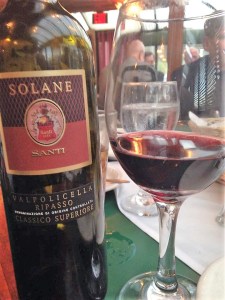
I guess that a couple of members have discovered a silver lining to the dark rain cloud that a few members have caused over the now current cash bar status for our dinners.  In the old days, I tended to drink cocktails through out the evening, because a lot of the venues used had a very poor selection of wines by the glass.  Now two or three members may opt to purchase a bottle of wine and sometimes there is a wine that can be interesting that the restaurant will not sell by the glass.  This was the case that evening.  One of the other members lamented that there were no quality Pinot Noir wines being offered even by the bottle, and he asked me if there was anything of note.  I found one that I thought he would like, I knew it would work well with the Tenderloin Tips that I had ordered, and since he likes Pinot Noir with Salmon I gave it a go.  We shared a bottle of Santi Solane Valpolicella Classico Superiore Ripasso 2013, and he had never had a Valpolicella.  Valpolicella has been likened to Beaujolais not for the wine, but for the ups and downs of the popularity and how both areas are striving to return to the good graces of the wine drinking public.  Valpolicella has always been one of the most popular red wines of the Veneto, but it was always a middleweight especially to its cousin Amarone.  Some of the producers in the Valpolicella Classico district attempted to give the wine more body and nuance by utilizing the same technique that makes Amarone so wonderful, and that is making it Ripasso and at the same time making the wine strong enough to be Superiore.  The Ripasso method is to take the grapes and lay them out to dry for three to four months before pressing them to beginning making the wine.  These dried grapes have a concentrated flavor that really elevates the finished product and have some salesman and wait staff calling these wines “mini-Amarone.”  While there are three grapes that are the core of Valpolicella, this wine is made with seventy percent Corvina and the balance in Rondinella and eschewing the third grape entirely.  I will also mention that Santi was established in 1843, so they have been producing wines in the Veneto for some time, in fact they are still using the original winery, but it has been updated and modernized to take advantage of some new techniques that can be done.  Santi is now part of Gruppo Italiano Vini and is now considered Italy’s biggest wine maker.  I might add that my associate was pleased with the wine, and a third member wanted to get into the action as well.  Until the next meeting where there will be some interesting bottles of wine.

Posted in Dining, Wine | Tagged , , , , , | Leave a comment

The Hotel Frankfort

After a couple good winery visits we were ready to check into a hotel and have dinner.   We planned on visiting wineries in the Leelanau Peninsula, because that would have us close to Frankfort, which I have written about several times this year and in the past.  We had to make a quick stop in Frankfort for business, actually for my Bride who had packed some materials for one of her account executives who covers the whole northern part of the lower peninsula.  When we were deciding what to do after Petoskey, knowing that we had to drop off the materials, I suggested that we stay at the historic Hotel Frankfort, they have a fine dining room, but it is only open for dinner and every time we had been in the town it was during the day, because if we were there at night, we had already had prior reservations.  The hotel is almost ninety years old on the main drag of the downtown and only about two blocks from a beautiful beach, and about the same distance to the huge marina.  The hotel has seventeen very good size rooms if our mini-suite was indicative of the other rooms.  There was only one thing we forgot to inquire about, they don’t have an elevator.  I lost track of how many trips we had to make to unload the car of everything we needed, we do travel with a portable refrigerator that goes from the car to a hotel room.   Also, three cases of wine get rather heavy going up even one floor (I guess I am getting old).  I did suggest the hotel, but it was really a nice place and we survived.

The Dining Room was a very nice with that genteel turn of the last century ambience.  The hotel also has a bar, but it is actually across the lobby from the dining room, so if there was any rowdiness because of an athletic event, it would never disturb the guests.  My Bride had the soup of the day, but I forgot what it was, and I started with a garden salad.  My Bride had ordered the Jumbo Lump Maryland Crab Cakes served with Lemon Aioli, and I might add that the cakes were large enough, that I had to finish the second one for her, and I am that kind of guy.  I went native that evening and I had the Broiled Lake Superior Whitefish with essence of Lemon Oil.  I am not a real big fan of whitefish, but once in a while, if I figure a place is going to do it right, and it is fresh, I will order it.  I mean it is hard in Michigan, especially as you go north, not to encounter whitefish.  After dinner we split a Crème Brulee along with some coffee.

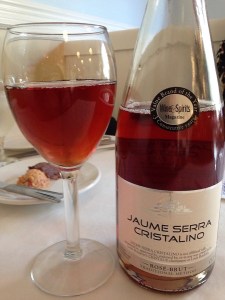
I got to the dining room before my Bride, as she was on the phone, and I wanted to make sure that we honored our reservation, and by the time we left, the room was almost to capacity.  After all that schlepping up and down the stairs, I had kind of cooled off a bit to get into my sport coat for dinner, even on holidays, but especially in resort towns I do like to dress for dinner.  I needed some additional assistance to cool the system down, and I look at the wine carte, of the wines by the glass and I ordered the Vista Point Vineyards Pinot Grigio-Colombard NV.  This was a California wine that as far as I was concerned was good for quaffing and was a great compliment to the tumbler of water, and I might add that it was a generous pour of this wine.  There really was no nuance or craft involved in the production of the wine, but it hit the spot for what I wanted at the moment.  When my Bride showed up, I picked something festive and a type of wine that we had not encountered the entire trip.  We ordered a bottle of Jaume Serra Cristalino Rosado Brut NV, a Cava from Spain.  This is a wine that uses the Metodo Tradiccional Cava from Spain by J. Garcia Carrion.  The sparkling wines of Spain have been made in the proper way since the earliest years of the last century and was marketed as Champana, until France flexed their muscles and declared that they were the only country to produce Champagne.  The Spaniards came up with a novel new name, not a geographic location, but from the method that the wines are stored and that is in caves, hence Cava, and while they are a bit looser with the designation, ninety percent of the Cava is still produced in the Catalonia region.  Originally the varietals for Cava were Macabeo, Xarel-Lo and Parellado, since 1986 Chardonnay was approved, but since this was a Rosado, the most popular grape is Trepat.  Trepat is indigenous to Northeast Spain and is an authorized grape for blending for Cava, in fact most Rosado Cava wines are pure Trepat, but this wine was sixty percent Pinot Noir and the balance was Trepat.  There wasn’t much of a nose to the wine, but the most striking feature of the wine was the raspberry color, which we both found rather unique.  The next morning, while my Bride went to church, I went and packed the car and we were ready to go home.

Posted in Dining, Wine | Tagged , , , , , , , , , , , | Leave a comment

Verterra Winery

Even with all of the driving that we did, we wanted to visit another winery that we had heard good praise about, and that was Verterra Winery.   I found it amusing that the same week that we had returned home, I was listening to a radio program about the virtues of Michigan and they were interviewing the owner of Verterra Winery.  He was explaining the process in which he had to get the name approved and his first several choices were already being licensed.  He decided to create his own name and went to Latin, which is the base language for so many terms used in winemaking.  He took the word Veritas which means Truth, and the word Terra which means land, combined them to make Verterra which means True to the Land, and Verterra was free and clear and he had his name.

The winery started in 2006 with an acre and a half and the winemaking fever took hold and now they have forty plus acres of land, cultivated on the slopes and undulations of the Leelanau Peninsula.  The Leelanau Peninsula AVA basically encompasses the entire Leelanau County and the peninsula takes advantage of the lake effects to keep the grounds cool during the hot summers, and allows the snow to cover the vines and for the most part prevents them from freezing, because this is Michigan.  The winery has a nice tasting room, and they also have a secondary outdoor tasting area, that is not always available, because not only is this area famed for winemaking, but a curious secondary business has risen up, and that is being the venues for destination weddings.  Several of the wineries have made accommodations for weddings or group events and Verterra is one of them, and they also can boast that they have permanent and proper enclosed areas for the caterers and for the wedding participants, a bridal lounge and for the  guests indoor plumbing with granite counters and tile enclosed,  which I am sure has made many a Bride even happier on her day.

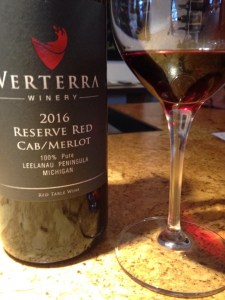
Of course, I digress, as is my nature, but we also tried some lovely wines while we were there, and the staff did not find me too annoying, at least I hope not.  Perhaps my only complaint and it is a mild one, was that they did not have paper printed lists of the wines for me to make my notes on, but luckily my Bride saved the day with a scratch pad.   All of the white wines we tried were aged in Stainless Steel for a crisp and fruit forward taste.  The Verterra Pinot Blanc 2017 was a very easy drink wine with a light floral nose and a nice finish.  The Verterra Dry Riesling 2017 was a very crisp and enjoyable wine.  This particular wine has captured the Best Dry Wine for two year running now in the Michigan Wine Competition.  This wine is so well made and drinkable, that there is a two-bottle limit only on this wine, and yes, after this latest trip up North, have decided that I really enjoy a well-made Michigan Riesling, a wine that I used to avoid like the plague.  The Verterra Dry Gewurztraminer 2016 was a real winner.  It had that slight effervescence that one sometimes finds in some of the delicate white wines of Italy.  This wine had a light floral and grapefruit nose that I found very enchanting, and yes, we have always been eager to find a new Gewurztraminer, like we did here.  The Verterra Pinot Noir 2016 had fourteen months of aging in French Oak, but I found it to be light, but potentially a year or two in the cellar may aid this wine to be more rounded.  The nose had cherries and pomegranates to make the nose more interesting and made us think that aging would be good for it.  The Verterra Reserve Red 2016 was a blend of Cabernet Sauvignon and Merlot.  It had a “smoky” finish to it, and I think a few years in the cellar will bring out this wine, at least this is what we said to ourselves while we were making our purchases.   I think part of the problem, if you can call it a problem, which it really isn’t is that the vines are still young and need to mature and get a bit more gnarly from the abuse of stressed farming will do to it, and since the winery is only ten years old, I will give them that liberty.  The last wine that we tried was the Verterra Cherraz Port NV.  Here was a cherry wine infused with raspberries, fortified with local apple brandy and aged in oak barrels.  It was an intriguing dessert wine with several layers that were very harmonious and complex.  We are really enjoying our trips to the Leelanau Peninsula and our cellar is showing a slight Michigan accent, of course all news reporters try to acquire that accent which is so easy for us here, and eventually the wines will also receive more acclaim.

Posted in Wine | Tagged , , , , , , , , , , | Leave a comment

Laurentide Winery

We decided to take the scenic tour along the lake from Petoskey to the Leelanau Peninsula and visit a couple of new wineries to us.  The first winery we pulled up to was Laurentide Winery on the 45’th Parallel.   As I quote from their web site about their name.  “Welcome to Laurentide, named in honor of the last great ice sheet that receded 10,000 years ago from the upper tier of the North American continent. With the completion of this great geologic event, the Great Lakes and surrounding lands assumed their present forms. The Leelanau peninsula was exposed and the rocks and fossils from a 350-million-year-old ancient sea floor started to formulate the soil that sustains our vines today contributing to the unique terroir of the region.”  William and Susan Braymer have a classic, almost romantic history leading up to their ultimate decision to becoming winemakers.  In 2006 they bought a cherry farm and began planting some grapevines.  They now have six varietals planted on ten acres, and we had a chance to try five of the varietals, the sixth was sold out, as well as their Cherry wine, which from this region when done properly is a very singular experience and it is extremely popular in the land of the Michigan Cherry Festival.

We had a wonderful time in their tasting room, and we really don’t abide by the rules of the house, and are always willing to pay for our indiscretions, depending on the winery.  Some wineries are probably glad to see us go, but we were treated with open arms at Laurentide and it was a pleasure.  We started off with the Laurentide Emergence 2016, under the heading of “Standard Sweets” as they were really touting this wine, and we agreed to a tasting.  We are truly fans of dessert wines, but normally sweet wines we tend to avoid.  Here was a wine that was a blend of Pinot Gris, Riesling and Chardonnay that was much better than I had expected, and it set the tone for the rest of the tasting.  The Laurentide Sauvignon Blanc 2017, was their Seventh vintage and I found it to have the grapefruit aroma that I enjoy and some spice to the taste with a nice balance finish.  The Laurentide Pinot Gris 2016 was aged in Stainless Steel and it had a good fruit forward taste and a nice nose for a wine that more often than not, lacks a good nose.  The Laurentide Dry Riesling 2016 was also done in Stainless Steel, in fact I think most of the whites were.  We are not fans of Michigan Riesling wines, but that may have been from the earlier years, as these wines are growing on me and are not as cloying as I once found them to be.  This particular wine had a positive green apple nose coupled with a crisp balance taste and a decent finish that I normally do not get from Michigan Riesling wines, so they are doing this one right.  The Laurentide Chardonnay 2016 was listed as unoaked.  I found it to be on the pale side, but it was crisp, but not a wine that I was enamored with.  The Laurentide Reserve Chardonnay 2016 definitely showed me that they could do Chardonnay in a proper way.  This was their first Reserve wine.  The wine was aged for nine months in one hundred percent new French Oak, and it really delivered.  It had a good oak (buttery) finish, but not a screamer like some of the California Chards and a good long finish, which is always what I tend to look for.

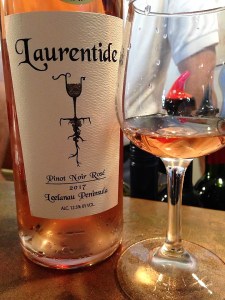
We then had almost a red wine, we had the Laurentide Pinot Noir Rosé 2017, which had a soft nose and a medium finish with a soft salmon hue to the wine.  The Laurentide Pinot Noir 2015 was sold out, so we could not try that.  Somehow, I missed trying the Laurentide Meritage 2016 and I don’t know how that happened.  I guess we were just so busy trying the wines and talking about the wines that both I and our server both missed.   I guess that I should mention that all of the wines were from the Leelanau Peninsula AVA  All I can say is that it will be a pleasure to go back to Laurentide Winery next year, if I get a chance to try their wines again, including the ones I missed.

Posted in Wine | Tagged , , , , , , , , | Leave a comment

Petoskey Farms Vineyard & Winery

While we were in Petoskey we decided to try another winery, before we headed out to our next destination.  We went to the tasting room for Petoskey Farms Vineyard & Winery.  Andrew and Tracie Roush are living out their dream of owning a winery and they bought twenty-two acres of land and started off with sixteen-hundred grapevines and they opened the doors in 2014, so they are a relatively new winery in the area.  When we were there they were offering five white wines, seven red wines, a fruit wine and four hard ciders; and not a bottle retailed above $28.00 which was reasonable for a new firm.  My Bride and I opted for only the wines, and we paid extra, because we are renegades and did six tastings, instead of the standard five pours.

The Petoskey Farms Vidal Blanc 2017 is a dry white wine and it is made from one of the Cold-Hardy grapes that can be found across Michigan.  The grapes came from the Lake Michigan Shores AVA and was aged in Stainless Steel for a nice crisp wine.  The wine had some grapefruit to the nose and a tinge of mineral on the aftertaste.  They produced one-hundred-two cases of this wine.  The Petoskey Farms Sur Lie Chardonnay 2017 also came from the Lake Michigan Shores and were aged on the lees for three months in Stainless Steel.  I detected some creaminess to the wine, even though it had a soft nose, but very easy to drink.  The production on this wine was two-hundred-fifty-two cases.  The last white that we tried was the Petoskey Farms White 2016 made from the Seyval Blanc, another Cold-Hardy grape.  They made four-hundred-fifty-two cases of this wine which they termed Semi-Dry and I would concur.  The majority of the white wines in Michigan are Semi-Dry, but the Vidal Blanc and the Sur Lie Chardonnay were both crisp and dry, and to my liking.

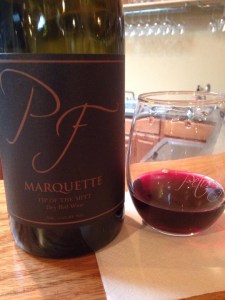
The first of the red wines we tried was the Petoskey Farms Romance 2017 which carried the Lake Michigan Shore designation.  The wine was a blend of DeChaunac and Noiret grapes.  DeChaunac is a French-American hybrid that was developed after the phylloxera devastation in the latter half of the Nineteenth Century.  Noiret is another Cold-Hardy hybrid grape that is found in the Northeast and in Canada.  I found this wine to have some spice to it, which I find appealing, and I thought I detected some vanilla or oak, but I couldn’t find out how this wine was aged.  There were seventy-three cases made of this wine.  The other red that we tried was the Petoskey Farms Marquette 2017.  Marquette is a real newcomer to the wine world, another hybrid for the colder climates and a grandson to Pinot Noir.  This wine came from the newest AVA in Michigan, the Tip of the Mitt which encompasses six counties at the top of the Lower Peninsula, and I think a cute name, because the map of Michigan looks like a mitten, and most Michiganders hold their hand up, to show where a city is to be found.  This was a nice dry wine with a touch of black cherry, which is kind of appropriate, because before the boon of wineries this area was all cherry orchards.  They made one-hundred-ninety-eight cases of this wine.  The last wine we tried was their sweet Rosé, the Petoskey Farms First Crush 2017.  This was a blend of Frontenac and Frontenac Gris, Frontenac is a Cold-Hardy grape that is a French-American hybrid developed in the Seventies, and Frontenac Gris is a hybrid from Frontenac that was releases in the early part of the first decade of this century.  The wine is Estate Grown and carries the Tip of the Mitt designation, and they made one-hundred-twenty-five cases of this wine.  This wine had a watermelon-pink color that was rather vibrant and it was a tad sweet for us, but I could see it being very popular, as I know that there is a segment of wine drinkers that prefer a sweeter wine.  To be candid, I was quite impressed with some of the wines, and since they are basically brand new, I look forward to seeing where the road leads them in the world of wines, especially since they will not break the bank.

Posted in Wine | Tagged , , , , , , , , , , , , , , | Leave a comment

Dinner in a Wine Cellar

Do you know how dangerous it is for the two of us to go strolling in Petoskey?  Petoskey is the perfect example of a resort town.  The shops were not cookie cutter and yet somehow my Bride knew about all of them, I don’t know, maybe it is osmosis.  She found some clothes, some Christmas presents (which for her is a year long occupation) and some kitchen ware.  She saw some kitchen stuff from MacKenzie-Childs and she became this woman possessed.  I had never heard of the line, but she informed me that one of my cousins, swears by this company, so now I guess, so do we (I must make a memo to myself to disown that cousin).  When we first got to Petoskey we found this charming shop called Symons General Store which opened up in 1956 in the oldest brick building in the city and it was nirvana.  We always like to have some noshes in our hotel room, and Symons did it up properly with some pate, and some exquisite onion crackers.  There was nothing proletarian about this shop or the products that they proffered.  They also had a very interesting wine selection, very well thought out and some very unique wines; not to mention that there was a shelf that ran the circumference of the shop just below the tin-stamped ceiling that had hundred of “dead soldier” bottles of wine, like First Growths and DRC.  I was kind of pushed to another section of the shop and away from the wines (go figure).

When we are out on holidays, it normally is my job to find some place interesting to dine at.  So, in the morning while my Bride was working at the board meeting that brought us to Petoskey, I had my morning constitutional and walked some forty or fifty blocks looking at the different restaurants that had been touted to us.  I know that I could probably do it on line, but ever since Google has become just one big commercial site, it is very difficult I find to navigate the maze of red herrings.  I thought I had found our restaurant, but the menu was not that exciting, and I do appreciate when menus are posted for the casual stroller to read.  After her work was done and we were walking around we found Chandler’s which had opened in 1999 and in the early autumn season, they were offering three venues for dining; the main dining room and bar, the patio and the wine cellar.  It did not take long to figure where we were going to dine.  It turns out that Chandler is the son of the man that started Symons and the cellar was underneath the general store.  The cellar was quite spacious and had wooden racks everywhere, but I am sure that there was some secret to the numbering and placement of the wines.   We had been noshing the whole day, so when we sat down for dinner, we were just ready for our entrée dishes.  My Bride had the Roasted Amish Chicken Breast with Angel hair pasta, roasted local tomatoes, marinated olives, basil and Fontina Fondue.  I had the Maple Leaf Farms Duck Breast with a roasted Michigan peach, Baby Bok Choy, Shiitake mushrooms, preserved Ginger and a Chinese Black Bean-Garlic Sauce.

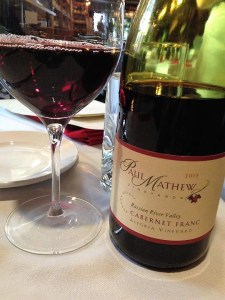
The wine carte was very impressive both in size and scope, it took a bit of time to ponder all of the selections.  There was also an exquisite caveat in various places in the wine carte next to some very famous wines and here is one quote “the following wines from Chateau D’Yquem have all been in our possession since their original release.  They have been properly stored & are sold as is.”  I know that some have already decided that I was going to order a bottle of Pinot Noir of some sort, because I was having duck, but instead we had a bottle of Paul Mathew Vineyards Cabernet Franc Alegria Vineyard 2015.  This wine was from the Russian River Valley in Sonoma County.  Alegria Vineyard is a five-acre block planted in 1991.  The wine is fermented in Stainless Steel and bottled in early spring after the harvest.  The wine delivered the fruit and it was still very fresh and youthful and by the end of the meal it had opened up and was a well appreciated bottle of Cabernet Franc, in fact it was so delicious I only had the empty bottle to take back to our room.  During our meal I had a chance to talk to the wine steward/waiter and we were naturally talking about wines.  When he learned where we live, he asked me if I knew a certain gentleman and I had to say yes, the gentleman in question is the owner of Fine Wine Source in Livonia which is where I have a membership in his wine club.  After dinner and a dessert of Crème Brulee we had a glass of Chateau d’Orignac Pineau des Charentes.  This a fortified wine that is made from sixty percent Merlot and the balance is Cabernet Sauvignon.  The current “must” of this wine is blended with a cognac made from the prior year, which is a blend of Ugni Blanc and Colombard.  Then the blended mixture is aged for five years in French Oak.  It was a delightful second night in Petoskey.

Posted in Dining, Wine | Tagged , , , , , , , , , , , , | 2 Comments

Mackinaw Trail Winery

Our first afternoon up in Petoskey and we had some free time, prior to dinner that evening, so we went into the downtown, which was all of a block and a half from the Stafford’s Perry Hotel.  The downtown area is what one should expect from a resort town.  There was some very fine shopping and only a couple of chain operations, some nice art and plenty of gift shops.  They also had two fine men’s stores which made me smile, so often a men’s clothing store is some t-shirts, but the two stores actually had merchandise that I would purchase.  Also, in the downtown area was a tasting room for Mackinaw Trail Winery of Petoskey, they actually have four tasting rooms in the state.

Mackinaw Trail was founded in 2004 and they have their second generation already working as a winemaker.  The winery owns thirty acres, but currently grow on fifteen acres.  Some of the wines that they produce come from the Lake Michigan Shore AVA, which produces about ninety percent of the wine for Michigan.  The AVA runs along the eastern coast of Lake Michigan from the Indiana border up to the Kalamazoo River, and runs about forty-five wide from the shore line.  The AVA supplies enough juice for about fifty different wineries in the state and the area is also a large producer of the Concord and Niagara grapes that are used for table juice and jams and jellies.  The cream of the crop is the wineries Unrestricted line of wines, where more attention and artistry are devoted.  While we were in the tasting room we tried five of the wines that were being offered.

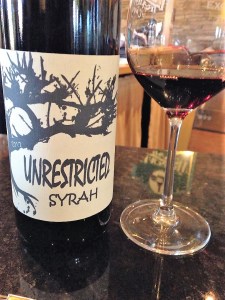
The first wine that we tried was the Unrestricted Barrel Reserve Chardonnay 2015.  This wine was produced using the Sur-lie method and was aged for ten months in Russian Oak.  The wine was served slightly chilled, more at cellar temperature for the nose to express itself.  I found this wine to have some natural sweetness and I can think of many relatives that this wine would appeal to.  The Unrestricted As-cen-sion 2017 was an interesting little blend of thirty-four percent Sauvignon Blanc, twenty-five percent Chardonnay, twenty-two percent Riesling and nineteen percent Pinot Blanc.  This had a sweeter nose and was a nice balanced wine and once again would be very popular among some of the females that come over here for occasions.  The Unrestricted Cuvee No. 7 2015 was a very interesting red wine, a blend of fifty-two percent Cabernet Sauvignon, twenty-eight percent Cabernet Franc and twenty percent Merlot.  This wine was aged for twenty-six months in French and Hungarian Oak and was an easy drinking red wine that had a nice tannic background that worked very well.  The Unrestricted Barrel Reserve Cabernet Sauvignon 2013 was a winner and only six barrels made the cut, for the aging period of thirty-two months in both French and Hungarian Oak.  A very nice Cabernet Sauvignon for Michigan, if I may say so.  The Unrestricted Syrah 2012 was a stellar wine from the Lake Michigan Shore AVA and I think it was the first Michigan wine that I had that retailed for a hundred dollars.  This wine had an extended maceration period and then was aged for twenty-four months in French and Hungarian Oak.  A good solid nose with vanilla and spices abounding with a nice long aftertaste.  A well-balanced wine that I think could easily age for another six to ten years, as it was that impressive young.  After the tasting allotment, our hostess in the tasting room wanted us to try another wine, as I guess she thought I must have been some crazy guy for taking all of these notes and making sure that every wine was photographed.  I mean who does that, but some over the edge wine bloggers.  She poured us the Tip of the Mitt Estate Grown Petite Pearl 2016.  There was not a lot of information to be gleaned about this wine, but this grape is a Cold Hardy variety where the grapes are very small.  This wine was dry and rather full-bodied with flavors of red fruit like cherries and currants.  Not to mention another grape for me, just in case I ever decide to sit down and apply for the Century Club, and one never knows.

Posted in Wine | Tagged , , , , , , , , , , , , , , , , | Leave a comment