Fine Wine Source October 2022 Club Wine Selections

We just flew back home, and I had to stop at The Fine Wine Source in Livonia, Michigan to get the October Selections of the Wine Club.  It happens to be the best bargain I have found and I have enjoyed some wonderful selections that I probably would have walked by on, just because sometimes I can be aloof, a common ailment, I think for most wine drinkers and collectors.  Not to mention that I ran into a local wine celebrity, who may even be a better raconteur than yours truly.   More to come about that afternoon, it is too good not to mention. 
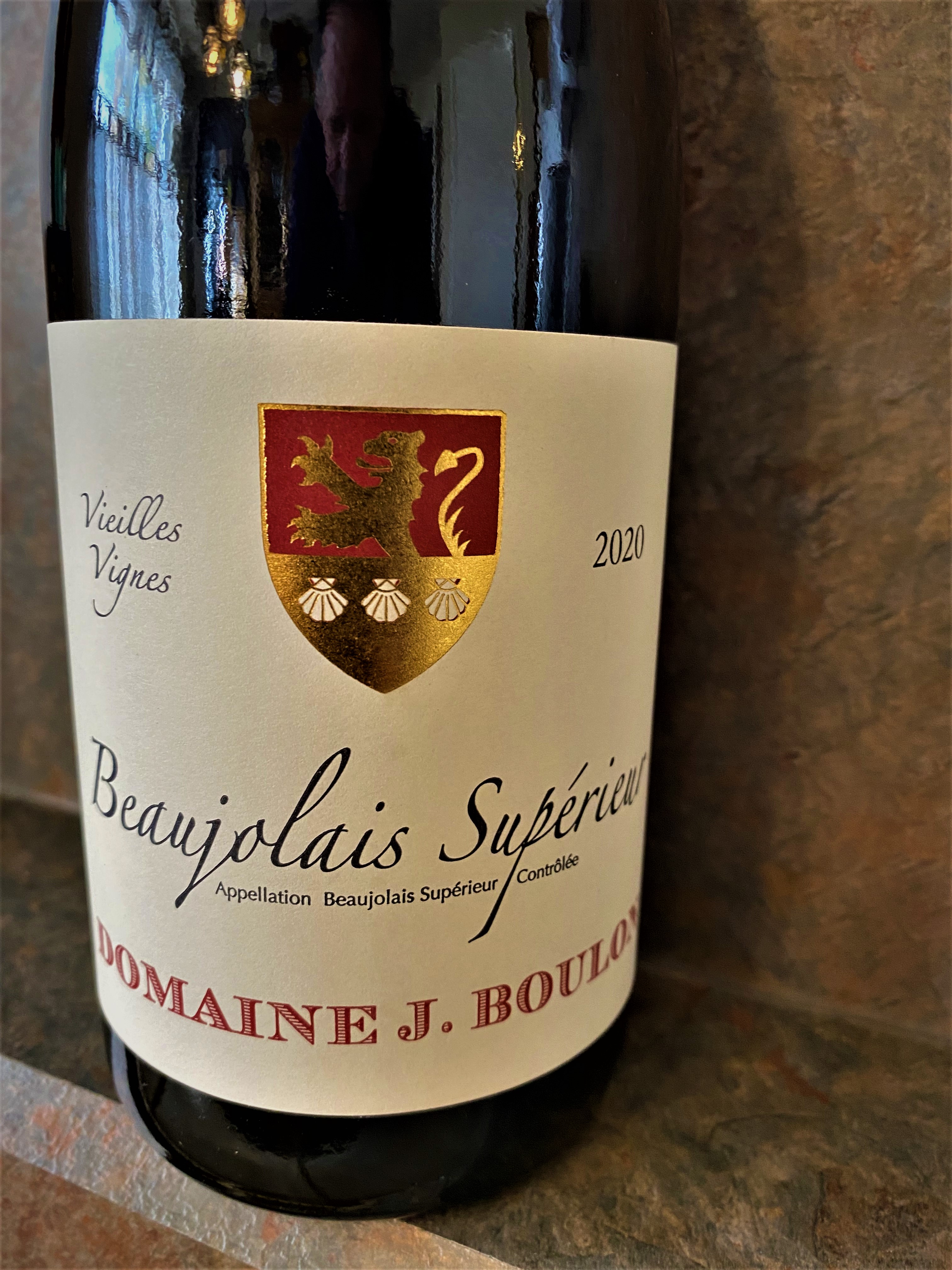
The first wine representing The Old World is Domaine J. Boulon Beaujolais Supereiur Vielles Vignes 2020.  Domaine J. Boulon is now in its sixth generation since about 1850.  In the beginning Joseph Gachot started with a few hectares of vines, as it became part of the Boulon family, the estate began to grow; and by 1973 they began bottling their own wines, and then they built a new winery and now have twenty-seven hectares including land in two Crus.  Beaujolais is a huge area, just south of the Maconnais, but the area is part of the Rhone, instead of Burgundy.  The region is basically entirely devoted to the Gamay grape and just a few varieties are permitted in small quantities.  There are ten Crus, Beaujolais Villages, Beaujolais Nouveau and Beaujolais Supereiur.  Beaujolais Supereiur has more stringent requirements. Like a higher alcohol level when picked, and a smaller yield.  The grapes are hand-picked, and pressed whole then fermentation and aging.  The wine is described as ruby red with notes of bright red fruits.  On the palate tones of cherries and dried cranberries, and with a year or two potentially some interesting tannins and structure.
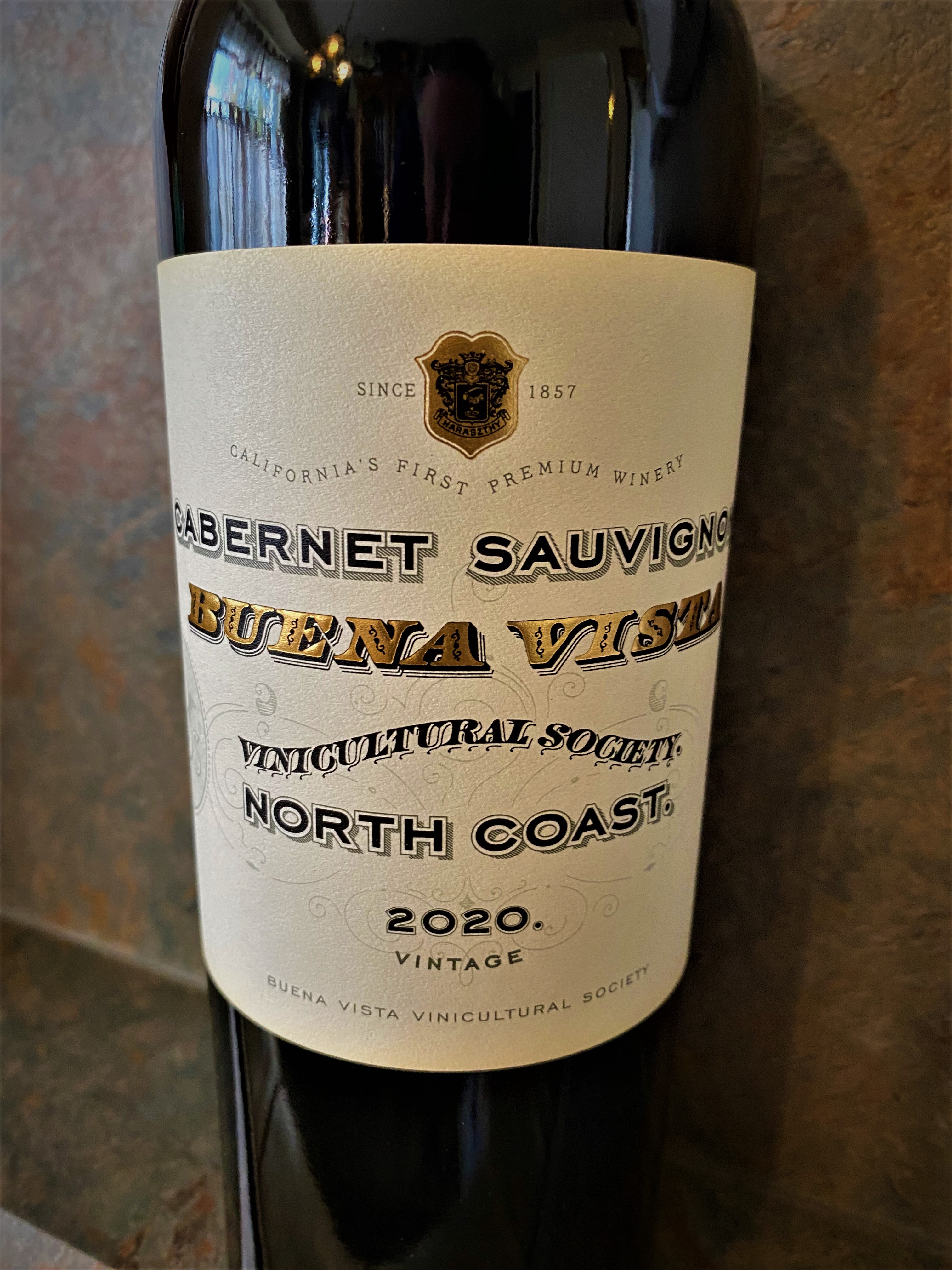
The second Fine Wine Source club selection was Buena Vista Winery Vinicultural Society North Coast Cabernet Sauvignon 2020.  The self-proclaimed “Count of Buena Vista” was Agoston Haraszthy de Mokesa and by all accounts he was as vivacious as he was eccentric.  As a metallurgist, he went to California for the “Gold Rush,” but in the end, after doing quite well settled on the “Purple Gold.”  In 1856 he acquired eight-hundred acres in Sonoma after seeing an old dry-farmed vineyard there.  The winery was established in 1857 and produced 6,500 gallons the first year.  It is considered the oldest winery in northern California.  One of his friends from San Francisco, Charles Krug, purchased some land and even borrowed a press from the “Count” for his first vintage.  In 1869 the Count died tragically in Nicaragua and the winery was forgotten until 1943 when it was purchased by Frank and Antonia Bartholomew.  They brought in Andre Tchelistcheff and replanted, and had their first vintage in 1949.  In 2011, Buena Vista Winery became part of Boisset Family Estates.  The fruit is sourced from Lake County and Sonoma County.  The wine is described as having “notes of black cherry, vanilla and pipe tobacco.  On the palate plum and black currant with traces of hazelnuts and mocha.  This wine is full-bodied, providing a delicious and lingering finish.”   
Posted in Wine | Tagged , , , , , , , , , , , | Leave a comment

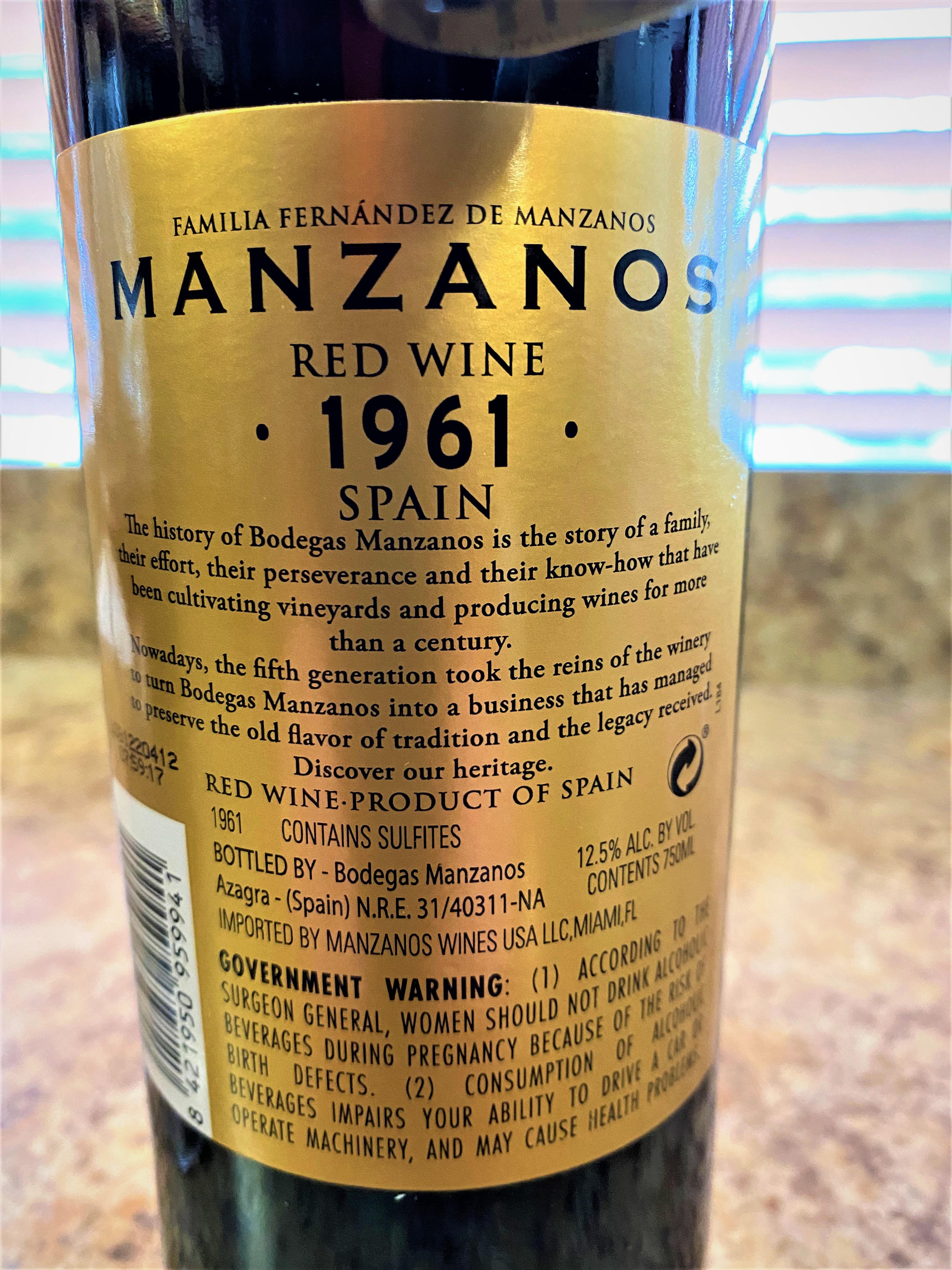
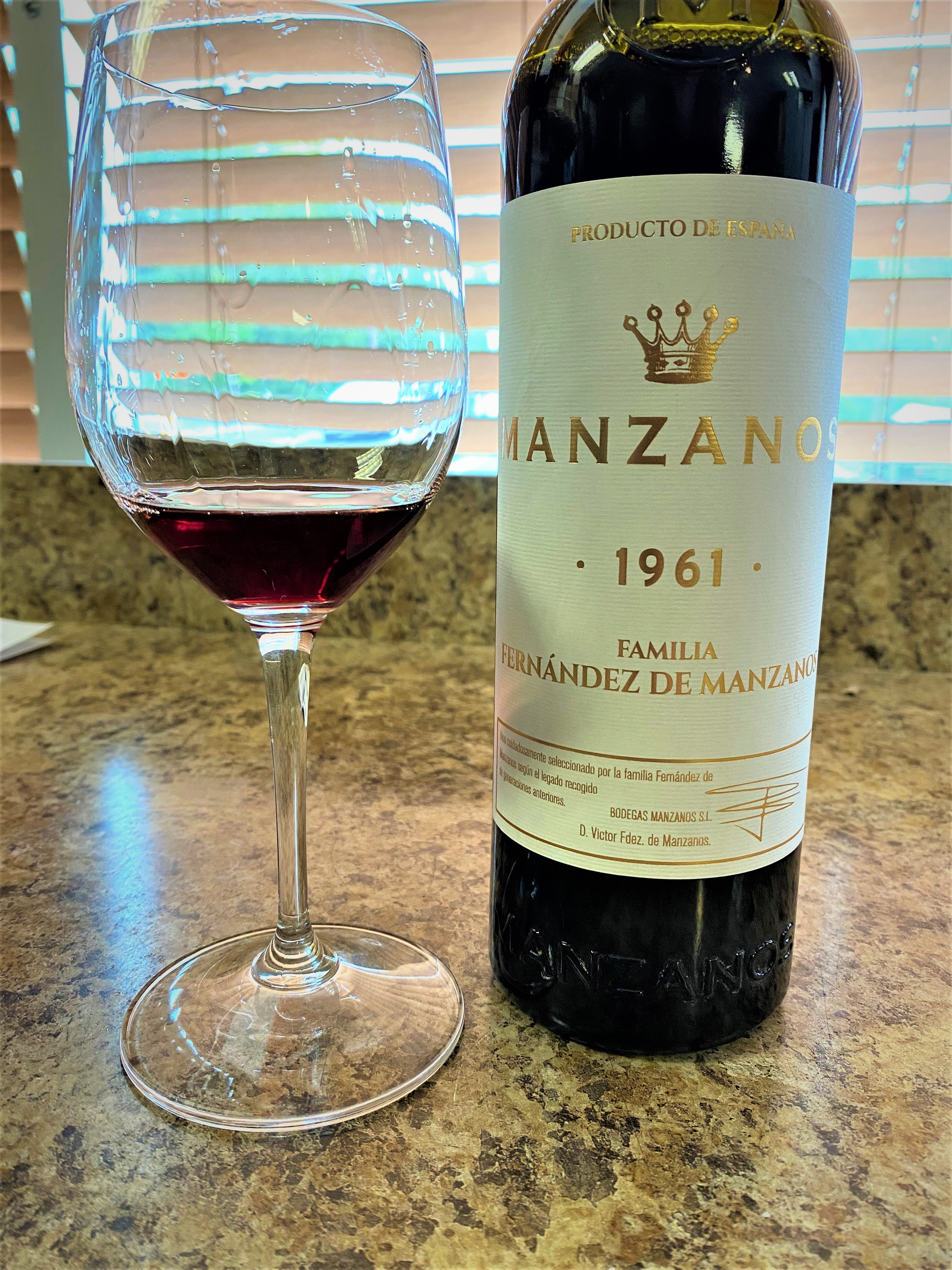
Manzanos Red Wine 1961 Spain

How often does one get the chance to taste a sixty-one-year-old wine, when they walk into their local wine shop, but this is what happened the other day.  I was only seven, when this wine came out, and while I may have tasted some wines, nothing of this caliber; back then most alcohol was administered as medicinal. West Side Story won the Academy Award, JFK was the President of the USA and I was always told that it was the Third Best Vintage in France.  

Bodegas Manzanos is a large wine producer in Spain, founded in 1890 and is now run by the fifth generation of the Fernandez de Manzanos family.  They are in the top three of Navarra and the top five in Rioja for production and they own ten wineries.  The original winery for the family is in the Rioja Alta zone back in 1890.  A cache of bottles was discovered in the cellar of the winery by Victor Manzanos.  After trying a bottle of wine, the decision was made to rebottle, recork and relabel the wine.  After spending three years in French Oak, this wine was bottled in the mid-Sixties and has been untouched since then, until two years ago.

Familia Fernandez de Manzanos “Manzanos Red Wine 1961 Spain” was the relabeled wine that was reissued.  The designation of Rioja was not as well known internationally, and it was not always indicated on the labels of wines from the region.  The wine is a blend of Tempranillo and Grenache (Garnacha) and was considered a Vino Tinto at the time.  The fruit was hand-harvested (automated wasn’t available then).  The wine on the first time was aged for three years in French Oak.  This wine was originally listed as a lighter wine at the time, and perhaps that is why it was left to age longer and then forgotten, as it was stored in a hillside cellar. There was six-hundred bottles of the original cache, every bottle was opened and four-hundred bottles were selected. The four-hundred bottles were emptied into vat and re-blended together, prior to re-bottling and re-labeling.  The wine was a deep garnet with notes of dark fruit, cigar box and spices.   On the palate there were tones of dark cherry, plums, licorice, soft tannins with secondary tones of coffee, vanilla and balsamic tastes.  The wine surprisingly had a shorter finish with a touch of terroir.  It was definitely a Rioja, even without being identified as one, and a very interesting wine to chew on and I needed to use one word, it would be elegant.        

Posted in Wine | Tagged , , , , , , , | Leave a comment

Armenian Wines in Livonia

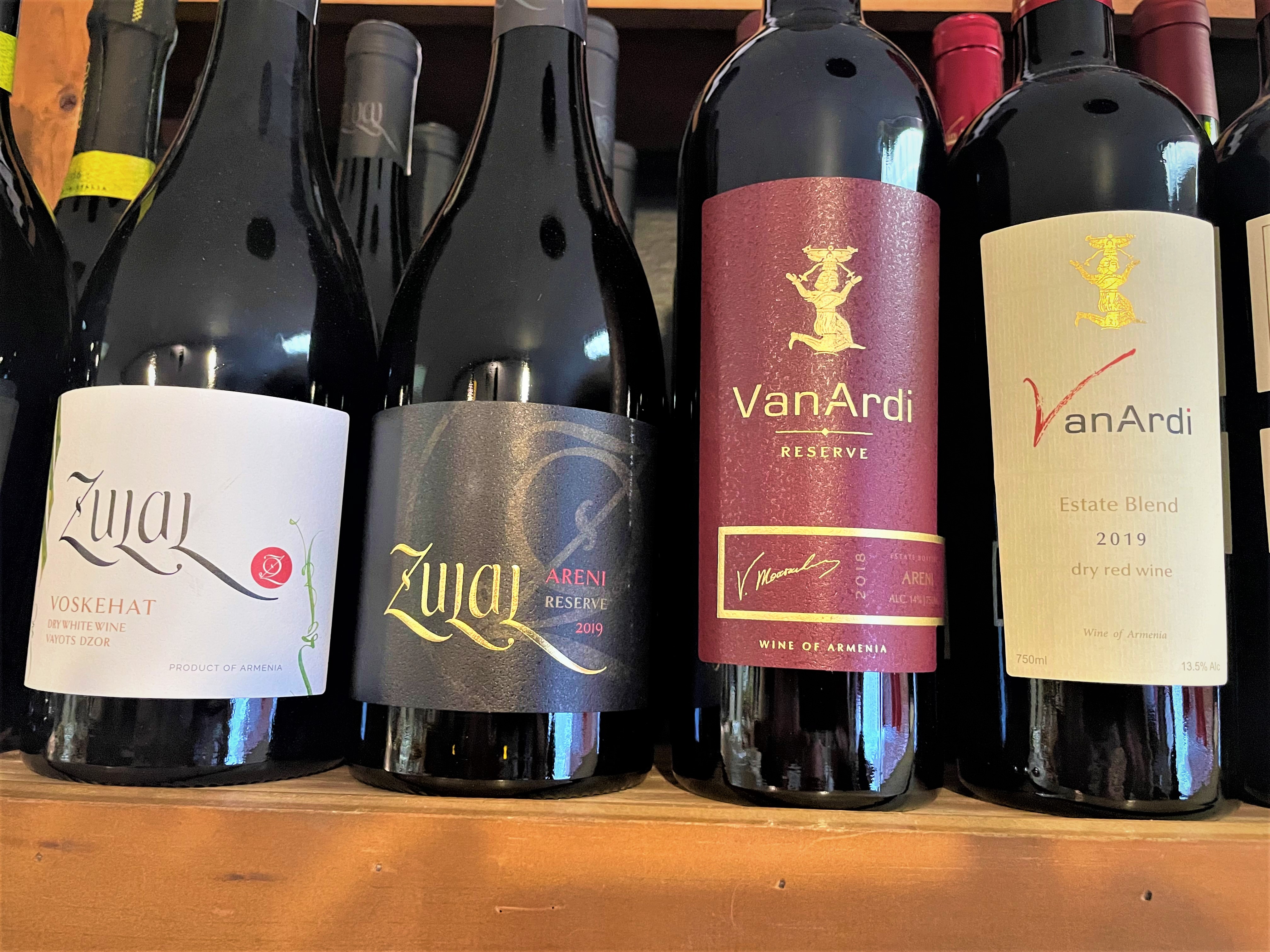
I have discussed Armenian wines periodically, and they have arrived at my local wine shop, The Fine Wine Source in Livonia, Michigan.  On one of my stops in the shop, they showed me some wines that were dropped off for them by a representative of Storica Wines.  They had tasted them the day before and they wanted to get my opinion of the wines as well.  Storica Wines is an Armenian wine import company in the United States of America.  The wines that they are representing are examples of indigenous grapes grown 6,000 years ago and some are near where the oldest established winery has been unearthed.  They are on a mission to give the oldest Christian nation more positive exposure.

The first two wines that I will discuss is from Zulal and Zulal means “pure” in Armenian.  Zulal wines are examples of high elevation viticulture, extreme climates and volcanic soil; all three are known to help shape wines.  Zulal wines were founded by Aimee Keushguerian in 2017, and introduced the Zulal Areni Reserve 2015 and Zulal Voskehat 2017.  The two grape varieties Areni and Voskehat are sourced from about forty grape growers in the villages of Aghavnadzor and Rind, and the Arpa Valley in the Vayots Dzor region.  They are already working on introducing other varieties that are even lesser-known outside of Armenia.   They currently make about ten-thousand cases of wine.  The Zulal Voskehat 2020 is from the village of Aghavnadzor in Vayots Dzor, grown at an elevation of 1400 meters on a soil of limestone and volcanic rock.  The vines are from fifty to over a hundred years of age, and this grape was grown for wine in Armenia, and then after the Soviets took over, this grape was used for “Sherry” during the Soviet years. The juice is macerated, fermented and aged in Stainless Steel to ensure the freshness of the fruit.  A pale straw-colored wine with notes of stone fruits.  On the palate tones of peaches and apricots and a touch of marzipan, good acidity and a finish of fruit and some terroir. The Zulal Areni Reserve 2018 is from the village Aghsafi in the Arpa Valley of Vayots Dzor at an elevation of 1200 meters on alluvial rock soil.  These vines are from fifty to a hundred years of age, and the grapes went from making wine to producing Brandy for the Soviets. The darker berries were selected for the Reserve wine and aged for twelve months in neutral Armenian Oak barrels.  A nice deep red wine with notes of bramble fruit and herbs.  On the palate blueberry and herbs, with a nice earthiness and a finish of terroir.

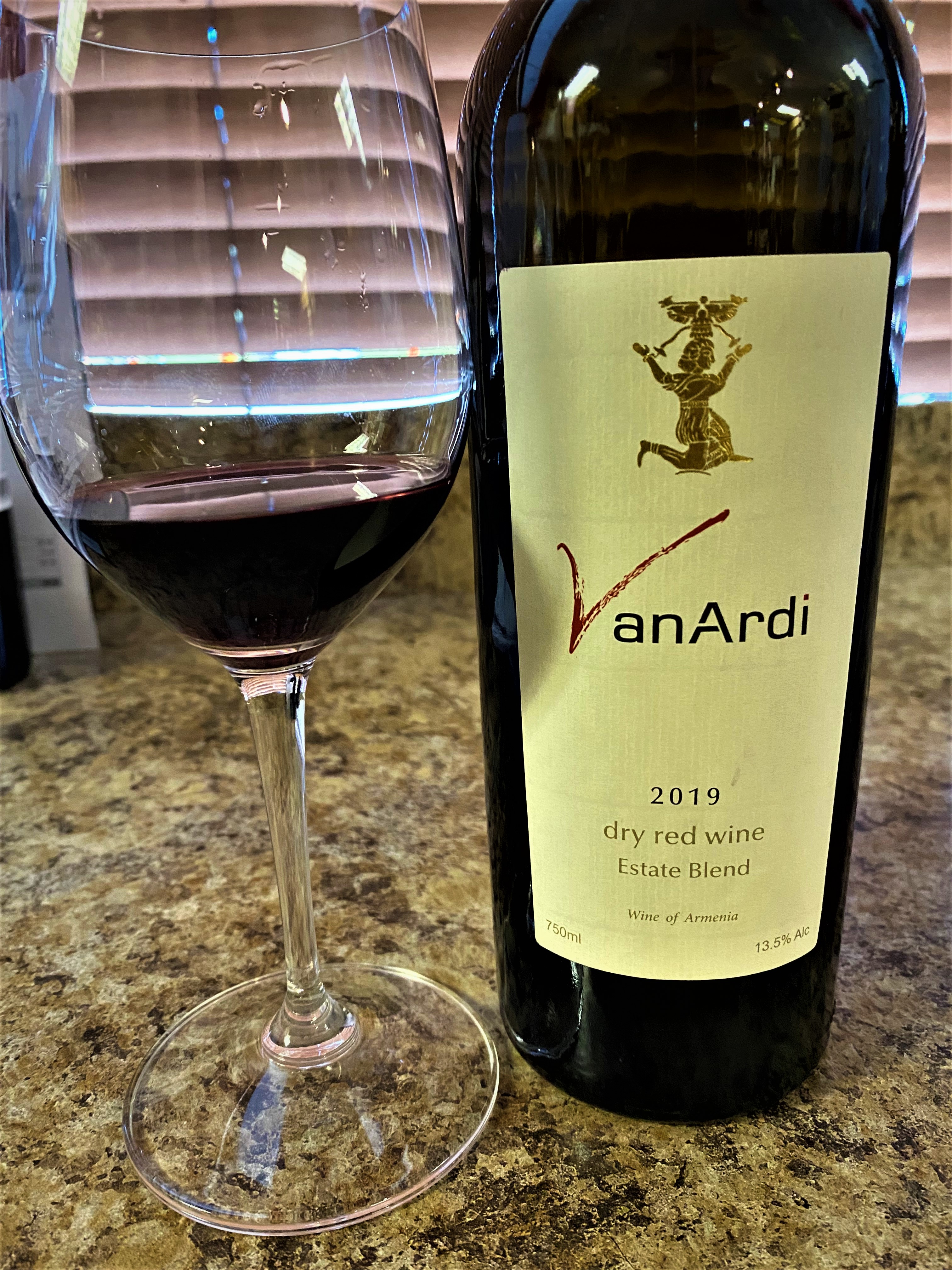
The other two wines that they are starting with are from Van Ardi Wines.  Van Ardi translates as “Sun of Van,” a reference to the ancient capital of Armenian where Varuzhan Mouradian’s ancestors are from.  Varuzhan moved to Armenia in 2008 to become a winemaker, after living in America.  A boutique winery based near Ashtarak and had achieved Organ Certification through Ecoglobe.  The Van Ardi Reserve 2018 is from the village of Sasunik, in the region of Aragatsotn, and it is pure Areni and grown at an elevation of 1050 meters.  The vines are twelve years of age, on soil that is a mix of limestone, volcanic rock and silt, and the wine is aged in neutral Armenian Oak barrels.  The deep red wine offered notes of red fruits and bramble.  On the palate, there were tones of red berries in a balance wine with a moderate finish.  The Van Ardi Estate Blend 2019 also came from Sasunik in Aragatsotn, and is a blend of Areni, Haghtanak and Milagh.  The varieties were tank fermented, then aged for six months in French and Caucasian two-year-old barrels.  The varieties were vinified separately, blended for three months and then rested for four months in bottle, before being released.  This deep red wine offered notes of dark and red fruits and spices.  On the palate dark fruits, mellow tannins and a nice medium length finish of fruit and terroir.  Of the two wines, I enjoyed this wine much more, as I found it fuller bodied.    

Posted in Uncategorized | Tagged , , , , , , , , , , , , , , , | Leave a comment

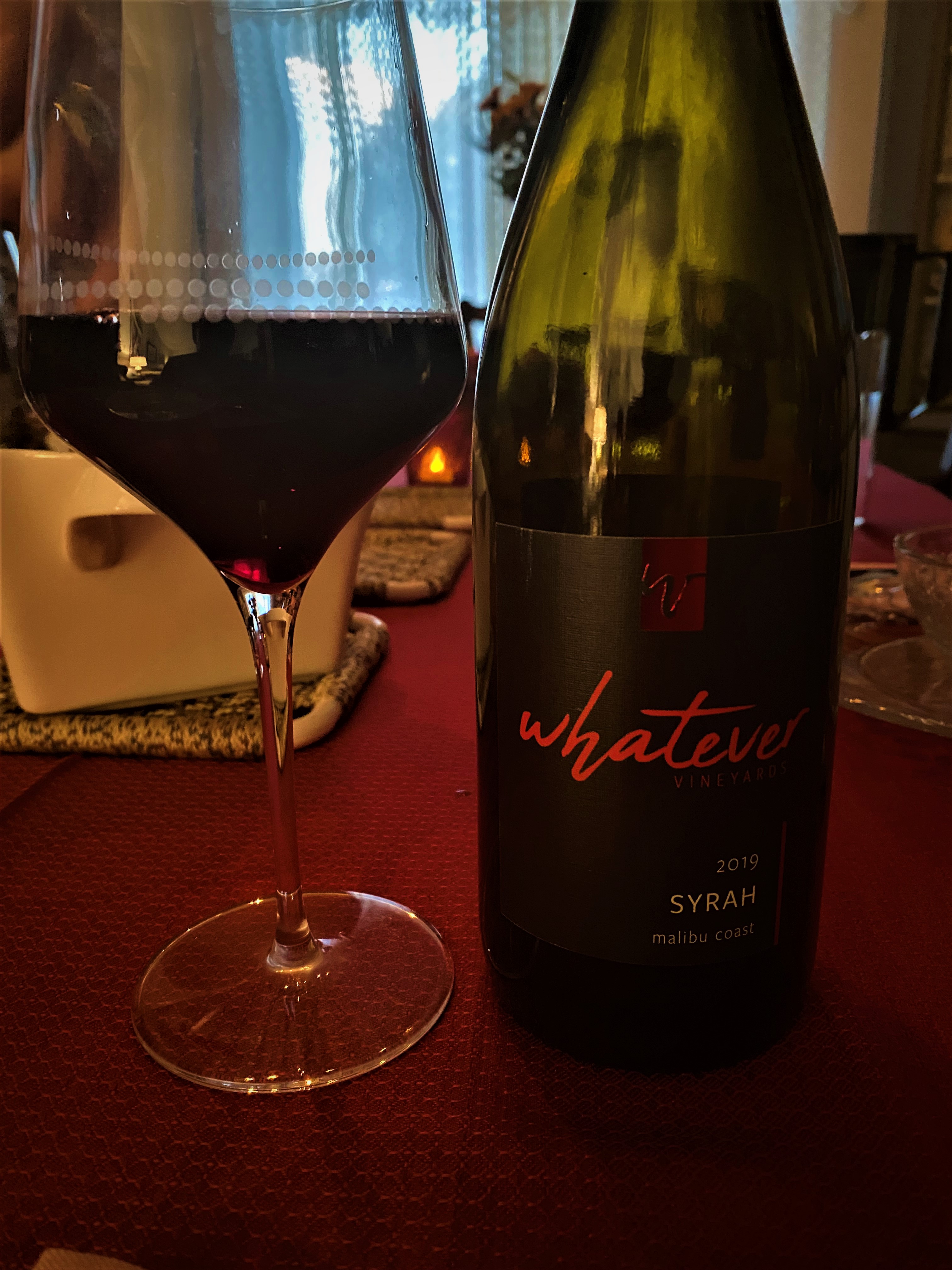
Whatever Vineyards of Malibu Coast

I think that most people that start a wine blog, anticipate a deluge of wine samples and that they will never have to buy another bottle of wine.  That was the least of my thoughts back in May of 2012.  I remember back in the dark ages when I had a reputation as a clothier, I waited on a gentleman, whose wife was a famed restaurant critic for one of the two daily papers in Detroit.  I said to her that it must be a great job, and she looked at me and said, “it is the worst job in the world, because if someone has a bad day and I pan a restaurant, think of all the people that I can potentially put out of work, and how that would affect their families.”  I was devastated by that answer and I guess that it has been with me ever since, even when I make a casual remark about a restaurant. We had a wine tasting dinner and we invited The Wine Raconteur, Jr. and his wife for dinner and wines.

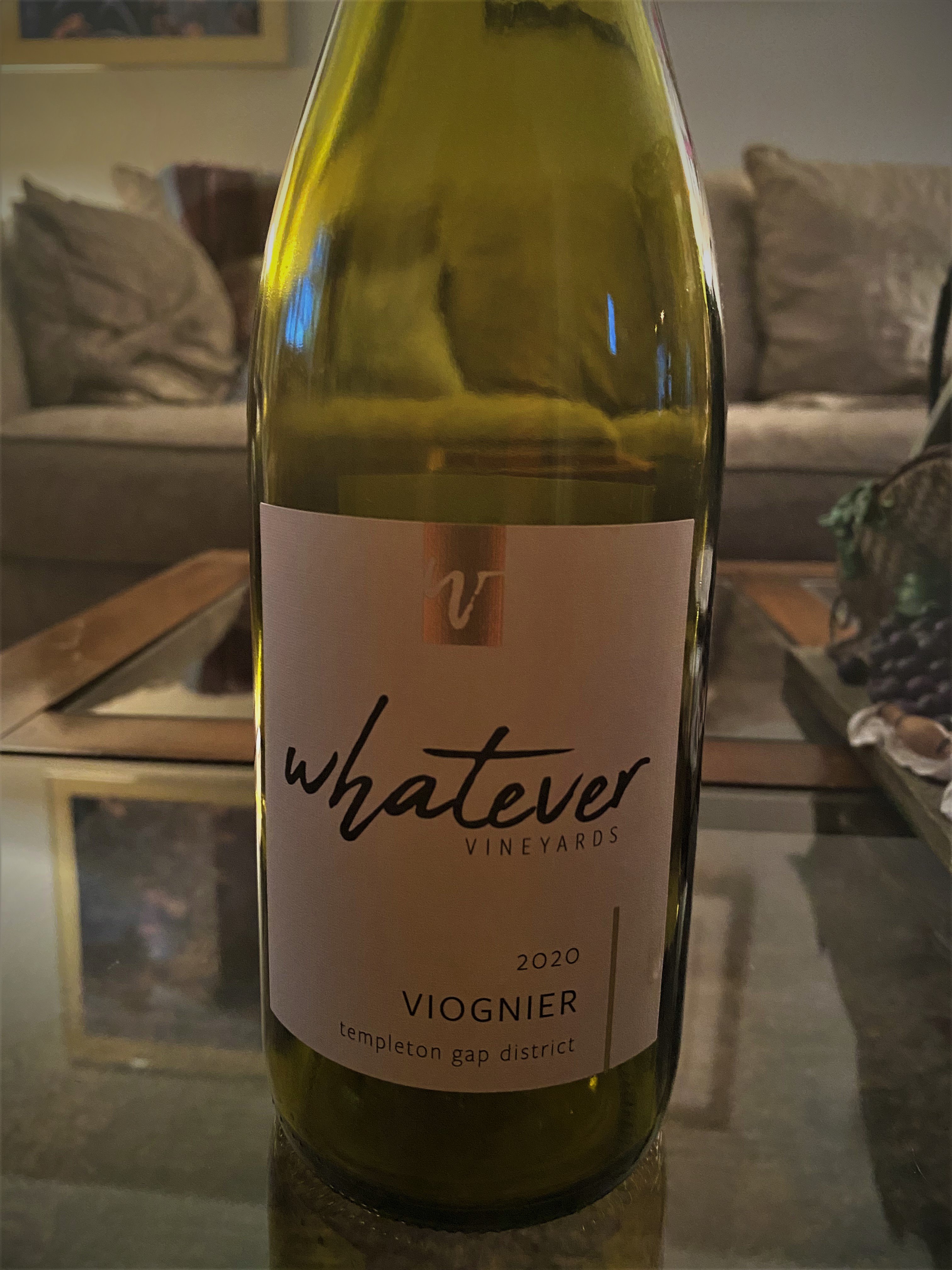
Which all leads me to a sample request from Whatever Vineyards.  Jason Hallock had a circuitous route from Michigan to California and he always wanted to be his own boss.  He eventually met his wife Kamie through a friend and she was from Michigan.  During their honeymoon in May of 2001, driving up the California Coast to Sonoma Wine Country, they became “true winos.”  He had started an accessory company called “Whatever” and in 2019, they moved into a manicured vineyard in the Malibu Coast AVA.  The previous owner had wanted someone interested in wines, and they got their wish and Whatever Vineyards began.  We started the tasting meal with some Baked Brie with an Onion Jam topping and some Bacon Wrapped Scallops.  We started off with a bottle of Whatever Vineyards Viognier Templeton Gap District, Paso Robles 2020.  Templeton Gap District AVA is one of eleven sub AVAs of Paso Robles and located just below the passes of the Santa Lucia Range and gets the maritime climate and the slight elevation on a soil of bedrock.  The soil is high in calcareous material with a deep soil profile, so the vines grow deep.  The other great feature of the maritime climate is the heavy fogs which allows this area to have almost two additional weeks of ripening as compared to Paso Robles.  The area has been very successful for Bordeaux style wines, Zinfandel and Rhone style wines like Viognier.  The wine was fermented in Stainless Steel to maintain freshness and fruit.  I am sorry to say, that we had such a great time, that I forgot to get a photo of the wine next to the bottle.  A very soft golden-yellow wine with a soft nose of white fruit and honeysuckle.  On the palate the wine offered tones of pear, honeysuckle and traces of nuts in a really rich and full-bodied Viognier with a nice finish of terroir.  The table was unanimous for this wine.   

For the dinner, we had the famous Caesar Salad, that she has been making since our honeymoon. She also decided to go with our new craze of Roasted Cauliflower with an abundance of cloves of garlic, Dijon Mustard, EVOO and Reggiano di Parma.  The main course was a marinated roasted Pork Tenderloin and Armenian Pilaf.  The wine for dinner was Whatever Vineyards Syrah Malibu Coast 2019.  Malibu Coast is a large AVA, long an area for wine, but only an AVA since July, 2014.  Of the forty-five-thousand-acres of the AVA, only a couple of hundred acres are planted to vine, and the best have been Cabernet Sauvignon, Syrah and Chardonnay.  The region is known for great sun during the day, and cool evenings, which slows the ripening process.  The soil is largely slate, shale and sandstone with good drainage. This wine is aged for twelve months in neutral French Oak, of which thirty percent is new.  I was touted by the winery to give the wine a slight chill, and when I opened the deep- ruby wine, notes of black fruit, vanilla and pepper opened up immediately.  On the palate, I was expecting a softer wine, because of my lack of knowledge of the district, but I was proven wrong; notes of black currants, spices and black pepper with velvety tannins, balanced acidity and a nice count finish with more pepper and some terroir.  I usually refrain from wine with salad, but the two women were gushing about how it even paired with the dressing, of course, by that time, there was no more salad, for me to try.  I and the rest of the diners all enjoyed the wine immensely and the two bottles were both drained.  Two new AVA districts for me, and trust me, I will look for more.     

Posted in Dining, Wine | Tagged , , , , , , | Leave a comment

Two Labels That Ms. Yoga Wanted

While we were at Sandhill Crane Vineyards, Ms. Yoga got very excited about a wine label, which reminded her of another wine that she had brought to Casa Raconteur for us to try, and she was trying to figure out, if she would have problems with TSA, trying to carry two empty wine bottles in her carry-on luggage.  She had tried one wine during her tasting selections, because of the label.  We asked one of the young men that were clearing the tables if he could find us an empty bottle for a label, and he first went to the bar, and then he went to a side room and dug through two different cases of used wines and returned with a bottle; that was worthy of a tip and he was very impressed.  My Bride told her that I have the touch in removing most wine labels quickly and rather easily, so when we got home, we immediately decanted the wine that she brought, plus the wine from the winery.  My technique for removing at least most modern North American labels that use an “Avery” type of gum label is;  preheat an oven to 255°and while the oven is heating rinse the wine bottles thoroughly, then place the bottles on a rack to bake for fifteen minutes, after that time, I use a razor knife for scrapping windows and with an oven mitt holding the bottle, I slowly peel the label up from the bottle until there is enough to gently pull the label off at an angle, then the most important final step is to lay the label, gum side down on wax paper (if you plan on removing it later to put elsewhere like a scrapbook and then place a weight on the label to keep it flat.

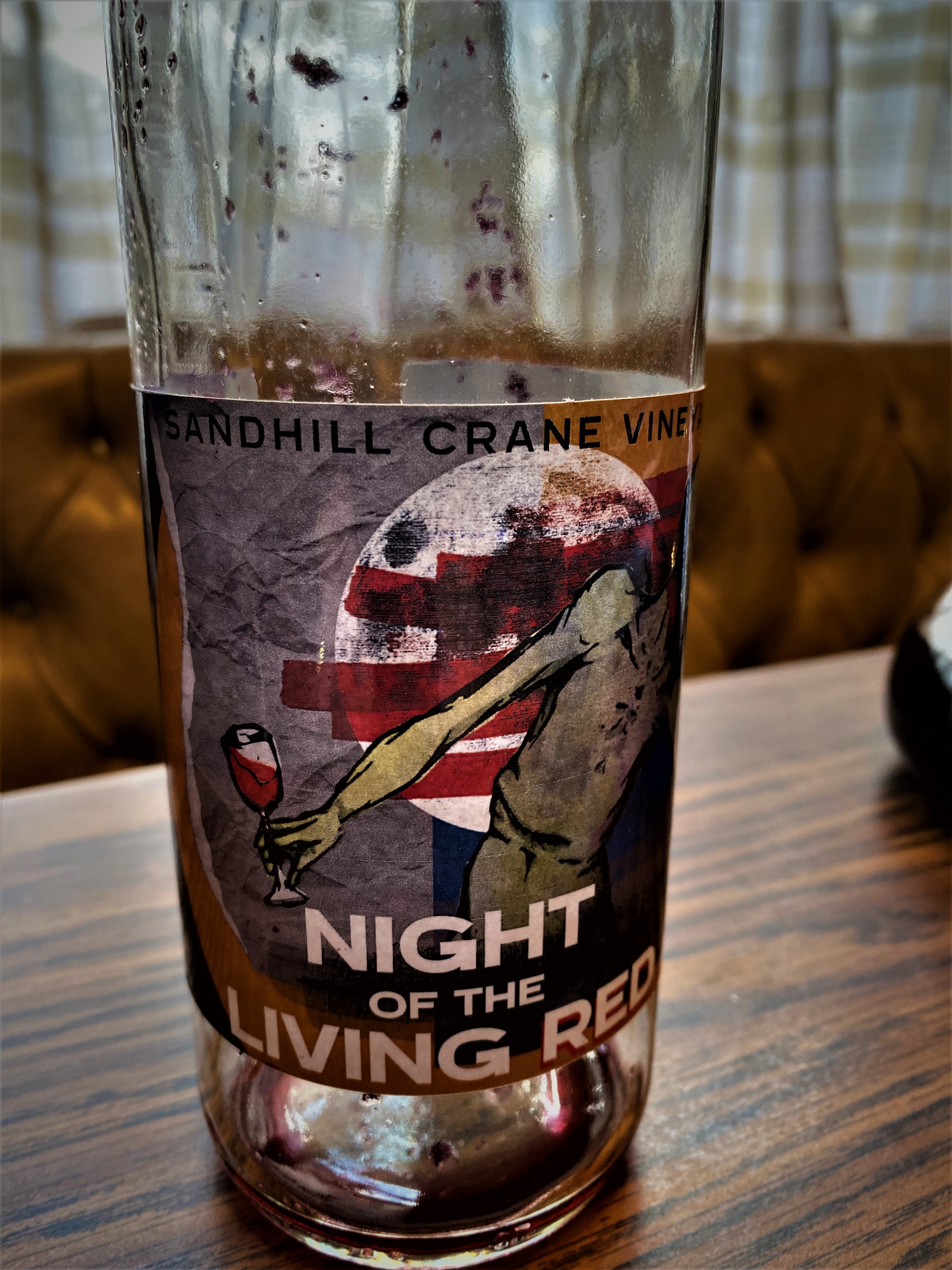
The first wine label that caught her attention was Sandhill Crane Vineyards Night of the Living Red Michigan NV.  From what I can gather is that the wine is their version of a “Gluhwein.”  A semi-sweet red wine that is seasoned with cloves, cinnamon, nutmeg, vanilla, orange peel and “essence of fresh-squeezed zombie.”  To be enjoyed either chilled or warmed up.  Ms. Yoga enjoyed the wine chilled, plus she enjoyed the label.

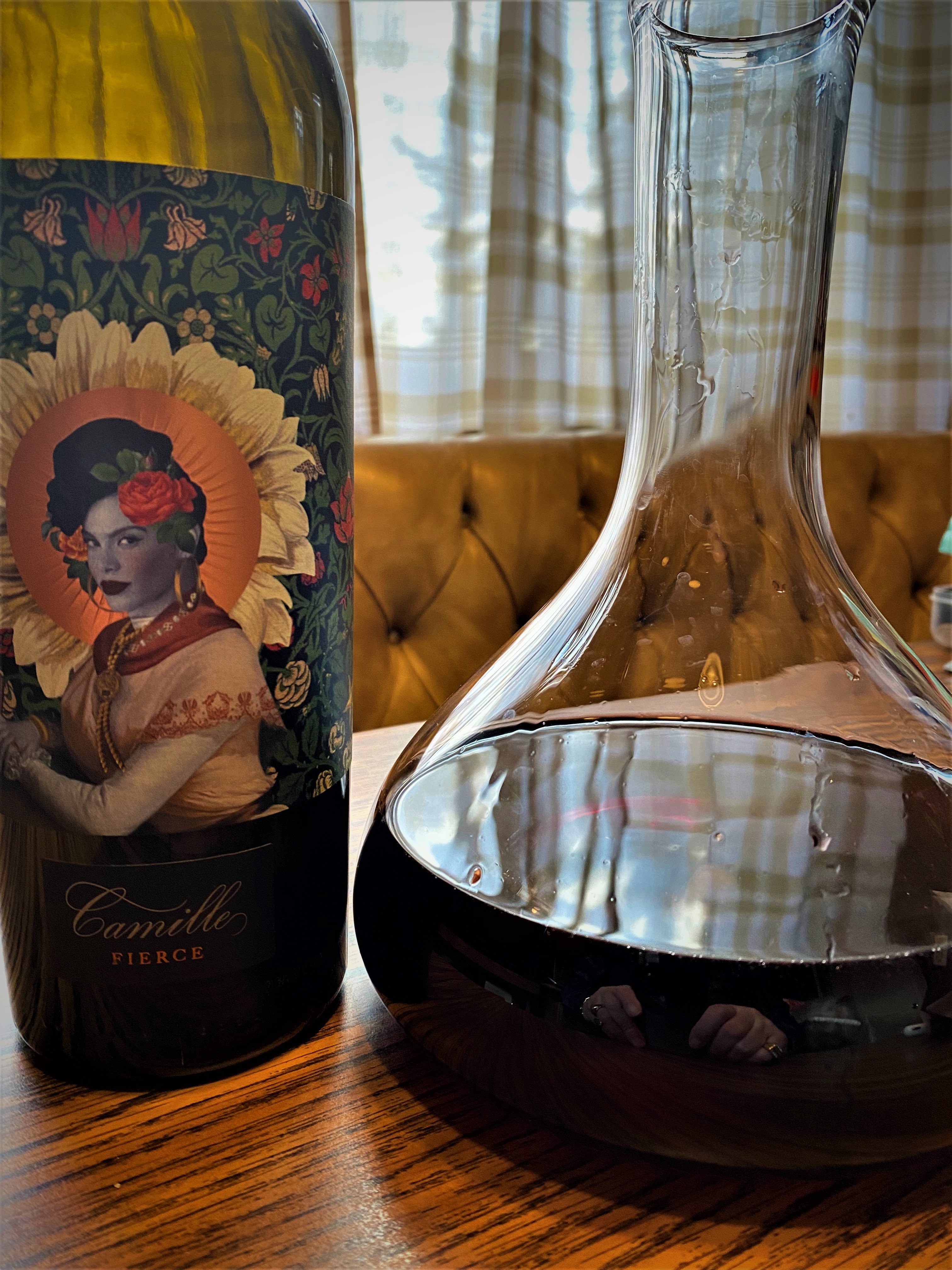
The second label was on a bottle that she wanted to share with us, before she went back home.  It was Ms. Yoga that introduced us to Marilyn Merlot from when I was creating a wine label door to my first wine cellar in our old house, which was originally a coal room.  The wine was Cooper’s Hawk Winery Camille Fierce Central Coast 2019.  Cooper’s Hawk Winery & Restaurants were founded in 2005.  They offer their own proprietary wines from Chile, France, California or Washington State.  The wine is a blend of thirty-five percent Pinot Noir, twenty-five percent Zinfandel, nineteen percent Valdiguie, sixteen percent Syrah and six percent Grenache; a very unique blend.  The garnet-colored wine offered notes of red fruits, vanilla and butterscotch.  On the palate raspberry, tart cherries, vanilla and cedar.  I feel that the wine was probably done in Stainless Steel with oak chips, I could be wrong, but the vanilla was a dominate flavor. I wish wineries would offer more information.  It was a nice evening of wine, and then Ms. Yoga left for home the next day, and until the next visit.    

Posted in Wine | Tagged , , , , , , , , , , , | Leave a comment

Four Wine Tasting at Sandhill Crane Vineyards

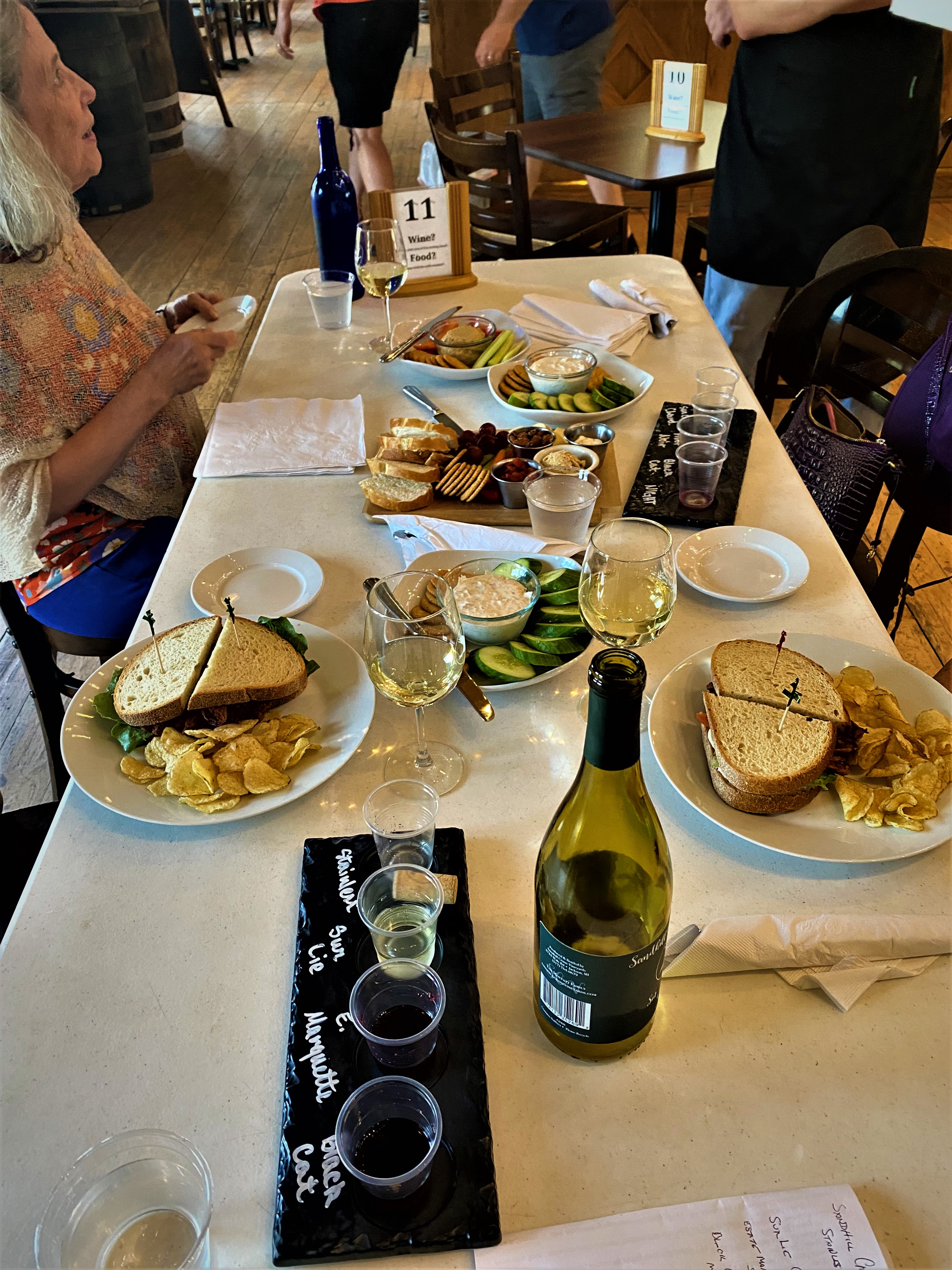
As hectic as it was fun, the crowd at Sandhill Cranes Vineyards was impressive.  It was like all roads lead to the winery.  Well, the lunch hour was not the best choice for tasting wines, but it was great to see all the people having a great time.  I did notice that there were more people outside drinking, compared to the crowds indoors, but it was a beautiful day to be out among the vines.  I actually nibbled on a few grapes on the vines, but it is like sugar cubes on the vines.  I tried to get information from our host as he was pouring and I was photographing the wines, but I was told that all the information that I would need would be found on their website.

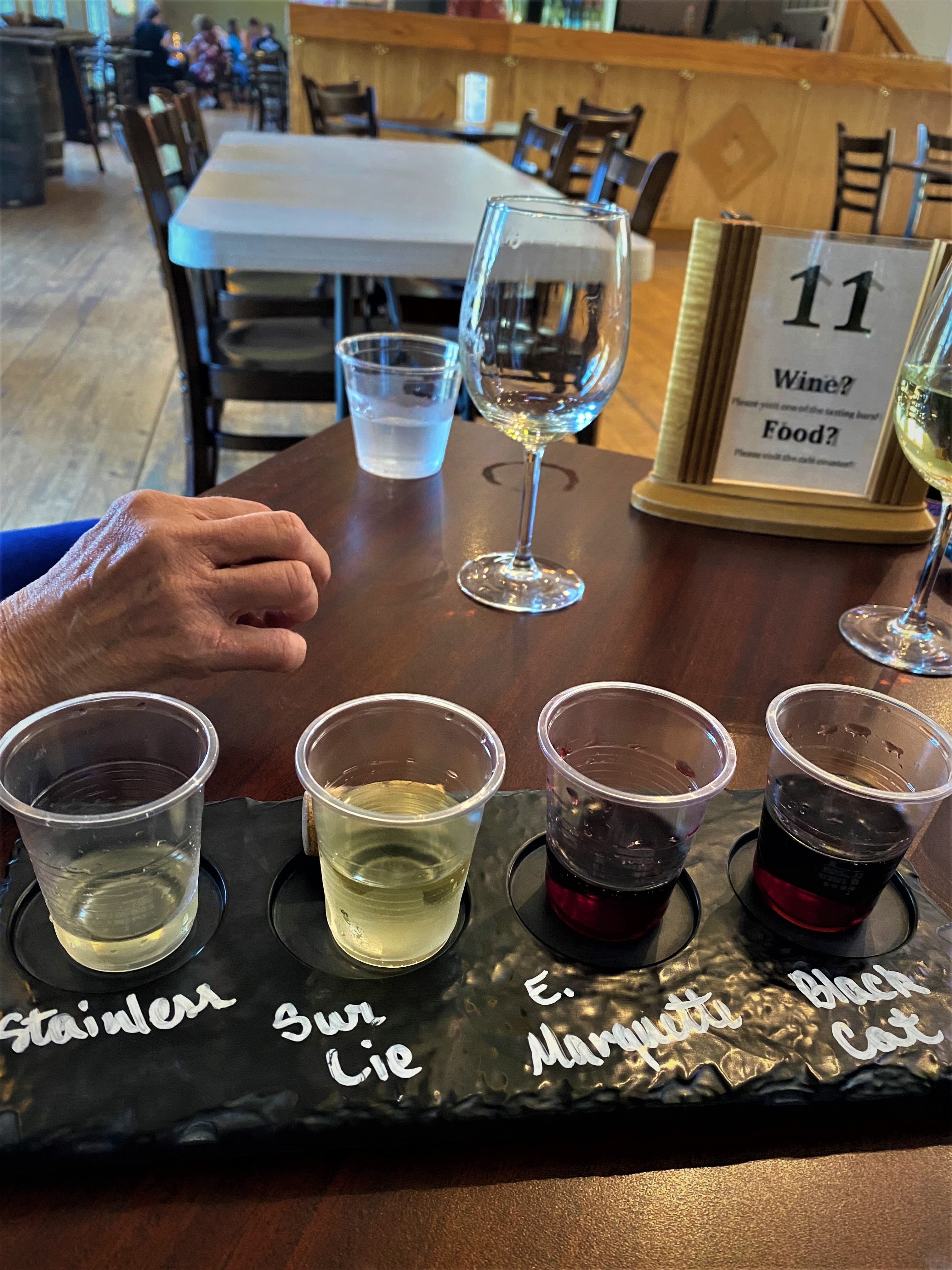
The first two wines that we tried was an interesting comparison.  We had the Sandhill Crane Vineyards Stainless Chardonnay Michigan 2018 and the Sandhill Crane Sur Lie Chardonnay Michigan NV.  What better than to try the same grapes (potentially) made two different ways.  The Stainless was aged, just as one would expect in Stainless Steel tanks. In plastic cups it was difficult to discern the true color, but it looked like a pale golden color and it had notes of lemons and florals.  On the palate tones of apples and very crisp acidity.  The Sur Lie Chardonnay was fermented in French Oak barrels.  The wine was also a pale golden color and offered notes of white fruit and oak.  On the palate the wine had tones of apple, honeydew melons and almonds in a buttery oak setting with a bit of terroir at the end.  Of the two Chardonnay wines, this is the one we bought a bottle of for the table, to accompany all the food, when it got delivered. 

Then we had two reds to taste.  The first was Sandhill Crane Vineyards Estate Marquette Michigan NV.  It was a deep red colored wine and offered notes of dark fruit and herbs.  On the palate there were tones of black cherry and spices, with soft tannins and a moderate finish.  It was a very easy drinking Marquette and a grape that does very well in the Midwest.  The second wine was Sandhill Crane Vineyards Black Cat Michigan NV.  This medium red colored wine offered notes of dark fruits and pepper.  On the palate there was some dark cherry and dried plums and black pepper, some rich tannins, some acidity and a decent finish of spices.  It reminded me, that there was probably some Noirette in the mix, for the rich pepper notes.  A mental reminder to go there in between lunch and dinner, when it is calmer, but still a pleasant time.  My Bride and Ms. Yoga enjoyed the trip.

Posted in Wine | Tagged , , , , , , , | Leave a comment

Stopping Off for Lunch at a Winery

My Bride, Ms. Yoga and myself were on our way home from Holland, Michigan and we were going to have lunch at Sandhill Crane Vineyards in Jackson, Michigan.  According to our GPS we were supposed to be taking a scenic route, but it really wasn’t, we were on no time table and the route only added about twenty minutes to the trip.  The changing of the leaves, which is beautiful in Michigan, had not started anyways, but we did see more two-lane roads, compared to freeways.  Also, the route that we took had us avoid some of the roads that our harridan campaigned to fix, but hadn’t, so the struts on the car didn’t suffer as much.

I guess the whole world had the same thought as we did, as it seemed that all traffic, including groups of bicyclists were all going to the same destination.  Sandhill Crane Vineyards is one of three wineries in Jackson, and we still have not visited the other two, but I know that we eventually will.  Sandhill Crane Vineyards is a family owned and operated winery, dedicated to making wine with pure Michigan grown fruit.   Norm Moffatt began growing grapes in his retirement and slowly his family joined in and the avocation became a vocation.  In 2003, Sandhill Crane Vineyards was official.  They offer about thirty-five different wines and three beers, and they also have an in-house café; and between those two selling points the place was mobbed.  One would think that they were giving everything away, it was that busy and everybody was having a ball. 

It appeared that the majority were repeat customers that were having lunch with wine.  They had tables outside on the lawns, tables under terraces, tables out on the porch, and tables in the huge tasting room.  The proper procedure that I discovered is that you go and place your food order, and then you go and select the wines that you wish to taste.  With both of the women placing orders independently of each other, we ended up with orders of the Local Smoked Trout Spread, Homemade Hummus, a Charcuterie board and three orders of BLT sandwiches with farm grown heirloom tomatoes.  In fact, I think that the whole horde of visitors were ordering the BLTs as the tasting room smelled wonderful, that is, if you like bacon.  After ordering the food, they gave us a number holder to place on our table, and then we ordered our tasting selections at the bar.  I did probably drive them a bit crazy at the bar, as I took photos of each wine in the plastic cups (remember plenty of people were drinking outside) next to the wines.  We all did a sampling of four wines, that are put on a tray, with the wines written out on the tray that we took back to the table to drink with the food when it came out.  We were having a good time, and next I will discuss the wines.       

Posted in Dining, Wine | Tagged , | 1 Comment

We Had Dinner at Butch’s Dry Dock

It wouldn’t be a trip to Holland, Michigan without dinner at Butch’s Dry Dock.  It seems that forever I would see this restaurant listed in the Wine Spectator magazine Restaurant Awards issue as having a great wine selection, and affordable food and wine prices.  It has been true, each time we have been there, and it is still holding on, in spite of spiraling costs and a bleak stock market for us retirees.  We had to take and show Ms. Yoga this restaurant.  We didn’t get our usual table at the window to observe the flow of people, but we still had a nice view.  What I did notice is that it is the type of restaurant, where we have seen three generations of a family dining out.  We also saw that there were young couples out on dates, that were dressed up for the evening.  It made me smile to notice these things.

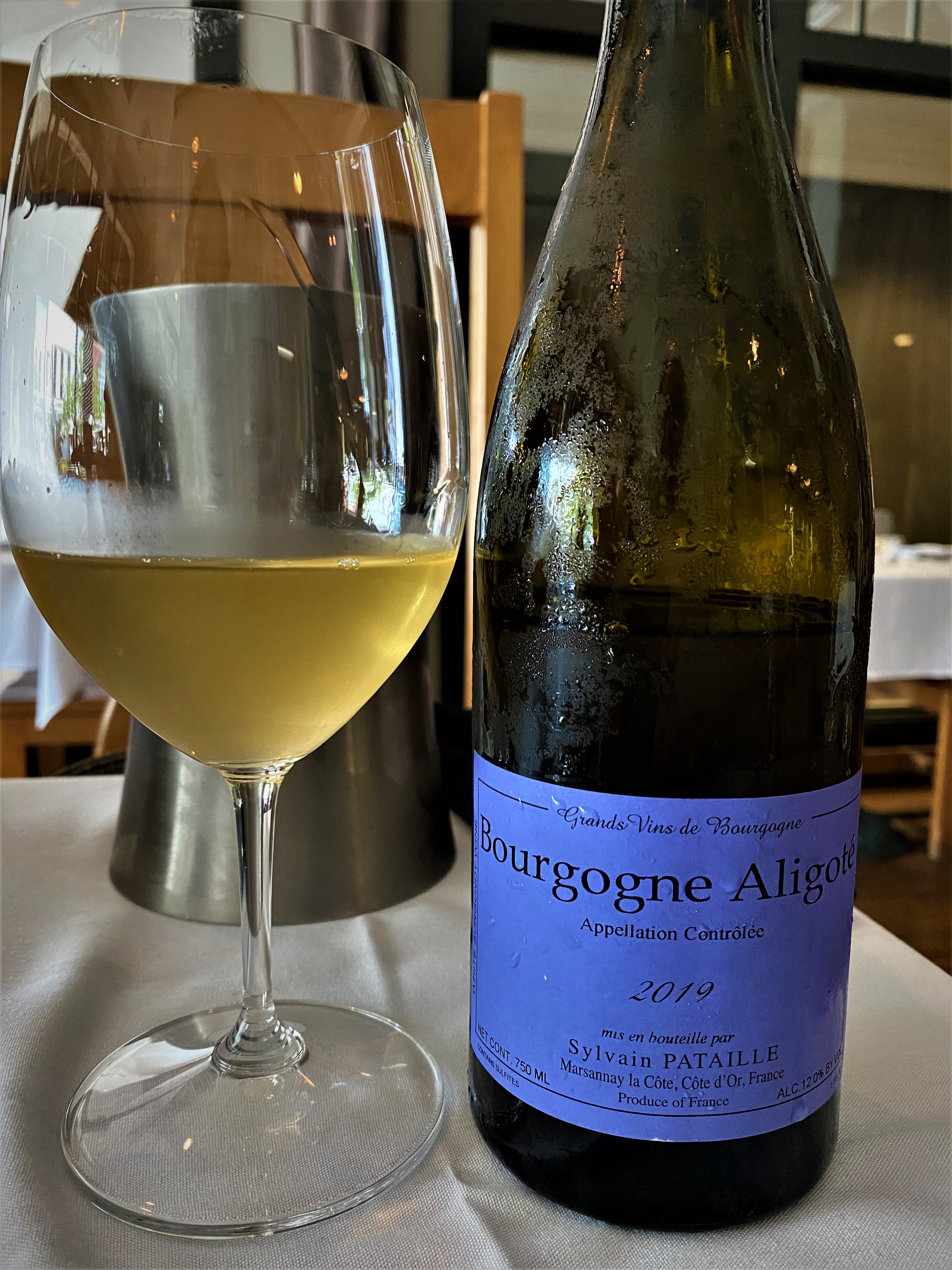
The restaurant is very unique in that it is a wine shop, and a restaurant.  They have a few wines listed on the menu, as offerings to pair with different entrées.  The majority of the wines are on shelves displayed in groupings like Old World and New World, and then alongside of the wines on the shelves are more wines displayed in a series of coolers.  The wines are retail priced and then there is a corkage fee for the dinner.  A very admirable way of marketing the wines.  We started off with a couple of appetizers for the table and the Truffled Cauliflower with Grana Padana was excellent.  We started off with our pull, a bottle of Sylvain Pataille Bourgogne Aligoté 2019.  He is very well known in the Marsannay region, just outside of Dijon in the northern end of the Cote de Nuits.  The Domaine is known for its Pinot Noir and he is a strong advocate and champion for Aligoté.  He started as a consultant enologist for a number of Burgundy domaines, and established his own operation with one hectare in 1999, and today he has about fifteen hectares all basically in the Marsannay boundary and the vineyards are certified organic.  He produces about twenty wines, including five Aligoté Crus.  This wine enjoys his concept of pressing long and slow, usually about twenty-four hours and fermentation is done using indigenous yeasts, and his vines average about fifty years in age.  The fruit for this wine came from two different sides, one of limestone and gravel, and the other of clay and marl soil.  The wine is then aged for twelve months in oak, filtered, but not fined and minimum use of sulfur.  A nice soft yellow with notes that almost reminded me of a Chardonnay with peaches, lemons, cut hay and butter.  On the palate peaches and tart apples, mouthwatering acidity and a very nice long finish of terroir.          

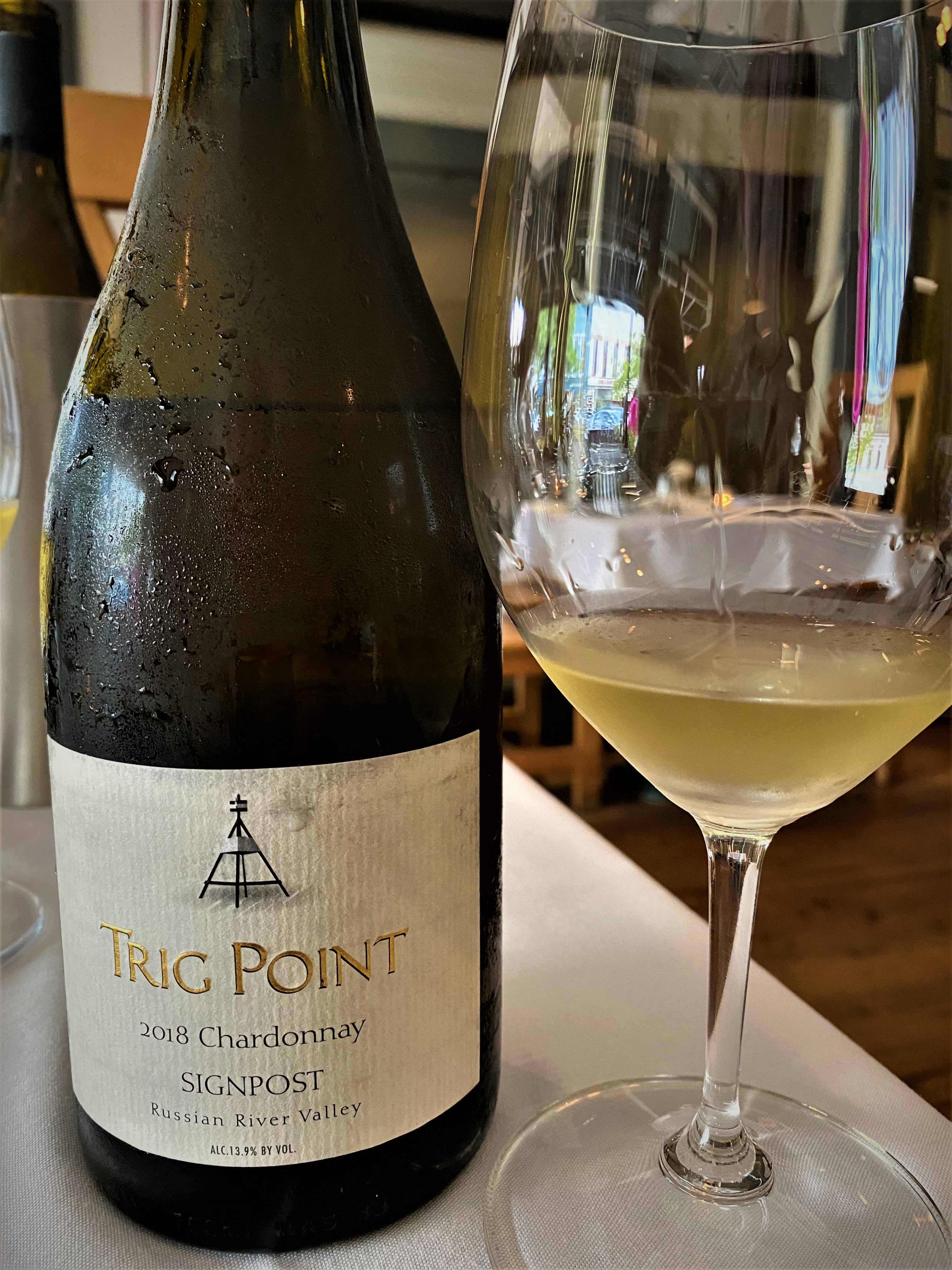
While we were going into the main dishes of seafood, salmon and whitefish, it was a white wine evening.  Ms. Yoga selected the second bottle for the table, and it was the exact wine that my Bride and I had tried earlier this year at the Carriage House at the Hotel Iroquois on Mackinac Island.  We were enjoying a bottle of Trig Point “Signpost” Chardonnay Russian River Valley 2018.  A nice pale golden wine that offered notes of pear and melon.  On the palate, the wine reminded me more of a Chablis, with the fresh fruit, crisp acidity and a creamy texture, not oak induced with a nice medium finish of terroir courtesy of the Russian River Valley.  Ms. Yoga is very partial to her Chardonnay wines, when she is drinking white and we all had a wonderful meal.  I am also please to say that we were not even charged with a corkage fee. 

Posted in Dining, Wine | Tagged , , , , , , , , | Leave a comment

Noshing and Shopping in Holland, Michigan

We were walking up and down the downtown of Holland, Michigan, there was me tagging along with my Bride and Ms. Yoga.  We even did the Farmer’s Market and thankfully, we came in Ms. Yoga’s rental car, so there wasn’t enough room, or we would have had a produce vehicle on the way back home, but we still bought enough there.  Then they had to shop the apparel stores, which is kind of a given.  They don’t have to worry about me, as there were only two men’s stores and one was a chain that I wouldn’t even venture into, and the other was an outfitter.  Trust me, my wardrobe doesn’t suffer, only the budget does when I shop.

The three of us walked into a shop, and I knew that I would probably be getting a video call or two, to help in the decision making.  I asked some of the help, for somewhere I could go and take care of my parched throat, shopping is such an arid endeavor.  They pointed right across the street to Waverly Stone Gastropub and I was off like a Mad Hatter.  I walked into the establishment and commandeered a table window side to see how many bags were being carried, and then I looked at the menu and the wine list, and I knew that I could weather the storm quite easily from my little command post.

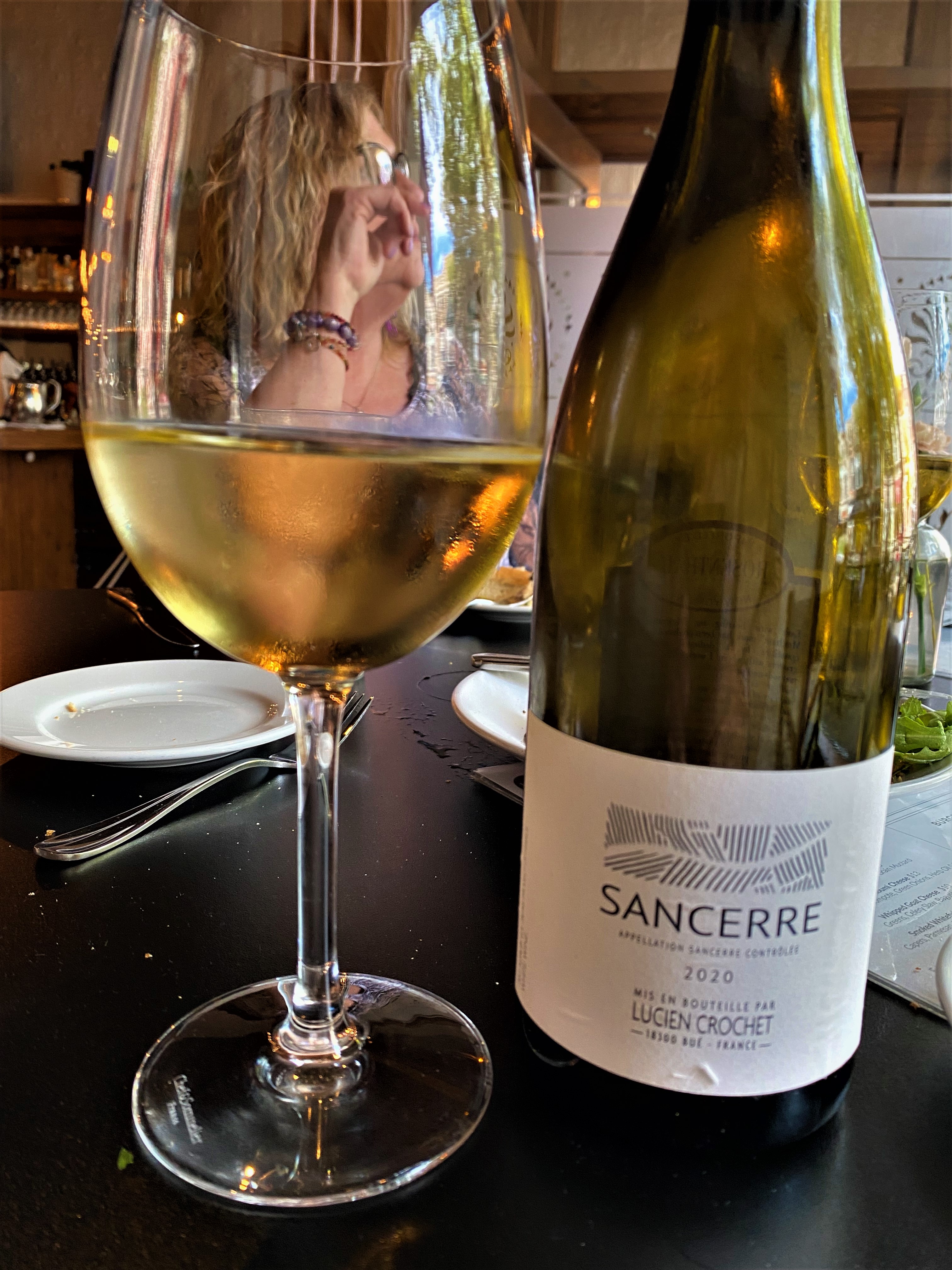
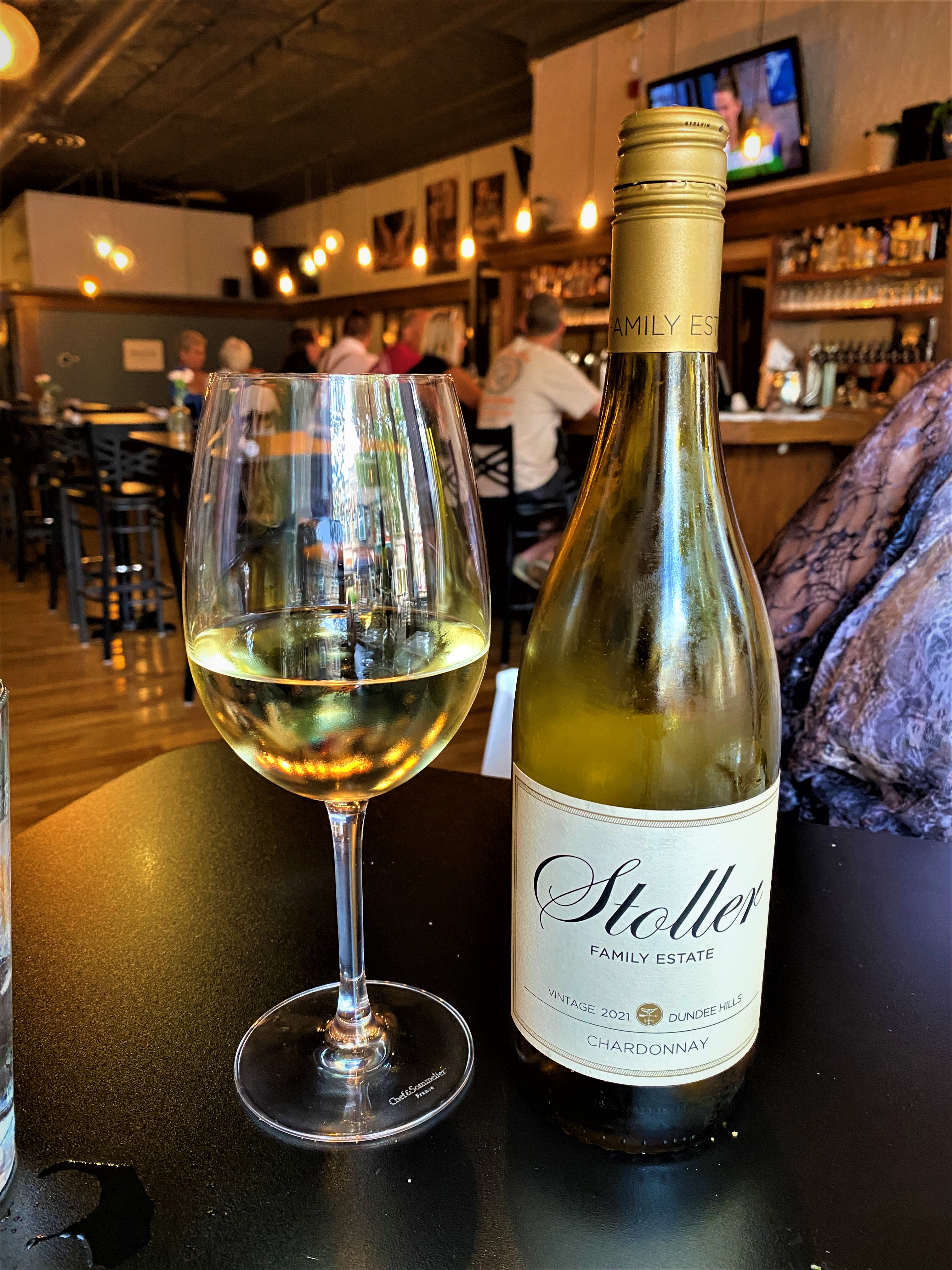
I started off by ordering a plate of their Smoked Whitefish Spread with Capers, Parmesan, Peppers, Celery and Crackers, after all Michigan is the Whitefish Capital of the World (I think).  So, I had a chance to nosh, and watch for the shoppers and I started off with a glass of Paul Mas Domaine Astruc “dA” Viognier IGP Pays d‘Oc, France 2019.  Domaines Paul Mas covers about six-hundred-hectares in the heart of the Languedoc.  The estate was acquired in 2002 and is located at the foot of the Pyrenees about 200-300 meters about sea level.  The Malras location is in Limoux sur le Geu and housed and ultra-modern winery and facility.  Domaine Astruc is eighty-hectares in AOP Limoux, AOP Malepere and IGP Pays d’Oc depending on the wine being made.  The wine had a pretty yellow color and offered classic notes of stone-fruit and citrus.  On the palate some pineapple and passion-fruit and a short finish of limestone and chalk.  A light and easy wine to enjoy.  The ladies finally finished and my Bride ordered the Lucien Crochet Sancerre 2020, which was a given.  Lucien’s grandfathers Andre Crochet and Lucien Picard were winegrowers in the 1950’s and Lucien Crochet merged the two estates together.  Twenty-six of their thirty-five hectares are planted with Sauvignon Blanc on calcareous clay over Kimmeridgian subsoil.  The fruit is fed into pneumatic presses and Cold Fermentation for thirty days in Stainless Steel, and then matured on the lees for ten months.   A pale-yellow wine with notes of white fruits.  On the palate tones of peach and pear, in a nice balanced wine with a medium count of terroir in the finish.  We also ordered some more of the Whitefish Spread and some IPA Beer Cheese and some great jumbo Bauhaus Pretzels with a side of Whole Grain Mustard.  Ms. Yoga stayed true to form and had a glass of Stoller Family Estate Chardonnay Dundee Hills 2021.  Stoller Family Estate is the largest contiguous vineyard in Oregon’s Dundee Hills in the Willamette Valley and spans four hundred acres with two-hundred-twenty-five-acres dedicated to vines at higher elevations.  The Chardonnay juice after maceration and fermentation, which is done in a mix of Stainless Steel, Concrete and Neutral Oak for about four months, and then the three juices are blended together in Stainless Steel and aged for an additional three months.  A pretty yellowish-golden color, the wine offers notes of lemon tarts and wet slate. On the palate tones of persimmons and starfruit, very crisp and finishing off with a nice touch of terroir.  We were on a roll.

Posted in Dining, Wine | Tagged , , , , , , , , , , , , , | 2 Comments

Another Trip to Holland, Michigan

We took another trip to Holland, Michigan and this time with Ms. Yoga.  Holland was settled in 1847 by Dutch Calvinist separatists, who left the Netherlands during a time of dire economic conditions.  To this day, Holland has promoted the ethnic background of the city with its Tulip Time Festival in May, which is almost impossible to secure hotels, anywhere near the area.  There is also a windmill and wooden shoes can be found in abundance around the city.

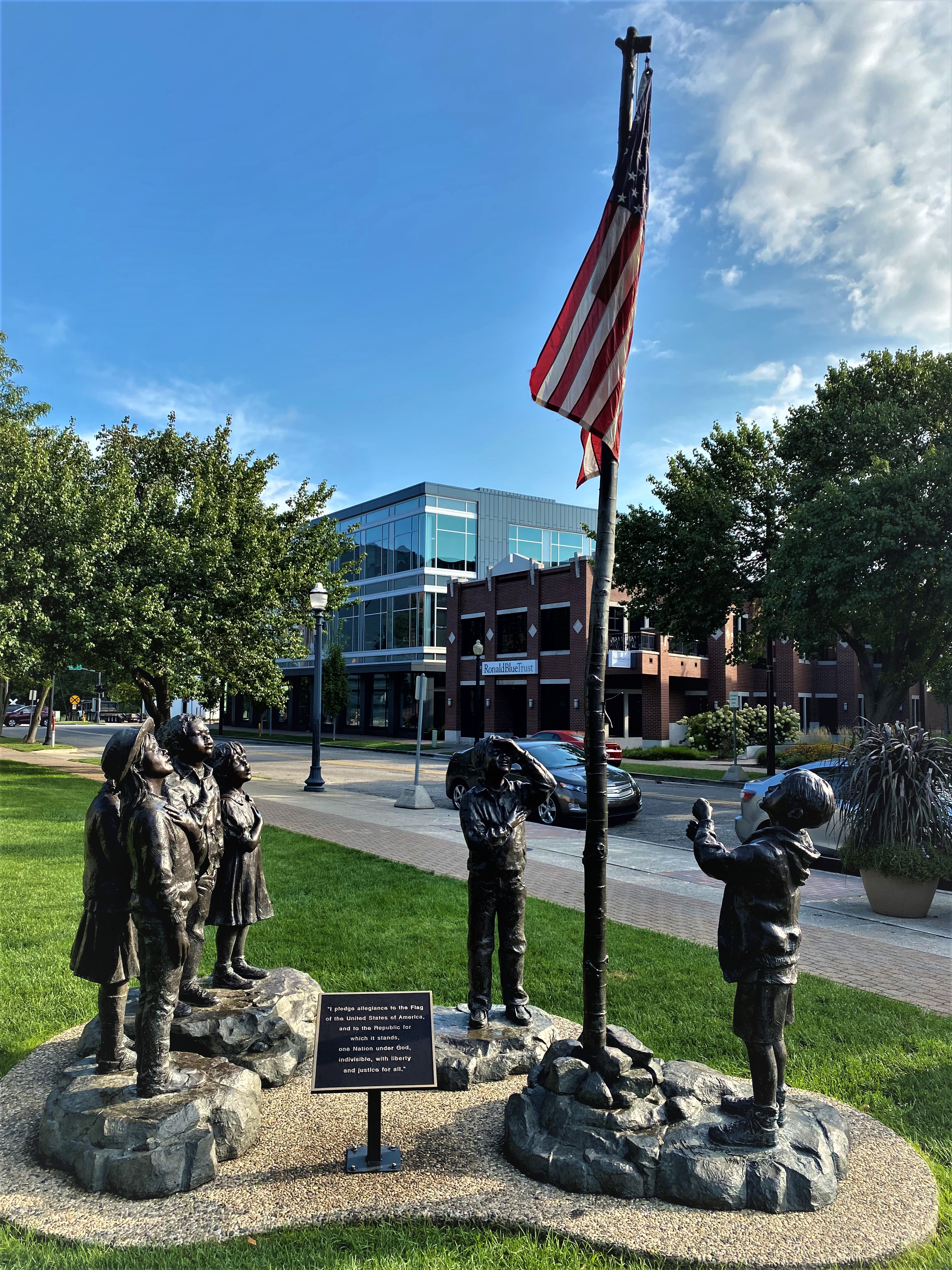
Shopping and dining are the two major draws for us and Ms. Yoga, it was a get-away for both of them, and I just tagged along, like a third wheel.  We have never been there during the winter season, but the city actually had the sidewalks reinstalled in the downtown area, which is the shopping and dining center of the city, after they installed geo-thermal hot water pipes underground to melt the snow and ice for the benefit of the tourists, visitors and the locals.  Imagine, shopping in Michigan with dry sidewalks.  Also, one can find statues everywhere on with themes strong for the city, both civic and whimsical.  I mean how can you not enjoy seeing a group of school children around a flag pole, and in your mind, you are reciting the Pledge of Allegiance along with the children.  There is a great statue honoring the Police Department, escorting a young girl.  In the center of the downtown, instead of another building, this is a charming little park with a local music group looking splendid in bronze, and the details and expressions are captivating. 

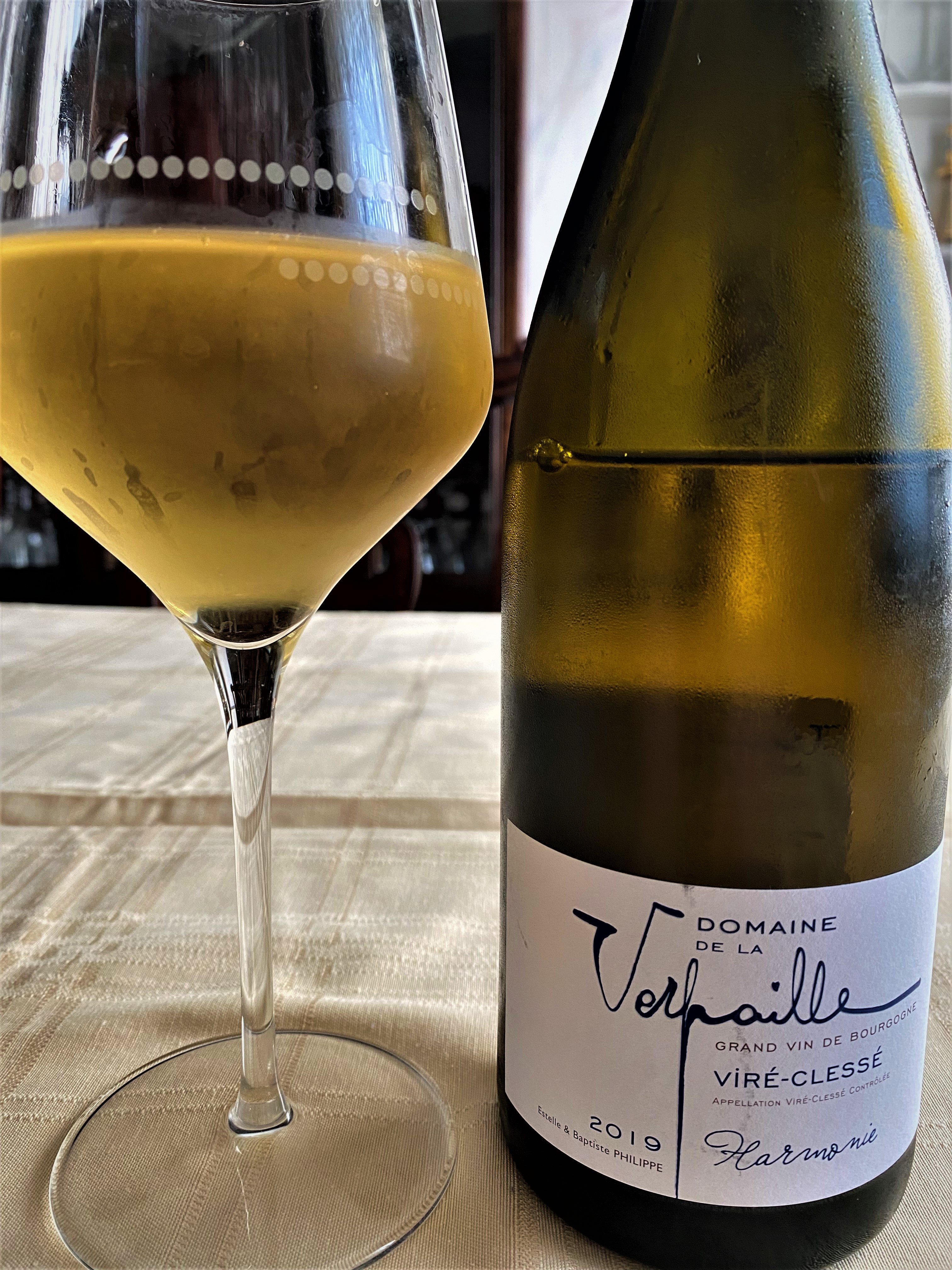
After we arrived, and settled in, we opened a bottle of wine in the room to celebrate the mini-vacation.  We had a bottle of Domaine de la Verpaille “Harmonie” Vire-Clesse 2019 by Estelle & Baptiste Philippe.  The Domaine is in its fifth generation, located in what is now the heart of Cru Vire-Clesse.  They actually make wines with five different designations from the one property; Vire-Clesse (cru du Maconnais sine 1998), Macon-Village, Macon, Burgundy and a Blanc de Blancs Cremant.   The Domaine converted to organic farming in 2006 and in 2009 they were officially recognized for their efforts.  They only grow Chardonnay on a clay-limestone soil and the average age of the vines is sixty-five years of age.  The Vire-Clesse appellation was created in 1999, but the 1998 vintage was allowed to use it, as well.  The appellation only is for Chardonnay grapes and replaces the older Macon-Clesse and Macon-Vire and includes several other communes as well in the immediate region and the region is considered to offer wines as dry as Chablis.  After harvest the wine undergoes fermentation, maceration and aging for twelve months on the lees, which adds to the flavor and richness.  The wine is a pale yellow with notes of yellow fruits and florals.  On the palate there were tones of apples, pears and peaches in a full, round wine with a nice meandering finish of gun-flint.          

Posted in Wine | Tagged , , , , , | 2 Comments