MWWC 20: Variety

“Variety is the spice of life, that gives its flavor,” the oft quoted line from William Cowper and is the perfect opening line for the Twentieth Monthly Wine Writers Challenge. It is hard to believe that twenty of these challenges have occurred and the themes alone have been quite varied.

wine-stain Monthly Wine Challenge

Variety to a wine drinker is almost universal, at least to the people that I know that drink wine. I know some that only drink French wine, but the selection of wines from that esteemed country is almost limitless, when you start listing the regions, the sub-regions and the varietals that one can find there. Just the thought of trying all of the wineries in the Medoc would be an awesome goal, but then as you start exploring outward from there, the variety would be a lifetime pursuit. Wines can be red, white, orange and rose, and then if one starts on the color gradiations, that is a study by its own. The wines are still, Petillant and sparkling; and then they can be dry to super sweet. The wines can be blends from large areas, to single barrels and just barely there plots of land (just think of the plots in Burgundy). Variety is everywhere one looks. Then the variety of tastes that one can discover if one has the good fortune to ever try a vertical run of one producer over many vintages, not only would this be mind boggling, but it could be epic event for ones taste buds as well.

Richebourg

Then compare the variety that France offers and apply that same rationale to almost anywhere in the world. Germany, Italy, Australia and the United States just for some examples of the large assortment of wines to taste and to compare, and even if you pare it down, say to the state of Michigan, where I live, it would still apply.

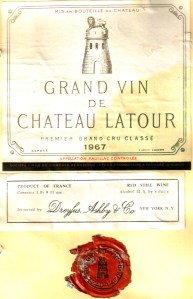
Chateau Latour Pauillac 1961

Variety of tastes, I think is what drives wine lovers on. There is always that new varietal, that new winery, that new concept; that we have to try because of our thirst to broaden our knowledge, in hopes of finding something new and wonderful, that we weren’t aware of. There is the Century Club that many of the Bloggers post on their sites, to show the variety of varietals that they have tried. So far, I have refrained, probably for fear of having tried too few, or maybe, because I feel that I may be bragging, because I have tried too many. I am just an amateur with no titles, or letters to follow my name, but I have sure enjoyed wines over the years.

Dominus 94

Speaking of years, when one thinks of all the different price points of wines that I have tried, we have come up with another variety factor. When I was a kid, the cheap wine that we would drink at the park sometimes instead of beer, was like one dollar for the bottle, and I think of some of the “wine” that we had back then. I was already trying to teach myself about wines, and I am still in that same mode. Back then for three dollars, one could buy a Bordeaux Superior, a Medoc, a Rioja Reserva or a great Chianti. For five dollars the choices were amazing, and if you splurged on a ten or twenty dollar bottle, you had found wine Nirvana. I have prided myself that I have only shown labels of wines that I have actually had, and that is why some look pretty ratty. I just found an old wine sale circular, boy do I save things and now I am glad that I did, a bottle of Richebourg DRC was on sale for $19.99, boy if I only had the money back then to really put away a cellar.

Ruffino Riserva Ducale Oro Chianti Classico 1988

To finish of this essay, to me, wine means variety. Even if I had a lifetime supply of that Richebourg DRC, I would still desire more variety. I would have missed the chance to savor the nose of a glass of Dominus, a pleasure, no one should miss. I do like variety, just step into my closet and you will see variety of suits and sport coats, trousers, shirts, ties, hosiery, shoes and even hats, because fabrics and colors have always driven me as a clothier. The same can be said for wine and the search for the next bottle of “wow.”

Posted in Monthly Wine Writing Challenge, Wine | 4 Comments

Champagne Day

“I get no kick from Champagne, mere alcohol doesn’t thrill me at all,” while it is a great lyric from Cole Porter, while I enjoy his music immensely, I must disagree with the sentiment (out of context). This sung has been immortalized by Frank Sinatra, and it has also been immortalized on the silver screen by Clevon Little. October 23 is Champagne Day according to the Wine Lover’s Calendar, so yes I must speak of Champagne.

Dom Perignon 1969

Is there anything as festive as hearing the pop when a bottle of Champagne is opened? Picture the excitement in the dugout after winning the World Series and all that Champagne that is opened and poured freely on the players as well into glasses. Of course Champagne, now and officially, only comes from France and rightfully so. What a grand discovery was made from the Benedictine Monk Dom Perignon, who is now immortal in the annals of wine making lore.

VCP La Grande Dame 1988
I have read many articles over the years about the intricacies and care that is required to make Champagne. I am not so learned to discuss these methods, but suffice it to say that they actually start pressing the grapes in the fields, with the ability to get fill many barrels of the juice immediately, and that the pressings and barrels are recorded for the initial grading of the juice for production. All of the Pinot Noir and Chardonnay that is required to make this heady wine, and I think that I read that there is like two hundred miles total of underground tunnels and vaults underground that has been carved out, just for our enjoyment. All the time that is required after the wine is bottled before the final determination of creating the different grades of Champagne, of which Brut is by far the most popular and most requested. Then there is that wonderful excitement when a vintage year is announced which creates such special wines and issues, because most of the Champagne put out by the houses are non-vintage. Then there is the danger to the employees that must handle these bottles that under pressure, that explode in the thousands each year; and I have read that there is a certain scent that permeates the air in Champagne that one notices upon arrival there, which I have never experienced.

Mumm Cordon Rouge Tres Sec 1937

As I said earlier, only Champagne from the Champagne region can be called that, though in other parts of France there is sparkling wine being produced and whether made from Methode Traditional or from the new bulk methods, the wines are called Mouseux or Cremant. In Austria and Germany the sparkling wines are called Sekt. Then there is Prosecco and Spumante from Italy, while Spain is famous for their Cava.

Mumms Caesar's Palace

For years in North America, sparkling wine was called Champagne albeit with a modifier as in New York Extra Dry Champagne or Canadian Champagne, but the French demanded in the international courts that the word Champagne should be protected and only used for Champagne and not to be generic. Here in the New World, the sparkling wines have either unique names and the best have the wording Methode Traditional on the labels to identify that they are made in the tried and true way.

Hyatt Hotels Champagne NV

The best thing about Champagne is that one can make any event special, just by opening a bottle. One can celebrate anything achievement or goal, and sometimes it is just so romantic to just sit back and enjoy the wine, just because. In fact I think that I shall, because I have finished this article.

L'Instant Taittinger

Posted in Wine | Tagged | 6 Comments

A Surprise Phone Call

Sometimes you get a left curve that you actually connect with and pop it out of the stadium. Well that is how it felt the other night. It was going to be a quiet night of maybe some writing, and finishing off packing for a quick get-away, and just a quiet dinner home, as the weekend would more than make up for this quiet night. Instead of what was to be expected, one of the phones in the house rang, and we found that a dear friend from Charlotte was in town early, we thought that with our planned trip, that we would miss her visit. Not only was she in town early, but she was with another mutual friend and they had just invaded the bar at Fleming’s near our home, and wanted to know if we wanted to join them. Of course that invitation was accepted most graciously and we were out the door in minutes.

Navardia Rioja 2014

By the time we got to Fleming’s they had secured a table a table and had started without us on the beverages, and to be truthful, I can’t blame them, as we would have done the same thing. We all ended up getting the cheeseburgers at Fleming’s and it is still one of the best bar burgers that I have found, though instead of a side of onion rings, the more prosaic French fries accompanied the order, but at least they were hand cut and well done, which is the way I prefer them, if I have to have them. It was over-kill for me on potatoes, because we had been munching on the home-made potato chips earlier with our first rounds of wine.

Charles & Charles Cabernet Sauvignon Syrah 2014

I started off by having a glass of Charles & Charles Cabernet Sauvignon & Syrah 2014, made by Bieler and Smith, both of whom are named Charles. The blending of Cabernet Sauvignon and Syrah (Shiraz) is very popular in Australia, and this wine is from the Columbia Valley in Washington State. I found this wine listed as being from the Wahluke Slope AVA, a subset of the Columbia Valley. Wahluke Slope is a high production area with Merlot, Cabernet Sauvignon and Syrah to be the leading varietals. I will have to surmise that the wine is blended with other wines because the label read Columbia Valley and not the smaller AVA of Wahluke Slope. While the wine was fine, all the women were drinking another wine and all raving about it. The wine that they were enjoying was Bodegas Bagordi Navardia Rioja 2014, and while I enjoy Rioja wines, I had this same wine from the 2012 vintage and thought it was on the light side for a Rioja. This fully organic wine in the later vintage was most enjoyable, in fact I switched over on my second glass and joined the ladies as this wine was great and worked so well with the burgers. This Rioja is a classic blend of Tempranillo, Graciano and Garnacha. Another lesson that I learned is that always give a wine a second chance, especially if it is from another vintage.

Posted in Dining, Wine | Tagged , , , , , , , , , , , , | Leave a comment

A Few More Assorted Wines

There were a few more wines that I thought I should share with you from the Culinary Extravaganza 2015. These wines were located on the International Table and were furnished through Eagle Eye Brands, and the wine was underwritten by MGM Detroit. It was a good mix of assorted wines from several different countries. There was a wine from Germany, Chile, Croatia and two wines from Spain.

Two wines on ice

The wine from Germany was Joh. Jos. Prum Wehlener Sonnenuhr Riesling Kabinet 2011 and it is a classic wine from the Mosel. Wehlen is on of the most known villages of the Mosel and Sonnenuhr is an Erste Lage or a First Growth Vineyard.

Koyle Carmenere 2012

The wine from Chile was Koyle Gran Reserve Carmenere 2012, and this wine was originally called a Reserva. The wine is from the Alto Colchagua Valley, the southwest half of the larger Rapel Valley, which is famed for Cabernet Sauvignon, Carmenere and Syrah.

Enjingi Grasevina 2011

A unique wine was offered from Croatia, the Enjingi Grasevina 2011 from Kutjevo. Grasevina is also known as Welshriesling, which translates to “foreign Riesling.” Two thirds of the wine from Croatia is white.

Mar de Envero Troupe Albarino 2013

There were two diverse wines from Spain. The first wine was La Ardilla Moscato de Valencia from the Toria Valley. This wine is from the varietal Muscat of Alexandria and is of on the earliest Muscat grapes and comes from the Nile Delta, hence “Alexandria.” The other wine was Mar de Envero “Troupe” Rias Baixas 2013 from Galicia, Spain. While Albarino wines from this area must be at least seventy percent Albarino, this wine was one hundred percent Albarino.

Posted in Wine | Tagged , , , , , , , , , , , , , , , , , , , , , , | Leave a comment

Merlot Me

October 16 has been designated “Merlot Me” day and to be candid with you, the syntax of the wording just gnaws at me. The concept of a day to honor Merlot is great, I just have a problem with how the English language has been abused in today’s lifestyle of fitting in as much, in as little space as possible.

Chateau Cheval Blanc 1985

Merlot is one of my favorite varietals, and I have often mentioned this fact. Suffice it to say, that I do not regard myself as a wine authority, but I certainly have enjoyed a few glasses of wine over the years. Merlot has often been relegated to second place in its comparison to Cabernet Sauvignon, but in actuality it may be planted almost equally around the world. When I was a kid, learning about wines, before the big California upset, the world rather rightfully centered on Bordeaux, and yes I am that old. The wines of Bordeaux were the red wines that the world knew, and when one was either shopping or looking at a wine carte, one would always find Bordeaux or Bordeaux Superior. As I began my self-learning about wines, I also discovered the Medoc and all the communes that one should look for.

Ch Ausone 1957

It was at this point in my education that I discovered Saint-Emilion and Pomerol, and what a grand discovery it was. In my youth, drinking some of the Clarets that I could find and let alone afford back then, these two new areas opened new horizons for me. Some of the Bordeaux wines were so heavily Cabernet Sauvignon that they were almost too tannic to drink, but Saint-Emilion and Pomerol with their dependency on Merlot, were almost wonderful, even in their youth. Merlot blended with Cabernet Sauvignon mellows the wine and makes it more rounded and back then, when my palette was young, it was appreciated and I still appreciate the almost sexy smoothness that Merlot brings to the table.

Ch La Conseillante 1970

Even on my first trip to the wine country in California, when Napa Valley could have renamed itself Cabernet Valley, I encountered a new winery that was bucking the trend and they were making a name for themselves with Merlot. Duckhorn Vineyards not only offered Merlot, but they also offered Merlot from their plots in Howell Mountain and from Three Palm, not to mention that they use Merlot in their red blended wines as well. That was such a heady experience for me, because I remember that we were taken on a private tasting, before they even had a real tasting room, to the back of a semi, and we just opened up cases of wine, that we were sitting on, to try all of the wines that they were offering. I still remember the moment and smile, and wish that we had bought more wine, but we still went crazy on that trip.

Duckhorn Howel Mtn Merlot

Even if Merlot is treated unfairly, it has still been hailed in a couple of films as a most worthy wine. The man who brought us “gratuitous sex and violence” in my youth, Sean Connery as the debonair James Bond drinks Chateau Cheval Blanc in the film “Never Say Never Again.” Chateau Cheval Blanc may be one of the most famous Merlot based wines in Saint-Emilion and consistently rivals the first growths of the Medoc. Peter O’Toole’s character Anton Ego in the cartoon epic for “foodies” “Ratatouille” asks for a Cheval Blanc 1947 to go with a dish that he is to serve. Of course I would be taken to task if I did not mention “No, if any one orders Merlot, I’m leaving. I am not drinking any f****** Merlot” the oft quoted statement uttered by Miles in “Sideways,” but of course (spoiler alert) Chateau Cheval Blanc 1961 may have been the biggest star of the film.

Duckhorn Merlot Three Palms Vineyard 1999


While I am still thinking of Hollywood, yes, I am crazy about a wine, that most wine authorities and writers would probably sneer at, but to be totally truthful, to date I have yet encountered a bad wine from Marilyn Merlot. The first bottle that I tried was a gift, because of the label, and yes, I was skeptical until I tried the wine, and now I try to get at least a couple bottles of each vintage, though I have missed some. I mean what a perfect combination, the seduction of both Marilyn Monroe and the varietal Merlot; I never had a chance.

Marilyn Merlot 1994

Posted in Wine | Tagged | 2 Comments

“Drink Local Wine” Week

According to the Wine Lovers Calendar the week of October 11 to 17 is the “Drink Local Wine Week.” I think that it is a noble cause and one worth paying attention to. I notice that most of the new restaurants are promoting the concept of buying local produce and meats whenever possible, and living here in Michigan, the concept of fresh fish from the Great Lakes has been promoted since I can remember. So why not drink local? I mean if I lived in Carmel or Yountville or Bordeaux or Avignone, I would be drinking the local wines. As I said I live in Michigan and I have touted the local wines before, and I will again, when I can.

Sandhill Crane Vineyards Legacy 2013

This program made me think of a recent side trip my Bride and I made, not too long ago, when we were returning from a trip to Grand Rapids, Michigan, which I have not even had a chance to discuss yet. On the way home, I mentioned that I had never been to Jackson, Michigan and since I knew that there were a couple of wineries in Jackson, we should stop and at least visit one on our way home. When people think of Michigan wines, when they do, they normally think of the Traverse City area of the state, which used to be all cherry orchards and is now the center of viniculture. While it may be the largest center of activity, there are pioneers in this state that are striving to make wine in other parts of the state as well, and Jackson is almost mid-state. We ended up at Sandhill Crane Vineyards. Not only are they a winery, but they had a delightful café on the premises for a surprising and satisfying lunch while we were there. We shared a plate of Local Smoked Trout Spread with cucumber slices and baguette slices. The my Bride had the “Magic Mushroom” which was goat cheese and sun dried tomato spread, sautéed portabella mushrooms, artichoke hearts and kale on rustic Italian panini. While I had “Maggie’s Club” a toasted rustic Italian bread with turkey, bacon, lettuce, tomato, provolone and guacamole. We had lunch after the wine tasting, and bought a bottle of wine to have with lunch.

Sandhill Crane Vineyards Medals

The winery offered twenty-seven different wines, some were from fruit other than grapes, but I am sure that they have a following for them as well, but I was interested in the grapes. Sandhill Crane Vineyards offered wines made from the classic grapes like Cabernet Sauvignon, Riesling, Pinot Grigio, Pinot Noir, Chardonnay and Syrah. They also offered wines made from some of the Cold-Hardy grapes that are safer and popular in the Mid-west and the North-Eastern states. There were wines made from Vignoles, Traminette, Noiret, Vidal Blanc, Seyval Blanc, Frontenac, Chardonel and Chambourcin. There was even a wall that showed the medals they had won, laid on top of the bottle that had caused the win. They may be a smaller winery, but they were proud of what they have accomplished and of their future goals. We tried several different wines including their Pinot Grigio 2013, which were as good as some house wines in restaurants that I have had. Their Proprietor’s Reserve Traminette, is estate grown, barrel-fermented and left on the lees for five months, and aged for ten months in toasted oak. The Noiret 2012 had that special pepper taste that I have discovered that I really like in that wine. We tried some of their Veranda, mead that they make from estate grapes and local honey (and there is that word local again). We tried one of their dessert wines Sweet Ellie 2012; a blend of late harvested Traminette, Vidal Blanc, Vignoles and Chardonel. I also tried tastings of their two “Port Wines.” The “840” is made from their Frontenac and Chambourcin grapes aged in both American and French Oak barrels. The “840 Reserve” has been aged for four years, and only one barrel is available every four to five years. After the tasting we selected a bottle of Legacy 2013 which is an off dry blend of Chardonnay and Vignoles and it was very crisp and was enjoyable with our lunch. Sandhill Crane Vineyards donates four dollars from the sale of every bottle of Legacy to the Legacy Land Conservancy, which is now a thirty-seven year old accredited land trust. Drinking local, just like dining local works very well, and can be so appreciated especially when they are done by dedicated individuals and should be supported as often as possible.

Posted in Dining, Wine | Tagged , , , , , , , , , , , , , , , , , | Leave a comment

The Italian Wines at the Culinary Extravaganza

I realize that I have been going on and on about the wines that were served at the Culinary Extravaganza 2015, but I have no choice. The selection was fantastic, compared to some of the years. Some years it felt like the wine distributors were just dumping slow moving wines onto the charity event, but this year with the MGM Grand underwriting the wine, not to mention having a table for food, the selection was grand (and pardon my wording). One would think that the wine distributors would want to showcase finer wines at an event like this, which would make their wares more desirable to the attendees, who might remember having a taste of the wines. The majority of the wines were in the twenty to thirty dollar range in retail and even more at the restaurant level.

Gardiz Prosecco     Bonci Verdicchio dei Castelli di Jesi Classico

One of the other wine tables that I tended to frequent several times between the food tastings was the Italian wine table. I will mention with my tongue-in-cheek that there was not a fiascha or a jug in site. The first wine that we tried was the Gardiz Prosecco DOC NV, as my Bride is very partial to sparkling wines, because they are easy to drink and very understandable. This is just a popular type of wine, which keeps gaining in popularity. This wine from the Veneto region, because of the popularity has gone the extra step to rename the grape Prosecco, and wines of this nature not from the DOC area, must use the old name of the grape, which is Glera. Another wine that I tried that is not often seen from the Marche region was the Bonci Verdicchio dei Castelli Di Jesi Classico Carpaneto Vineyard 2013. This is the oldest classic wine area of Jesi, the Verdicchio grape does wonderful there and the “Classico” means that it is another half percent higher alcohol proof by volume. The next wine that I tried was the Marchesi Biscardo Valpolicella Ripasso Superiore 2013. Another wine from the Veneto, and I have enjoyed Valpolicella wines for at least forty years and I feel that the wines have increased in quality from the old days. This is the classic blending of Corvina, Rondinella and Molinara of the region and the Ripasso is the added step that is done to make the wine fuller and more nuanced. The wine is refermented using the tannin-rich skins of the grapes, which greatly enhances the taste of the wine.

Marchesi Biscardo Calpolicella Ripasso Superiore 2013      Tenuta Argentiera Villa Donoratico Bolgheri 2010

Then there were a couple of wines from the famed Tuscan region of Italy. The first wine that I tried was Tenuta Argentiera Villa Donoratico Bolgheri 2010. Bolgheri now has its own DOC, as it was the grand experimental region that evolved into the famed “Super Tuscan” wines. This wine is a blend of Cabernet Sauvignon, Cabernet Franc and Merlot, all stellar grapes that are not really native to the area. The other Tuscan wine was Buonamico Cercatoja Toscana IGT 2010 which is using the Toscana IGT designation, because once again, some of the grapes are not local. While the wine is made using Sangiovese, the work-horse of Tuscany, it is blended with Syrah, Cabernet Sauvignon and Merlot to create a mellower flavored wine from the region. Finally for the last of the reds of from Italy was a bow to the new emerging wine market. The wine was Drei Dona Tenuta la Palazza Magnificat Cabernet Sauvignon 2008. A finely made and mellow Cabernet Sauvignon from the Emilia-Romagna region of Italy, which is not known for Cabs, but the world, knows Cabs.

Buonamico Cercatoja Toscana IGT 2010     Drei Dona Tenuta la Palazza Magnificat Cabernet Sauvignon 2008

The last wine that I will discuss from the Italian table was a delightful dessert wine that was new to me, and most enjoyable, as it reminded me of a Sherry, which I enjoy so much, but my Bride is not partial to. There were a couple of bottles of Fattoria Il Lago Vin Santo del Chianti Rufina. This amber colored dessert wine is from Tuscany and since 1997 has its own DOC. The wine is made from Trebbiano and Malvasia grapes and Vin Santo means “Holy Wine,” but I would not call it a “Communion” wine. It is of the group of wines called “straw wines” as the grapes are left out on straw mats after harvesting to dry for three to six months under the Tuscan sun. Then they are gently pressed, then fermented in small barrels that are completely sealed for three to ten years. This unique approach for wines of this area, gives the wine a slight oxidation taste, which as I stated earlier reminded me of a Sherry. I guess as I have mellowed I appreciate the dessert wines more and more.

Fattoria Il Lago Cin Santo del Chianti Rufina

Posted in Dining, Wine | Tagged , , , , , , , , , , , , , , , , , , , , , , , , , , , , , , , | Leave a comment

French Wines at the Extravaganza

There was just so much to enjoy at this past Culinary Extravaganza benefiting the Culinary Arts Program at Schoolcraft College. The food was delicious, think of three hours of different tapas being served, in fact there was a new tapas restaurant that was among all the restaurants and it is near by for me, so that will be another adventure. Of course I like to try wines and sometimes I even get a chance to write about wines. This year, rather than have tables representing a wine distributor, the tables were arranged by geography when possible and I already mentioned the American wines represented, even before we got into the main room.

CE French Whites 1

One of the first tables that we encountered was the French table, and what a table it was, in spite of the fact that I got to listen to so many people go up and ask for a pour of Cabernet. There were two ice trays on the table and there were four white wines and one rose wine on ice, and the selection was well chosen and not the run of the mill. There was Albert Bichot Brut Reserve NV. This was a Cremant de Bourgogne from Domaines Albert Bichot made in the Methode Traditionelle with Chardonnay and Pinot Noir from the Cote d’Or. The Cremant de Bourgogne is used for sparkling white wines from Burgundy, which compliments Bourgogne Mouseux for sparkling red wines. We also tried Joseph Mellot Sancerre “La Chatellenie” 2014 from the upper Loire region of Sancerre made from Sauvignon Blanc. The next wine was Karantes La Bergerie Languedoc 2014 a rose made from Grenache, Mouvedre and Syrah. Another wine from Domaines Albert Bichot was Chablis Premier Cru “Les Vaucopins” 2011, just a classic Chardonnay wine. Then there was an interesting little wine Chateau Mourgues du Gres La Galets Dores Blanc 2013 from the Costieres de Nimes. A White Southern Rhone blend which could have Grenache Blanc, Marsanne, Roussanne, Viognier, Ugni Blanc, Clairette, Bourboulene and Vermentino (Rolle). The AOC Costieres de Nimes was created in 1989, prior to that year the wines of Nimes were listed as VDQS under Costieres du Gard, administered in the Languedoc, but now it is administered by the Rhone Regional Board in Avignone. The last of the white wines, and thankfully there was still some left when I returned to the table was Chateau de Rayne Vigneau 2011, a First Growth Premiere Cru Classe Sauternes wine made from Sauvignon Blanc and Semillon. I mean these were all fine wines and we were just getting started.

CE French Whites 2
There were two French red wines being poured as well, and they were equal in stature to the white wines on the table. Chateau Cantenanc Saint-Emilion Grand Cru 2011 is not too shabby of a wine at any time. Of course I am quite a fan of the wines of Saint-Emilion and then again it is a Merlot wine as well. To be truthful, the wine is a blend of Merlot, Cabernet Franc and Cabernet Sauvignon; so all of the people that were requesting a pour of Cabernet were in for a treat, as far as I was concerned.

CE French Reds

The other red wine that was being poured at the French table was just as impressive in my humble opinion. Domaine Berthet-Rayne Chateauneuf-du-Pape 2012 a classic wine from the Southern Rhone district and a wine famous in its own right and I really did not expect to see this caliber of wine being poured. Chateauneuf-du-Pape and its famous blend of varietals has been emulated around the world and it is now referred to as GSM, which stands for Grenache, Syrah and Mourvedre, though one sometimes also finds some Cinsault added to the mix. After this wonderful table, I couldn’t wait to see some of the other wine tables and what they would offer.

Posted in Dining, Wine | Tagged , , , , , , , , , , , , , , , , , , , , , , , , , , , | Leave a comment

Culinary Extravaganza 2015

It was the time for the 24’Th annual celebration of food and wine to benefit Schoolcraft College students and the Culinary Arts Program. The event is held at the VisTaTech Center/Waterman Wing of Schoolcraft College, which may be the finest array of kitchens that most of the graduates will ever work at, as they learn the skills necessary for their chosen careers. My Bride and I have only missed a couple of these events over the last twenty years and it was always because of other dates that had usurped the event, as we are strong supporters of the graduates and what the college stands for.

Ranch House Red 2010

The Culinary Extravaganza is three hours of fine dining and the chance of having some new beverages to try. Most of the tables represent different restaurants, hotels and catering companies, where past graduates of the college are now employed. Each table offers a small, usually two bite dish, for the people to try. It may not sound like much, but after three hours of this type of “grazing” one leaves totally sated and happy. Some of the restaurants that were there I have written about in the past like the Detroit Athletic Club, Karl’s Cabin, No. VI Chophouse, and the Sardine Room. Some of the restaurants I still have not written about, and eventually will are: 5ive Restaurant at The Inn at St. John’s, Coach Insignia, Cuisine Restaurant, Steve & Rocky’s and The Root Restaurant and Bar. Then there are also a couple of restaurants that will be slated to try in the future, as some times there just doesn’t seem to be enough time to get everywhere.

Cru Chardonnay 2013

One of the new things that I noticed this year, as compared to years past, was the fact that the Wine Sponsor for the Culinary Extravaganza 2015 was MGM Grand Detroit. This was a wonderful change from years past, as it seems that there was many different wine distributors and they just donated anything that they wanted to get rid of, it seemed in some years. This year, it seems that all of the wines were from Eagle Eye Brands and they did a stellar job of supplying a vast array of assorted wines, from different countries, different varietals and not just wines from the bottom rungs of what they had to offer. All of the wines were good medium priced wines, that most people may order when they are out for dinner, and they were not the run of the mill “popular” labels.

Seven Hills Merlot 2013

Before even entering the main room of the Extravaganza, we picked up our tray and wine glass. The tray is a small square plastic item, which is perfect to hold the individual plates of food that were to be offered by all of the restaurant vendors at the affair. The tray also has a groove cut out in one corner, so that one can rest the wine glass safely in place, while sampling the food. It is a very well designed and simple piece that works wonderfully in this type of setting.

Gamble Sauvignon Blanc 2014

Also outside of the main room was the first table offering wines, and they were American wines that were very easy for anyone there to understand and to try. The first wine that I tried was from Cru Wine Company, which originally was founded in 2003 as Mariposa Wine Company. The Cru Chardonnay 2013 was a great way to start off the event, as the fruit came from the Vineyard Montage from Monterey County and I really enjoy most of the wines that I have had from the Monterey area. My Bride and I would each have a different wine at the tables and then try each other’s glass, as a way of sampling more wines in the short period of time. The other white wine that we tried was Gamble Family Vineyard Sauvignon Blanc 2014 from Yountville AVA and from the Gamble Vineyard, and the fruit came from clones from the Loire Valley and from Graves, two historically famous areas for Sauvignon Blanc. We also tried two red wines, while we were there. Seven Hills Winery Merlot 2013 was from Columbia Valley AVA in Oregon. This was a good dependable Merlot sourced from one of the largest AVA regions in the country. The other red wine was Ranch House Red 2010 from Long Meadow Ranch Winery of St. Helena in Napa Valley. This was a fun proprietary red wine which was a blend of Cabernet Sauvignon, Merlot, Sangiovese and Petite Syrah. Just some nice wines to get our tastes buds wetted and our appetite whetted for the dishes and other wines that awaited us inside of the main room.

Posted in Dining, Wine | Tagged , , , , , , , , , , , , , , , , , | Leave a comment

Vin Jaune and Chateau-Chalon

The Jura wine tasting dinner at Selden Standard was going strong, and we were getting to the main entrée. The two stars of the evening were coming, not to mention a special surprise bottle of wine. Our host Elie Boudt of Elie Wine Company and his guest was Jean-Francois Bourdy of Domaine Jean Bourdy from Jura. Most of the courses were designed to be shared, but the entrée of Grilled Trout with fennel, fingerling potatoes and salsa Verde were individually plated.

Bourdy Chateau Chalon 1947

The wine that was served was one of the Jura regions most famous wines, and the wine that was paired with the entrée was Bourdy Cotes du Jura Vin Jaune 2006. Vin Jaune, which means “yellow wine”, came into existence in the early Nineteenth Century, when a forgotten barrel of wine was discovered. The Savagnin grape had been grown in the area and recorded since the Thirteenth Century and had been called “age worthy wine” and or “frost wine.” The grapes were traditionally harvested when frost arrived to the area. After the grapes have been pressed and placed into fermentation tanks, a long fermentation period ensues, the wine is then drawn out of the tanks and into used barrels, but not full, to leave a pocket of air, which is not the normal way most wines are made. Instead of producing vinegar, which is what one would suspect, this classic nutty and distinct wine is produced. This air pocket is what allows the voile, a film of yeast that covers the surface of the wine, and it is what causes the unique “yellow” of the wine. This voile is similar to the concept of flor that is found in the production of Sherry wines, and a similar process in the production of Tokay. The wine in the barrels are stored this way for around seven years and tested twice a year in this state, before the wine may be bottled. With the extra work and aging in the production of the wine, Vin Jaune can be enjoyed immediately after bottling and can still be enjoyed fifty years later.

Bourdy Vin Jaune 2006

Even the bottles used and they are a trademark of Vin Jaune, is unique like the wine. The bottles are shorter and squat and called a “clavelin” and they contain 620 ml. The quantity corresponds to what remains of one liter of wine following the required aging in the barrels. Even with the new government rulings that standardized wine bottles in France, there was such a strong opposition from the wine growers of Jura and their intervention that the clavelin is still around. In spite of the government, it is the only bottle whose volume is 600 ml.

Bourdy Chateau Chalon 2005


Afterwards we enjoyed the cheese course of the meal, and it was Comte, a cheese that is very prominent and noted from the Jura. It was during this course that we were treated with not one, but two different vintages of the most famous appellation in Jura, Chateau-Chalon. Chateau-Chalon is not a chateau like one imagines from the Medoc, but it is the name of a village. Chateau-Chalon is where the Savagnin grape truly shines, and its quality is truly tested. It is the only appellation in France that may not be produced every year, the wine is checked and tasted, checked and tasted and after the seven years is again checked and tasted, to make sure that it is worthy of declaring a vintage year. It was stated that one vintage in five, on the average does not make the cut for Chateau-Chalon, and the production of Chateau-Chalon is so important, the clavelin even has an additional glass seal for the appellation. We had the chance to enjoy side by side Bourdy Chateau-Chalon Vin Jaune 2005 and Bourdy Chateau Vin Jaune 1947. As the night progressed our room got a bit darker, and I created a make-do background of white paper and photographed with my phone the two glasses of wine for a comparison of color and one can see the difference the additional aging has. I did not care for the wine glasses that these two wines were served in, though my Bride liked them, I found that the nose did not suffer from them, and the “nuttiness” of the wine was great. In fact, my Bride tried a taste of the ’47 and then selflessly gave me the balance of her tasting to me, to further enjoy the moment. Jean-Francois informed us that the library of wines that they maintain at the domaine is not only huge, but extensive and he let us know that the 1781 was still magnificent, and he referred to the wines that we had that evening as mere children in the life expectancy of the wine,

Comparison of Chateau Chalon 2005 and 1947

Finally for our dessert, which I was kind of sad to get to, because I knew the evening and the tasting was drawing to a close, was an Apple Tarte Tatin with goat cheese ice cream and rosemary Carmel. We all had a chance to enjoy a tasting of Bourdy Galant des Abbesses NV, which is a fortified wine and perfect for after dinner, in fact even an intermission cigar would have been a great choice with it. This beverage is very unique that the juice runs from the press and placed in a copper cauldron, to which twenty-five precisely weighed Indian spices are added from a closely guarded recipe from the year of 1579. The cauldron is then heated to reduce the liquid. It takes an entire day to cook one batch, the heated grape juice is put into a barrel with one third Marc de Franche-Comte, an eau-de-vie brandy made from the same grapes, and it is then age for five years to achieve total maturation. As one can readily see, there is nothing that is hurried in Jura and life is much slower and appreciated even in this fast technological age that we are living in.

Bourdy Galant des Abbesses NV


Posted in Dining, Wine | Tagged , , , , , , | 2 Comments