An Old and a Young White Burgundy

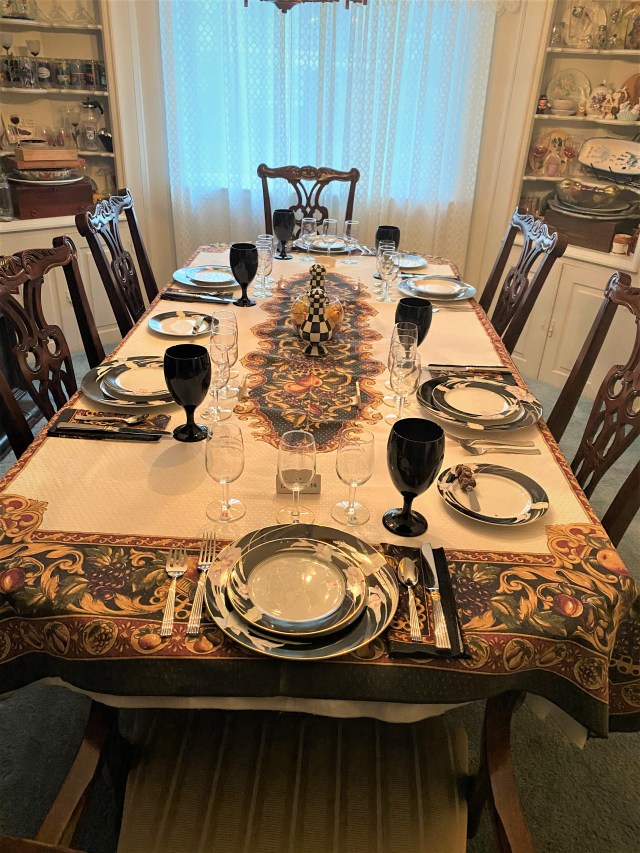
It was the day of the Vertical Wine Tasting Dinner and we were as prepared as we were going to be.  The house was clean and orderly, the dishes were all set and so were the glasses.  We decided to have appetizers in the living room and I even though I was almost conked on the head with a frying pan, I was not threatened with divorce, though I kept adding ideas to the list for the appetizers.  We finally decided on two classic Armenian appetizers and we did not make them in house.  I have to admit that my Grandmother made some of the greatest dishes known to man, especially if you like your meals savory and spicy.  She was also an accomplished baker, and many a time, I can remember my Mother and the lady next door coming over to start rolling the sheets of paper-thin dough to make Paklavah using broom sticks, and they would start at about five in the morning. Thank God that there is an Armenian caterer in the Detroit area, and I could swear that he learned from my Grandmother, but I know that is not the case, but I will no longer buy these dishes from the Church Bazaar anymore, because they are poor relatives to what I went and bought. 
Thankfully this caterer, who is located out in the boondocks, far from any major Armenian enclaves that I know about, has survived what so many other food-oriented businesses have not, in our state.  It was rather unique, in that I had to call ahead of time and order the dishes, and they would give me a pick-up time.  I could not enter the shop, and I had to tell them what type of car I would be driving.  It was a unique experience, as it was the first time I had been out in that community, and I did get there early, but since there was no other customers slated at the time, I was allowed to pick up my order earlier.  The first was Cheese Beoreg and the best way to describe it in laymen’s terms is that it is a Phyllo half-round pastry filled with White Brick Cheese, that you bake for ten minutes on the high rack of the oven, and then ten minutes on the lower rack of the oven, and the trick that was not included in the instructions is to give them an egg wash before baking.  The other dish is Lahmajoon, which is best described as Armenian personalized pizzas, to make the vision easy.  Part of the secret of making this dish, is the dough, and so many cooks cheat on this crucial step, then I remember my Grandmother using triple ground lamb sauteed with finely chopped onions, garlic and parsley mixed with a tomato paste which is smeared on the dough circles and then they are baked two at a time laying topping to topping.  Afterwards all they need is a little sprinkle of Cayenne and some crushed red pepper flakes.  There was enough for a fast nosh for me the next day, so I guess they were a big hit. 

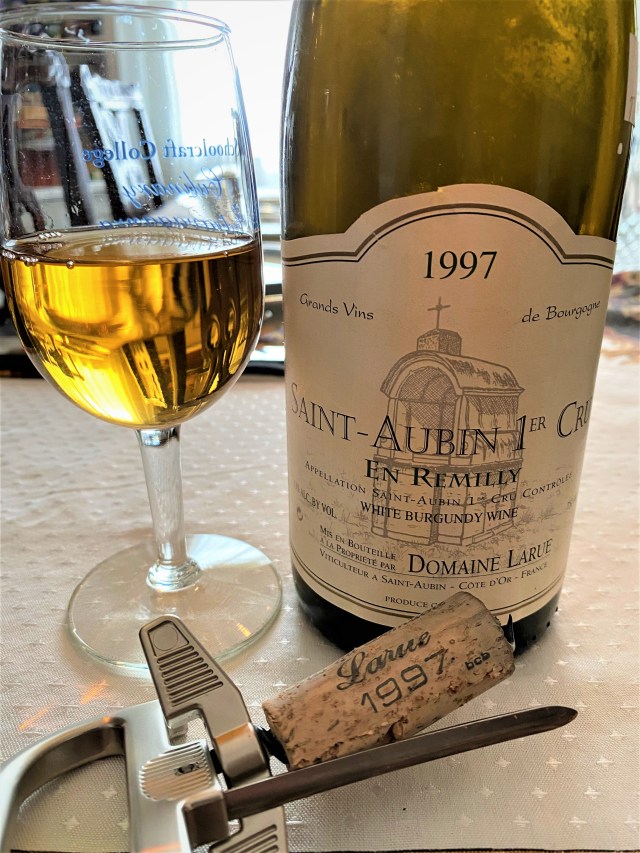
Now what to serve during the appetizers?  I thought that I would let them try an older white Burgundy, the stuff I have been writing about for awhile as I am reorganizing the wine cellar.  I had a bottle of Domaine Larue Saint-Aubin En Remilly Premier Cru 1997 and I can’t believe it slipped through the cracks.  The Larue family domain is forty-two acres, based in Saint-Aubin but extending into Chassagne-Montrachet, Puligny-Montrachet and Aloxe-Corton.  They actually offer nine different bottlings from Saint-Aubin.  Saint-Aubin is located in a valley that cuts through the Cote d’Or and En Remilly is just above the valley floor on the south-facing slope, directly across from the Chassagne-Montrachet Premier Cru vineyards.  The wines of Saint-Aubin are made from Chardonnay, but are noted for their floral and mineral notes.  Alas, this twenty-three-year-old had lost the floral nose and the mineral terroir finish and was drinkable, but with no sparkle or excitement.  The second wine during the appetizers was Cave de Genouilly Bourgogne Aligoté 2018, the almost forgotten white wine of Burgundy, but it has its own appellation.  The Cave Des Vignerons de Genouilly was founded in 1932 as a co-operative of family growers in the Cote Chalonnaise region of Southern Burgundy.  Today it includes ninety growers with one-hundred-eighty acres based around Genouilly, Fley, Bissy-sur-Fley, Saint-Martin-du-Tatre and Saint-Clement-sur-Guye.  Bourgogne Aligoté is an appellation in Burgundy for white wines made from the Aligoté grape and the appellation was awarded in 1937.  The grape has been in Burgundy since the 17th Century, but only represent about six percent of the vineyards there, but is grown in about three hundred parishes in Burgundy, basically for the vignerons themselves.  The wines are generally made in Stainless Steel to allow the freshness and the crispness of the grape, if anything, some people are surprised at the high acidity and the resulting tartness that can occur, but that is part of the charm that I just recently discovered about this grape.  This charming wine saved the early part of the meal, as it is just a wonderful drinking wine and very refreshing.  If you can find this grape, by all means it is worth the purchase price and it is not that dear, because no one knows about it. 
Posted in Dining, Wine | Tagged , , , , , , , | 2 Comments

Chateau Duhart-Milon 1998

Having a special wine dinner for six is enough of a challenge, without all of the craziness that occurs here naturally.  We had the good fortune of getting a mixed vertical case from one of our favorite wineries and when I wrote about it, one of my cast of characters offered to duplicate the dinner from the 1996 film Big Night, while my Bride was talking to another cast mate about the mixed case as well.  So, putting as much energy as Judy Garland and Mickey Rooney, we decided to put on a show, or at least as fancy of a dinner as we could do.  We were going to share the wines with The Wine Raconteur Jr. and The Caller and their spouses, and the four of them had never met before, but we thought this was the perfect time to get everyone together. 

Of course, my Bride is married to a real pain in the arse and rather opinionated about a lot of things, including food and the preparation of said foods, even though I am probably best at staying out of the kitchen.  I guess by osmosis, I have learned a few things about food, pairing, preparations and how a dish should be done or taste.  I guess I also drove her crazy by adding more and more ideas of what should go into the menu.  We also debated on stuff like what china service we should use, as we have at least five different place settings to choose from, then discussions on the flatware, the tablecloth and napkins and stemware.  We did not have twenty-four matching crystal wine goblets, but we did have twice that many matching commercial stemware, so we searched to see if we had three sets of six wine bracelets to identify the wines, we didn’t; we ended up putting six place setting easels with erasable writing to identify the three wines for dinner and then we used circles that we placed on the base of each glass to identify the vintage.  We also had to do some math, so that we knew how much wine to pour into each glass ahead of time.  A lot of prep work was involved and by the time we had dinner the night before the event we were tired and my Bride wanted to make something quick and easy, so we had New York Strip Steaks and Armenian Pilaf, that was left over from another meal and that worked. 

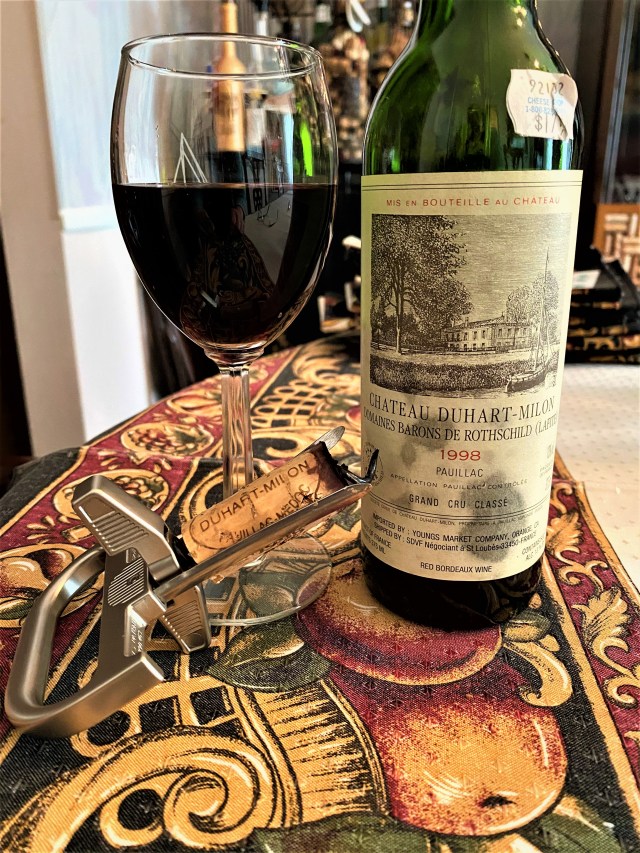
We had also finally finished off all of the opened bottles of wine, since we were trying to unclutter the house for the party, so I went down to the cellar and decided to get a split, which I figured would be ample for the two of us with dinner.  I found a bottle that I thought would be perfect to get us in the mood for drinking some great wine the next day, and I wanted to see how some of the other splits were holding up, just like I have been opening up a lot of the older white wines that have been in the cellar.  Chateau Duhart-Milon Pauillac 1998 is a “Fourth Growth” from the 1855 Classification of the Medoc and at one time it was known as Duhart-Milon-Rothschild.  The winery shares vineyard management and winemaking teams with its illustrious owner and neighbor.  The property has a storied history and is named from the pirate Duhart who sailed in the service of Louis XV and retired to the Medoc.  After the classification the winery had a slow decline and was purchased in 1962 by Baron Eric de Rothschild and eventually the entire vineyard was replanted.  The estate is a one-hundred-eighty acre of fine gravel and sand on limestone, similar to Lafite-Rothschild and it is planted two-thirds Cabernet Sauvignon and the balance to Merlot; though year to year that may not be the mix that makes the final cut.  The vat rooms and cellars are located in the city of Pauillac.  The vinification process is in vats for specific vineyard plots and the grand vin is aged for up to eighteen months in oak, they also produce a second wine called Moulin de Duhart and sometimes they also produce Baron de Milon.  If I had poured you this wine, without you seeing that it was from a split, you would have sworn that it was from a full bottle, as it was still young with plenty of fruit and tannins to make any fan of Pauillac happy. The color was still vivid and the nose belied its age.  The only problem was that it was the last bottle and it was totally delicious and should have been paired with a filet, but I digress.  We were going to relax for the evening and devote our whole next day to the party.   

Posted in Dining, Wine | Tagged , , , , , | 2 Comments

Low Cost Leeder Electric Wine Opener

I guess that I will never be a “wine influencer,” because I seem to go out of my way to avoid asking for goods.  Some of the new wine bloggers seem to have started their blogs in anticipation of getting free wine, free accessories and free what-ever.  I know on my mast head, I have an entry tab for “Samples” and I go out of my way to let you know, if I am getting anything for free, because that is not the goal of all of my writing.  I have been writing these articles since May 2012 and it was several years later that I had to write the tab for “Samples.” I think I have a phobia about asking, ever since I was probably about five or six and it was a real scorcher of a summer day and I was with a couple of kids that I grew up with and I saw a distant relative that was a barber in the neighborhood and I like a big operator, asked him, if he would buy us a couple of popsicles from the corner ice cream shop, they were a nickel apiece and between the three kids we didn’t have one nickel, let alone three.  Later that day, with the childish honesty of the times, I relayed what happened earlier that day to my Father, he not only gave me a boot in the arse for such behavior, but dragged me down to the barbershop to let the barber know that if I ever did a stunt like that again, he had my Father’s permission to beat me with the leather strop that use to dangle on the side of every barber chair to hone the straight razor.  Moral of the story is; don’t ask.

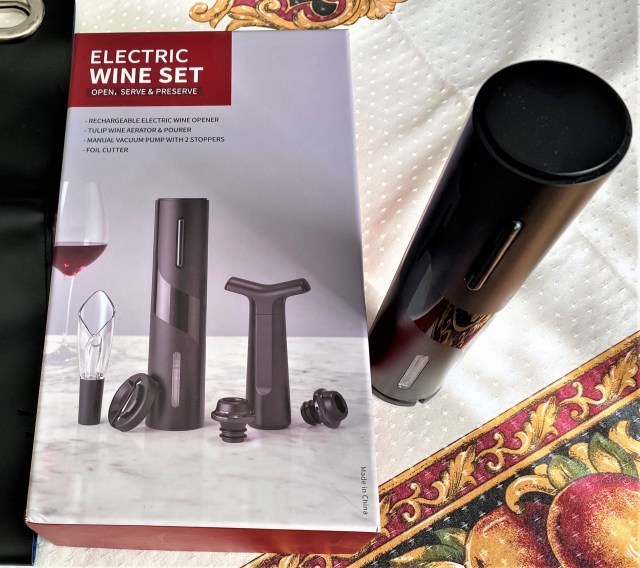
With the start of my blog, I began advertising the articles on Facebook, then on Twitter and finally in March 2017, I started advertising on Instagram.  I started rehashing my articles from May 2012 and by steady progress I am now up to September 2017 with the goal of having all the advertising sites on the same page.  I was recently approached by a gentleman, if I would kindly accept his kind and generous offer of an electric wine opener that he was marketing.  I gallantly tried to maneuver the conversation away from his offer and I really thought I was ready to close the conversation with the thought that the offer to do a review had been forgotten about.  I tried, but the gentleman was persistent, and I think he realized that I was not a kid and that I really did not need to do this, but I finally relented and the package was perfectly wrapped and bundled the atomic bomb would not have detonated if it was shipped like this wine opener.

The Electric Wine Opener came prepacked with the opener, and a foil cutter that nestled at the bottom of the “tube” of the cylinder, a tulip wine aerator and pourer, a manual vacuum pump with two rubber stoppers, an electric charging cable and an instruction sheet.  The mechanism is charged using a USB cable that one plugs into a cube and it takes about twelve hours to charge and it should open up about sixty bottles before requiring to be recharged again and works on both natural and synthetic corks.  I would venture to say that almost everyone has a cube that was not included, because everyone these days have a cellular phone, even I do, but I still maintain a land-line as well.  Most people when purchasing a corkscrew look at its appearance, I guess I am a nerd as I look at the coil of the screw as I have over the years bought corkscrews that looked cool, only to watch them tear up and destroy a cork.  When the unit arrived, we had several bottles in various stages of emptiness, so I had to wait, before I started opening up anymore wine, probably to the chagrin of the gentleman, who probably now realizes that I work at one speed, and that is slow; I don’t rush for anyone. We had a dinner party and I opened up four bottles of wine with each one requiring about ten seconds and not enough time or effort to work up a sweat.  I can barely load photographs on my blog, so don’t expect me to try to make a video production, I am a child of the last century.  I am keeping this corkscrew on the side table in my dining room with my other wine accoutrements, as it is so convenient.  For pricing and shipping information please go to www.lowcostleeder.com or lowcostleeder on Instagram. 

Posted in Uncategorized | Leave a comment

More Raids on the Cellar

It may be still awhile before we can start going out for dinner, like we used to, but I do hope that pleasurable activity returns.  It may be some time before there is full confidence, but until then I am still enjoying my Bride’s culinary skills in the kitchen.  I only growl and tease and make fun with the people I enjoy; if I am just enduring someone’s presence I stick to small talk, and if the person ends up being someone I dislike, I just ignore them altogether, as that has been my wont forever.  So, my Bride knows that she is safe and so do all that I bandy with, and that is an old term and some may have to look it up.  These days with my Bride working exclusively remote and from home, she is trying very hard to make some interesting dinners, but sometimes there are time constraints, as I have said, I really think she ends up working longer hours without a commute, then when she was commuting. 

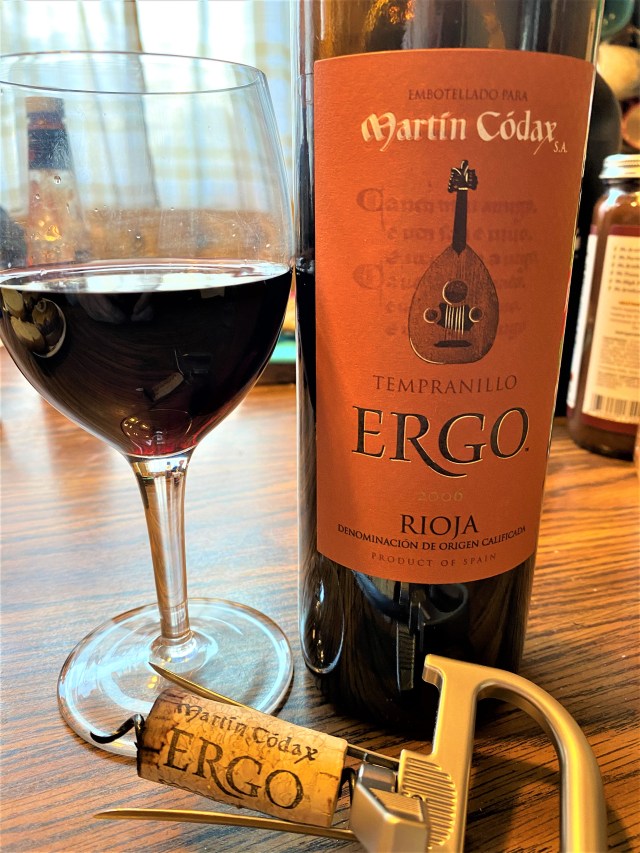
I am slowly, but surely getting all of the wines in the cellar, somewhat organized and at least trying to figure out what I have down there, and I am selecting some of the odd wines and some of the wines that I am not sure how they have matured.  The first wine that I will discuss that was recently opened was one that I was not too concerned about, as I have had the pleasure of drinking old vintages from the Rioja region for years, though in the old days there was kind of a feeling of a wink-wink, nod-nod about the vintage year printed on the label; whereas today it is all above board, but the good thing is, that in reality I have never had a terrible wine from Rioja.  The wine I grabbed is from a house that I have had over the years without any problems and this was a Martin Codex “Ergo” Tempranillo Rioja 2006.  What I guess I never realized was that Martin Codax is a co-operative of growers in the Rias Baixas in Spain.  It was formed in 1986 and is named for a famous troubadour from the 13th Century of old romantic Spain.  The winemaker and one of the original founders of Martin Codax is Luciano Amoedo, who was also one of the most vocal in getting a Denominacion de Origen (DO) for Rias Baixas in 1988 and the main varietal for the co-operative is Albarino, but since their creation they have expanded and now source grapes from about fourteen-hundred small growers in northern Spain.  This was just an opening grade of Rioja wine with no additional designations and while it was not a young wine, it still tasted like a young wine as there was still a lot of fruit in both the nose and the taste.  The color was good, the only thing that I thought was lacking was a good finish and it probably has more to do with its status then with its age.

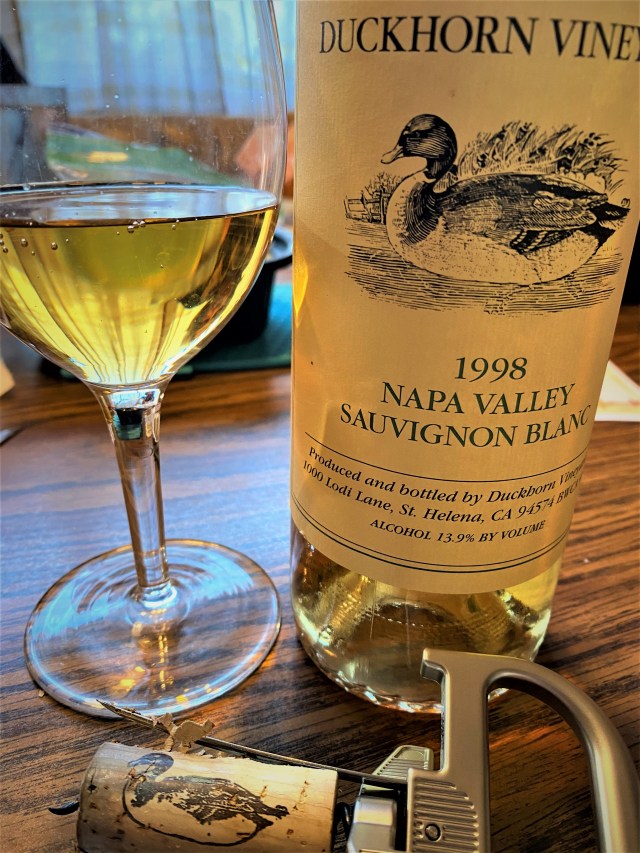
The other wine offered more trepidation, because it fell between the cracks probably from forgetfulness then anything else.  I chilled it and hoped for the best, because I have recently had some happy results from some older Sauvignon Blanc wines, so when I found a Duckhorn Vineyards Sauvignon Blanc Napa Valley 1998, I decided to give it a go and put it into the refrigerator and chill it.  Now I have been a fan of Duckhorn Vineyards even before I went and we had a great tour and tasting by one of the sons.  This bottle of wine is definitely when the Duckhorn family was in charge of the winery, long before they sold out, in fact at this time, every one of the labels were using fruit from Napa Valley, before they started expanding.  You will notice that the color is more amber or gold instead of the soft straw color that the wine usually has, and that is a common occurrence since white wine tends to darken with age and red wines will lighten with age.  The nose was basically non-existent, and there was no fruit, especially the typical notes of grapefruit.  It was another wine that we could not come up with words to express the taste, it had not gone bad, as it was easy to drink, but it was not like drinking alcohol either.  I can’t call it a winner or a loser, but I will put it in the plus account as it wasn’t poured down the drain, and I guess I can attribute it to the dedication of the winemaker, and it wasn’t even a Merlot.                                                                                                                 

Posted in Wine | Tagged , , , , , , , | Leave a comment

With the Family

I would venture to say that anyone that has a family, in the past six months has probably been a scofflaw, especially here in Michigan.  I was not designed to spend my time hiding in the basement and most people that I know were not either.  There were times when we had to defy the law and visit relatives, especially if no one was ill or showed symptoms, though I am sure that a hangnail may have been on one or two of the lists.  After surviving at home for three or more quarantines in a row, I think everyone was getting antsy and suffering from being “stir-crazy.”  I mean there was a time, when it was illegal to have two people in the same car.  We were defiant and broke the law at times, sometimes even my squeaky-clean and above the board Bride got together to do water-aerobics several times at her sister’s house, because she has an inground pool.  She was even joined with other sisters and cousins; and I don’t think that any of them wore a mask in the pool, they were as guilty as Dr. Faucci attending a baseball game with friends and not socially distancing or wearing masks.   There was even a couple of times when after the aerobics, an ad-hoc party would evolve.  With ordering of pizzas and salads and other noshes of that caliber.  There were times that I would drive over after the exercises and bring beverages for everyone to enjoy, because those that were in the pool earlier had worked up an appetite.

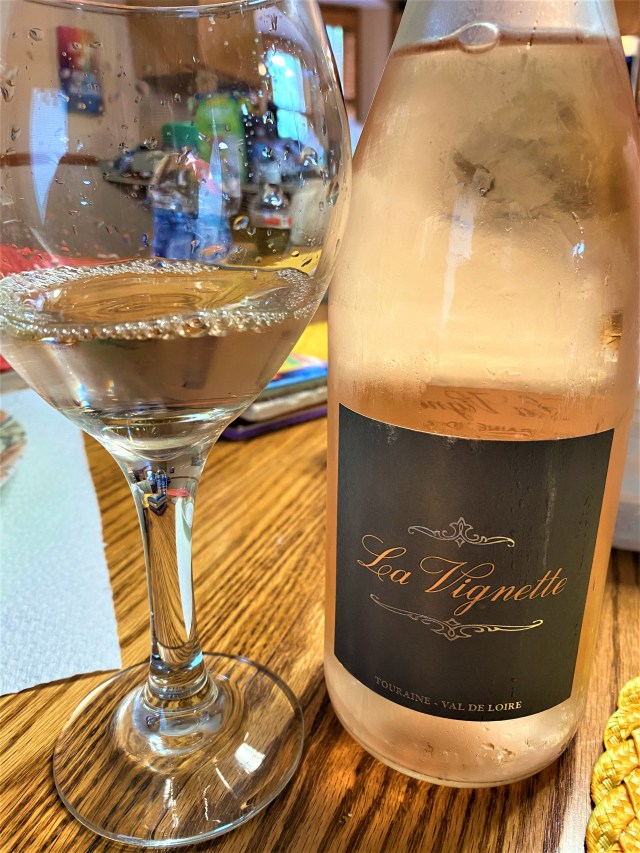
The first wine that I opened up for us to enjoy was Thierry Delauney “La Vignette” Rosé Touraine 2019 is from an estate that is twenty-one hectares situated in Pouille above the banks of the Cher, the very center of the appellation. The vineyards have been cultivated and tended by five generations of the same family and the first wines that were bottled at the Domaine was in 1971.  Through the years they have worked to increase the quality and the reputation of the winery and in the process have also entered into the négociant trade.  A Rosé wine from the Loire Valley, which is a major wine producing area that lives in the shadow of some of the other wine regions.  One of the main reasons that this area is over shadowed, because all of the wines are more nuanced and delicate, instead of big in-your-face reds that so many of the wine critics prefer these days.  The wine is made using Gamay, Cabernet Franc and Malbec (Cot).  The fruit is harvested from across the Touraine and the wine is aged on fine lees in Stainless Steel.  This wine had a pretty pink/salmon tint and the nose was red fruits, especially strawberries and very refreshing.  The wine was well balanced with nice acidity and luscious finish that beckoned for another drink.  

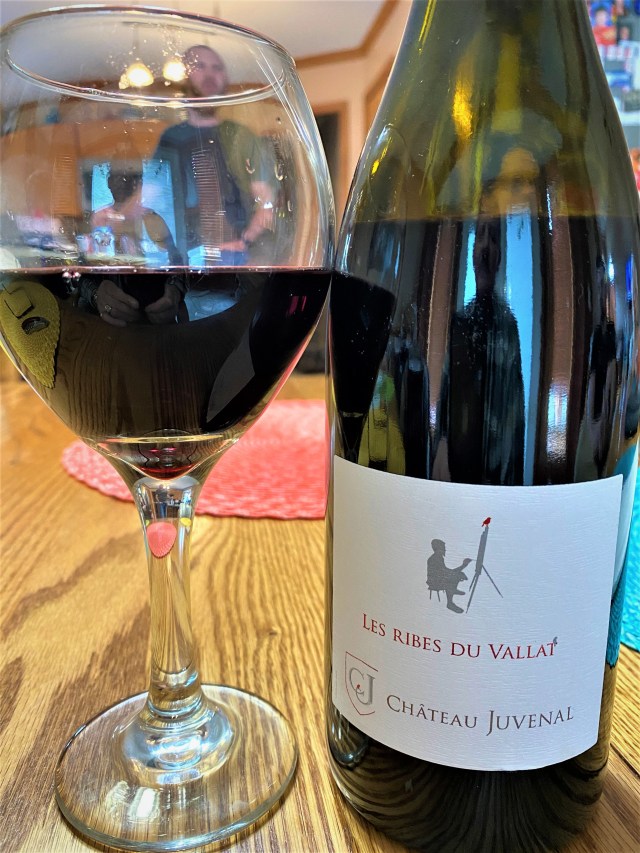
I also brought a red wine, because I knew that we would be having some good old-fashioned meat-lover’s traditional pizza pies, because of me.   Chateau Juvenal “Les Ribes du Vallat” Ventoux 2017 is so named because the plots are distributed on the hillsides (the “ribes” in Provencal) which border the ditch (the “Vallat” in Provencal) which crosses the domain.  In the spring, painters are known to set up their easels and paint different perspectives of the grounds, hence the artist and his easel on the label.  Chateau Juvenal is a residence formed by a Provencal country house and an old farmhouse completely renovated and is called The Castle.  The estate has five bedrooms and three lodgings with a classified 4-star tourist accommodation rating and also offers a swimming pool, a wellness center and a wine estate as well as producing olive oil in an ancestral method.   In 2001, Bernard and Anne-Marie Forestier bought the Provencal castle in order to restore the vineyard and open up a gite; a gite (so that I will keep your from looking it up, is a specific type of holiday accommodation, a home available for rent and they are usually fully furnished and equipped for self-catering.  Chateau Juvenal is located in Ventoux and until 2009 it was known as Cotes de Ventoux when the appellation was completed for the harvest of 1973. It is in the far southeast of the Southern Rhone and abuts Provence.   Bernard and Anne-Marie Forestier teamed up with the Alban family, wine makers for three generations to build the wine cellar and to offer new wines.  They have gone the organic route to create the wines.  The wine is a blend of seventy percent Grenache and thirty percent Syrah from plots located at the foot of the hillside (ribes), on the edge of the ditch (vallat).  The wine immediately shows the fruit forward sweetness of the Grenache and it is balanced with the peppery notes of the Syrah.  It may have been a bit overpowering for the commercial pizzas, but what the hell, it was good.                                                                                                                                               

Posted in Dining, Wine | Tagged , , , , , , , , , , , , , , | Leave a comment

A Soft Opening

We were invited to a “soft opening” of a new restaurant location for one of the chains.  Our nephew got a job there and he had invited his parents for the “friends and family” offer of free dinners, and they invited us to join them, as they figured that I might be able to offer some suggestions about his wine service techniques.   We had to drive for almost an hour to get to the location and his parents only live about three miles away; naturally we got there first.  I wasn’t sure what to expect, as I am not partial to this chain, but my Bride doesn’t mind them and she is much more allowing compared to me.  She thought that our nephew needed a curmudgeon to keep him on his toes.  While we were waiting for his parents to arrive, I was amazed at the number of people that were trying to get into the restaurant that evening, since they obviously didn’t pay attention to the signs posted that there were not open yet for the public.  Add to that, that the staff that was guarding the front doors were all masked, as restaurants here are still only partially open, so I give the company kudos for opening a brand-new building in this environment.  The greeters or guards also told us the rules, before we went in, that all of the dishes that we ordered were complimentary as well as soft drinks.  If we wanted alcoholic beverages, we would have to pay for that, but all the proceeds of the hard drinks were being donated to a local charity.   So, we put on our masks to be led to our table, so that we could take the masks off after we were seated.

We were actually kind of goaded to order appetizers, under the guise that the kitchen needed to experience in the trench battlefield operations.  We ended up with the four of us, splitting an order of Toasted Ravioli and an order of Classic Shrimp Scampi Fritta.  Then out came salads or soups and bread.  I was appalled when I heard that there were groups that were taking advantage of the “friends and family” and were ordering two entrée orders per person, I guess when it is free, some people become gluttons.  My Bride ordered the Herb-Grilled Salmon and I went with the Shrimp Scampi.  We were told to order desserts and we had those boxed up, as we were going to the other couple’s home afterwards and desserts would not go bad there. The food was much better than I had anticipated, and that is important; and a fun evening.

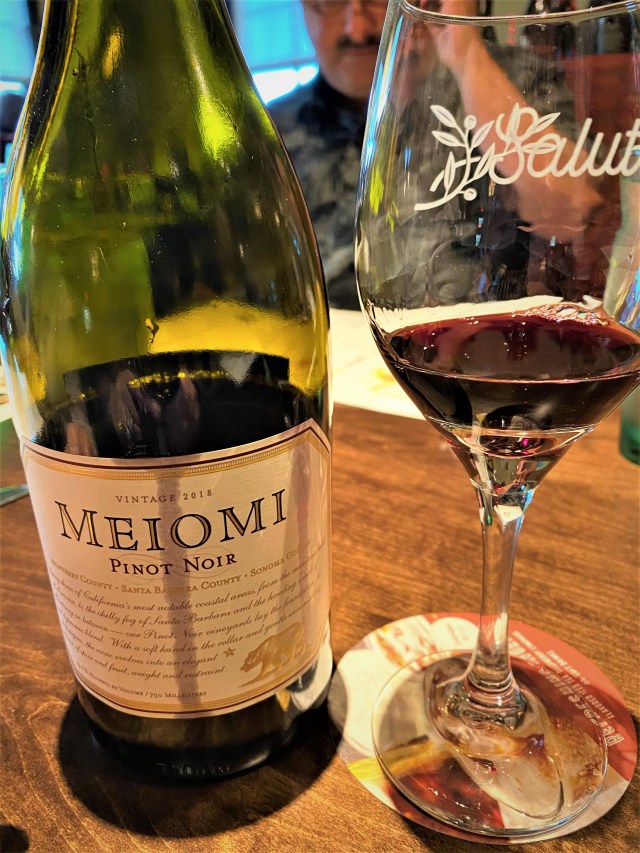
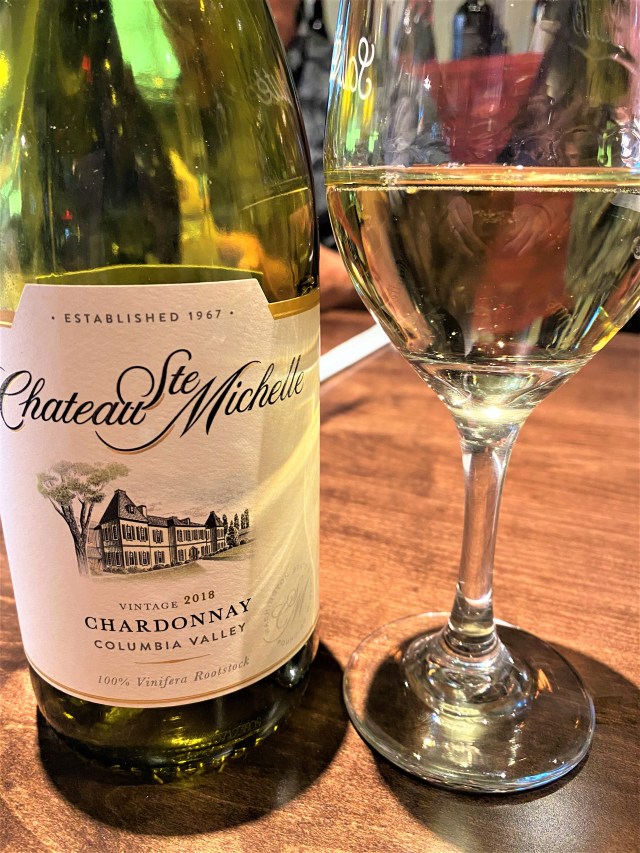
This was the same young man that I had given a lesson of using a Waiter’s Cork Screw on a Zoom session and he was still nervous.  Though he did come by as our waiter and offer us a glass of complimentary wine, and it was so good, that we ordered a bottle for the table, but the wine had a screw cap, so we had to order a second bottle and we found a bottle that had a cork, and one of the bartenders was giving him a “hands on” lesson on using the cork screw.  Then I gave him a quick lesson in wine service about the cork and finding out who will do the taste of the newly opened wine; with a screw cap there is way less pomp and circumstance.  The wine with the cork was Chateau Ste. Michelle Chardonnay Columbia Valley 2018.  Chateau Ste. Michelle is the oldest and one of the most prestigious wineries in the State of Washington.  They are known for their Cabernet Sauvignon, Merlot and Chardonnay, but are famed for their Riesling.  It was founded as the American Wine Growers in 1954 by the merger of two that companies that followed the repeal of Prohibition; the National Wine Company and the Pomerelle Wine Company.  The National Wine Company had planted Vitis vinifera grapes in the Columbia Valley, and under the consultation of Andre Tchelistcheff they planted even higher quality grapes in 1967.  These were under the name of Ste. Michelle Vintners and the first wines released were Cabernet Sauvignon, Pinot Noir, Semillon and Grenache.  In 1974 in a blind tasting their Riesling came in first place over Germany and California.  In 1976, they changed the name to Chateau Ste. Michelle.  The wine is aged Sur Lie for six months in a mix of French and American Oak, with ten percent new, and then blended with Chardonnay that was aged in tanks, so that there is a blend of crisp and oaky wine combined.  This is always a charming bottle of wine and I think it is very food friendly.  The wine that had a screw cap, that I was unaware of, and the wine that we were offered a free sample of was Meiomi Pinot Noir California 2018.  Later that evening, our nephew mentioned that the wine was the most expensive wine on the carte and he thought we would like it.  Meiomi Wines is a California winery that was founded in 2007 by Joe Wagner, the son of Chuck Wagner of Caymus Vineyards.  The winery started with Pinot Noir, then a Chardonnay and finally a Rosé.  Meiomi means “coast” in the language of the Wappo and Yuki tribes of the region.  The Pinot Noir is a blend of three coastal regions; Sonoma County, Monterey County and Santa Barbara County and hence the California AVA.  Their first vintage of the Pinot Noir was in 2007 and they produced ninety-thousand cases and quickly became one of the most requested wine labels for restaurants.  In 2015, Joe Wagner sold Meiomi Wines to Constellation Brands for $315,000,000, and he stayed on as a consultant for the 2016 and 2017 vintages.  This was the first vintage not overseen by Joe Wagner and the wine was a classic California wine that was jammy and velvety with a good nose and nice finish, that even appealed to our in-laws that are not really red wine drinkers.   Afterwards we helped our nephew with getting the wine bottles into specially designed self-sealing bags, as Michigan several years back started allowing unfinished bottles of wine to go home with the patrons, just like left overs in “doggy bags.”  Though one of the bartenders came by and redid our handiwork, as there was supposed to be a copy of the restaurant receipt in the bag as well, and the bartender realized that the none of the staff, especially the new trainees were taught this, so we helped out again.  We tipped our waiter for a job well done, left with all the leftover food and desserts and went to his parent’s house to play some four-handed cribbage.                                                                                                                                                            

Posted in Dining, Wine | Tagged , , , , , , , , , | Leave a comment

Where Did All These White Whites Come From?

One thing about retirement, all that free time you thought you were going to have, is just not there.  On top of it, I have my Bride home every day, even though she is an essential worker, she is working remote and now we both seem to have less time.  You would think that with the elimination of the rush-hour travel time, she could get more time for herself, because the roads haven’t been fixed, but she just seems to work more.  As for me, I just keep giving myself more projects and some of them have been pretty labor intensive.  It all started because we couldn’t go out for dinner anymore, and I started to raid the cellar; and this seems to be a rather common phenomenon among other wine writers as well.  I finally got the majority of the red wines inventoried and I can also look at a chart and know exactly where the bottle is.

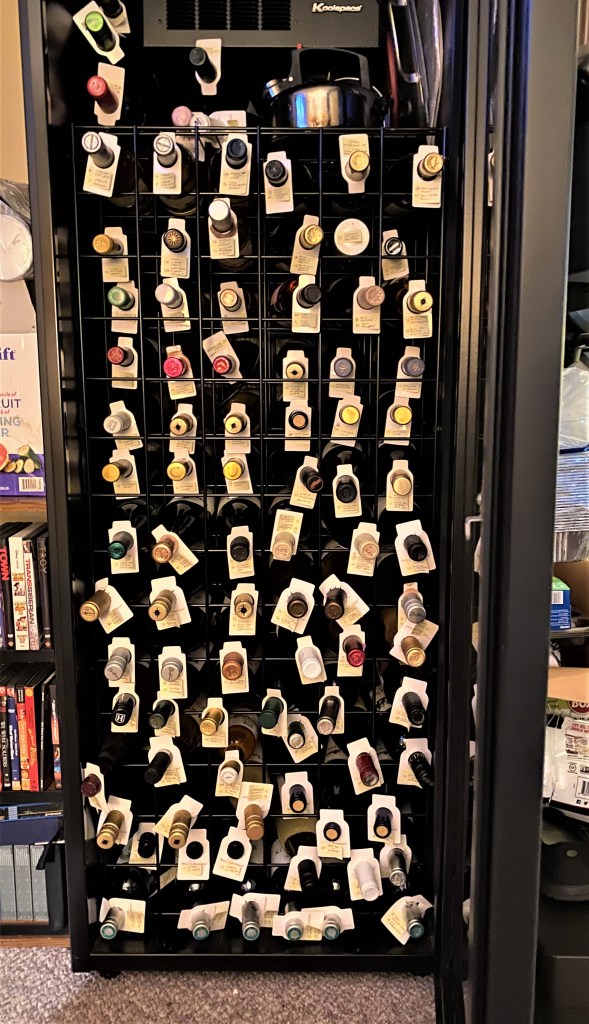
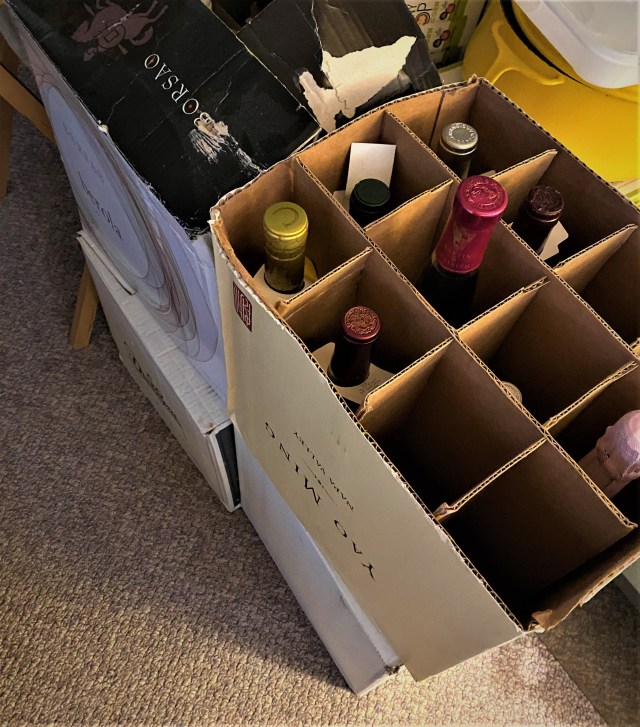
The white wines were placed in cartons to be sorted and I decided to finally make use of the wine vault, we have placed in the family room.  Supposedly, one can get two bottles per wire grid cubicle, but that is not always the case.  Some bottles have little or no punt, the indentation at the bottom of the bottle that can help you pour the wine; so some bottles just barely make it, and then other bottles that have long sloping necks can only get one bottle per cubicle, and I think I looked rather strange to my Bride as I would take two bottles at a time to see if they would fit, before I would make a new wine tag and also enter it on my map of the vault.  Also, some of the bottles are heavier and the circumference of the bottles are larger than the cubicle was designed for, so I had to place them on top of the grid work, and it may not look nice, but it works for me.  I was also going to try to get the wines by grape variety, but that didn’t work out to well, so I am glad that I have a map to help me find the wines.  As a side note, there are still white wines that I found still in a couple of the racks that I have not inventoried as of yet.

I have written some articles about some of the wines that were rescued and were still drinkable twenty years later, which is not as big of a deal for plenty of red wines, but the white wines have been dicey as we have been trying our luck.  In the old days when I was a kid, it seemed that more of the white wines were in colored glass bottles, like amber, blue or green, but it seems that most white wines are now in clear glass bottles.  I am not sure if that is a “green” thing or a “marketing” thing, but lately I have seen a couple of articles attacking clear glass for white wines, but I am not going to make any calls one way or the other.  As I was looking at some of the bottles, I cannot remember their provenance and others make me recall how they were our favorite wines and then another favorite wine usurped their position.  Other wines were placed in the cellar and just forgotten about, and some never had a tag made out for the wine initially.  And some were considered too dear for an occasion and then we acquired other wines that were also too dear and wines were put aside and eventually forgotten about.  I am sure that there will be some more surprises and some sad tales in the ensuing years as I try to get it all in a more logical order, but then there is human nature that may bollix everything up again.   

Posted in Uncategorized | Leave a comment

September 2020 Fine Wine Source Club Offerings

The month is almost over, but to help continuing my birthday celebration are two more wines from my local wine club, The Fine Wine Source of Livonia.  Even though, none of my wine clubs are aware of my birthday, they all added to the inventory in my birthday month.  The wine shop has had some physical changes as they are adapting to all the new regulations, especially if and ever they can really offer wine tastings again, which was a definite part of the charm of the shop.  Some beautiful wood racks have been dismantled and put in storage for the moment to allow for “social distancing,” even though wine tasting is best when it is a social event; as in the more the merrier.  They have been doing their best to keep up with their customers and have been doing a major personal delivery campaign.  Though I guess as a former merchant, I just enjoy the store experience and the comradery with the customers and even the sales representatives that always seem to populate the shop as well. 

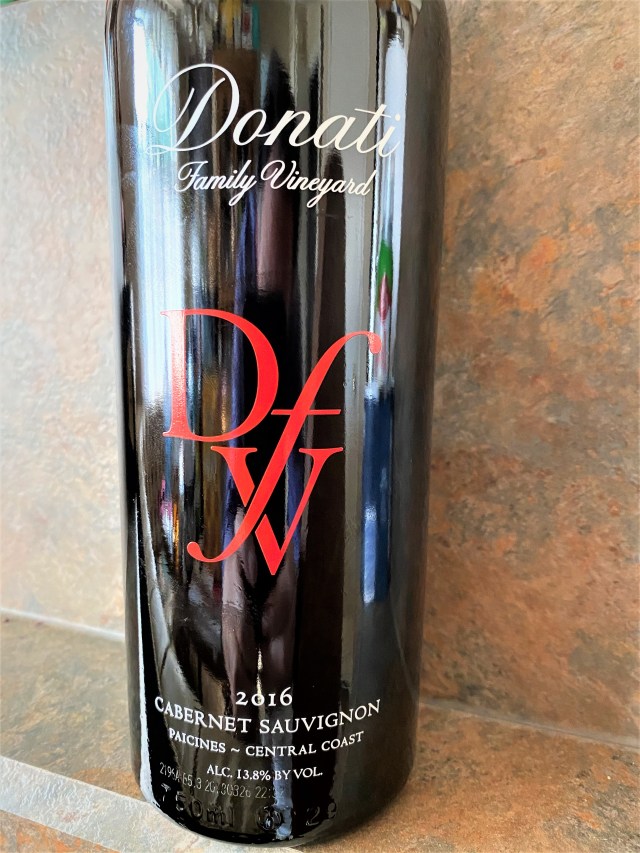
The first wine offered by the club is Donati Family Vineyards Cabernet Sauvignon Paicines AVA 2016.  The Donati family started arriving in the Paicines region of the Central Coast in 1998, when they purchased the land that would become the family estate and vineyard.  Since then they have planted the vineyards and built a state-of-the-art winery.  Paicines is the southern most AVA in the San Benito County and in the 1980’s and 1990’s the area was associated with the production of bulk wines, but a few wineries are attempting to correct that image.  To this day, much of the fruit is grown and then sent to wineries in other parts of California.  It is still home to the five-hundred-acre Vista Verde Vineyard that was previously owned by Almaden Vineyards, before the company was sold and split up in the 1980’s.  The sandy soils of gravel and limestone have forced the vines to develop deep root systems, because of the good drainage and has strengthened the vines.  The wine is ninety-one percent Cabernet Sauvignon with four percent Merlot, four percent Malbec and one percent Petit Verdot.  Initial fermentation was done in Stainless Steel and then it was aged for twenty-one months in a mix of French, American and Russian Oak, with some new in each category.  The wine is said to offer aromas of red fruits, with medium tannins with notes of cedar and mocha, with a long finish that even offers some cranberry notes. 

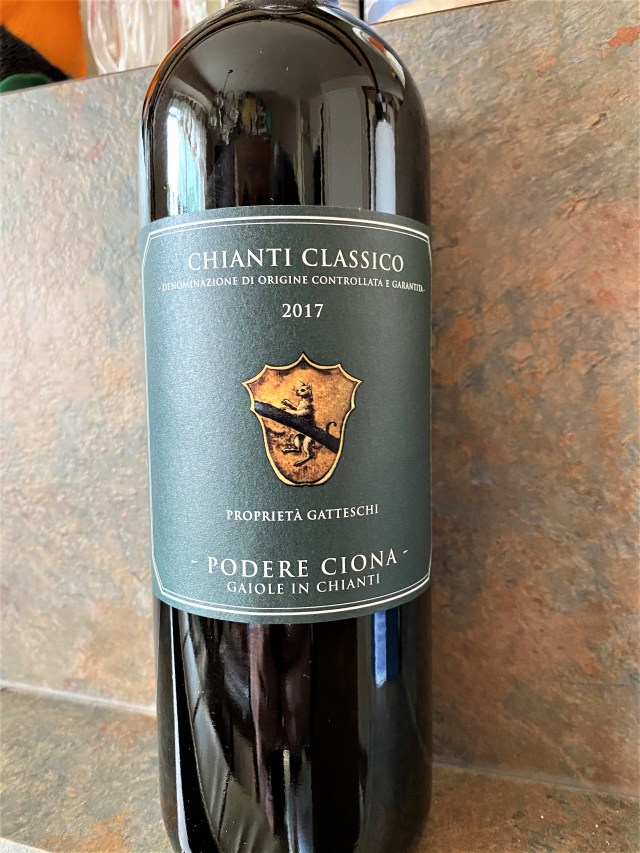
The second wine from the club was Podere Ciona Chianti Classico 2017.  I was reading the history of the winery on their website “Franca and Franco Gatteschi were looking for a place in the countryside to retire to, after many years of working in Italy and abroad, when they came across a small, beautiful, albeit run down property: 100 acres of land, mostly wooded with 10 acres set aside for cultivation, of which 2.5 acres already had vineyards; a house from the 18th Century, abandoned for more than 40 years; and, above all, a view without equal on the Chianti hills, with Siena in the distance.”  It really sounds idyllic and makes one ponder how this property was neglected and ignored for years.  “They purchased the estate at the beginning of 1990 and they immediately started the reconstruction work on the main house (it took nearly three years). They also set up a small but well- equipped wine cellar for making wine. In 1996 they permanently moved to live on the estate and the following year, the great 1997 vintage, saw the birth of the first “official” wine of Podere Ciona: A Chianti Classico DOCG Riserva.” The winery is in the Chianti Classico region Gaiole in Chianti which allows them to feature the famous Gallo Negro or Black Rooster, one of the earliest area recognition labels in Italy. This is the winery’s basic Chianti wine and they still maintain their desire to only produce one bottle of wine per vine.  The wine is eighty-nine percent Sangiovese, nine percent Merlot and two percent Alicante Bouschet.  They still maintain hand harvesting and initial fermentation is in Stainless Steel and then aged in French Oak.  The wine is described as a classic Chianti with red fruit notes and a velvety texture from the Merlot.  I have had their Chianti Classico Riserva, as well as some of their other wines, so I know that this will be a nice choice with a dinner.

Posted in Wine | Tagged , , , , , , , , , , | Leave a comment

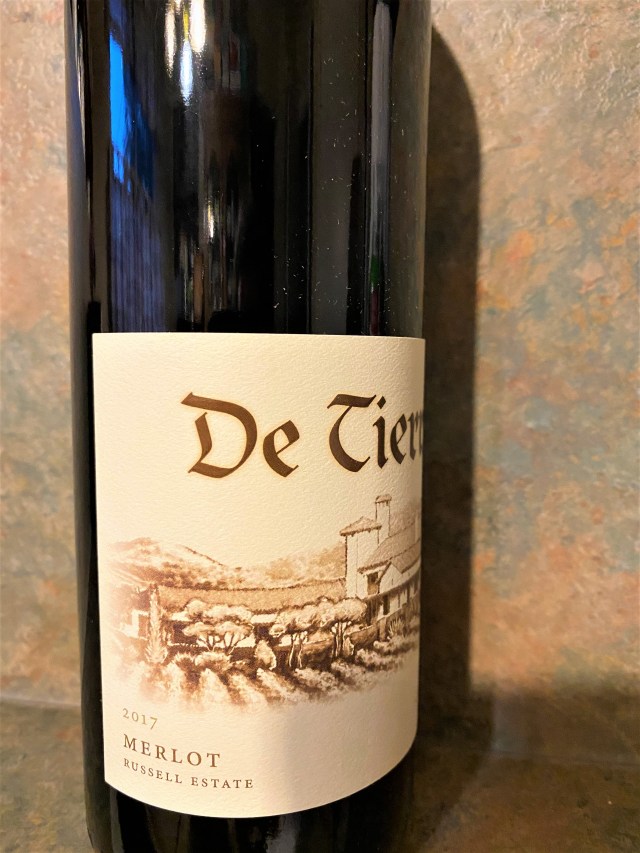
De Tierra Russell Estate Merlot

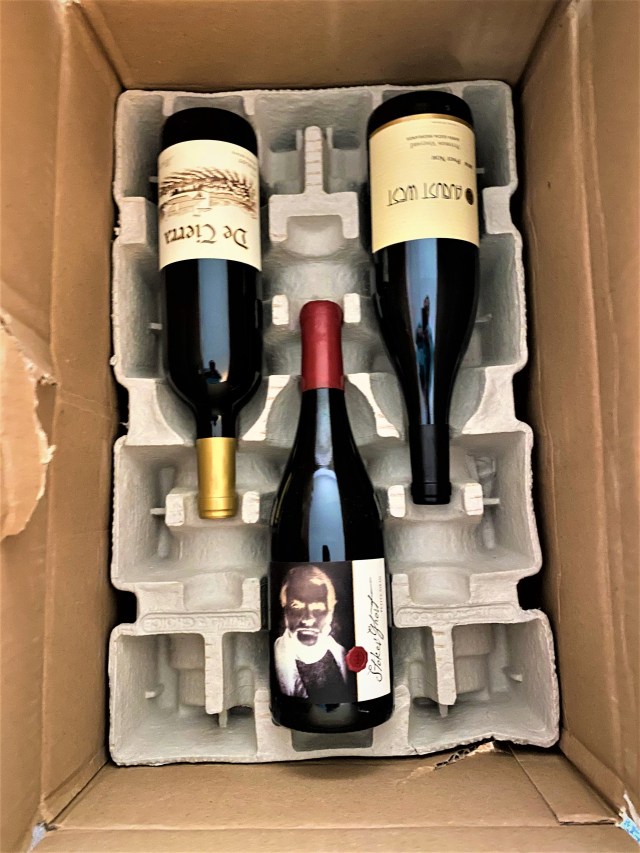
I am going to write about the third bottle of wine from the September shipment from “A Taste of Monterey.”  This was our first wine club that we ever joined and it has to be around eighteen years from that first day when we entered into their shop and tasting room.  So that means roughly two-hundred-sixteen bottles of wine have been delivered to us, and it was very exciting for us to find out that they were legally able to ship the wines to us in Michigan, because at that time Michigan was considered a felony state and one of the past governors was sued in a legendary court case for wine drinkers and she lost, which benefitted all wine drinkers in the state.  So, we have been enjoying the wines from Monterey County for some time, and it was all by accident, because we were having lunch at the famed Sardine Factory in the Cannery Row district in the city of Monterey.  We also bought a major piece of art that is featured in our living room, front and center; so that trip was rather monumental for us, in many ways.

Monterey County is a relative newcomer according the AVA as it was only awarded status in 1984.  It is a long and narrow region that follows the Salinas River, and the area was immortalized in the writings of John Steinbeck long before wine was a genuine crop for the area.  De Tierra Vineyards began in 1998 as an organic grape growing operation by Tom Russel, an agriculture professional from Phoenix, Arizona.  He had transitioned his crops from conventional vegetable operations to organic farming in the 1990’s.   He was very successful and tried his approach to winemaking in the Salinas Valley and he teamed up with Lucio Gomiero of Italy and they developed a forty-acre farm and De Tierra Vineyards was established.  The vineyard is now owned by Dan McDonnal and Alix Lynn Bosch and they strive to maintain the name which translates to “of the land.”  They grow eight varietals and they also make three different blends, but some of the fruit is sourced beyond the estate.  They maintain a tasting room in Carmel-by-the-Sea.

Over the years we have received many different wines from this winery and we are looking forward to opening the De Tierra Vineyards Russell Estate Merlot Monterey 2017.  Maybe I am more excited of the two of us, because I have always had a love for Merlot, since my days as a student, because the Merlot based wines of the Bordeaux region were more affordable for the most part compared to the Cabernet Sauvignon based wines, they were also more delicate if that is word that I will use, but back in the day, because the wines were softer, they were referred to as the feminine wines of the region.  Even after that movie Sideways, I still was a strong defender of Merlot, right, wrong or indifferent. The Russell Estate Vineyard is located deep in the Corral de Tierra at the foot of Mount Toro, between the Santa Lucia Highlands and the Carmel Valley in Monterey County; “the pastures of heaven” penned by Steinbeck.  There are five varietals grown on the estate and they are one hundred percent organic and sustainable practices in the farming and husbandry of the land.  The vineyard is run entirely on solar energy and hand farming practices are used whenever practical and possible.  There was no information on the fermentation of the wine, but there were tasting notes.  “Bright aromas of pomegranate, raspberry and orange rind meet with lively pinches of wild, dewy herbs and the hint of green peppercorns on the nose of this bottling.  The palate offers ripe cherry alongside the snappier cranberry flavors, with herbs and strong acidity throughout.” There suggested aging potential is six to eight years.  I am never sure when I may get a strong desire to try a new Merlot, but it does seem to go in cycles and I will write about it, and I am sure that I won’t use their descriptors, but it works for them. 

Posted in Wine | Tagged , , , , , | Leave a comment

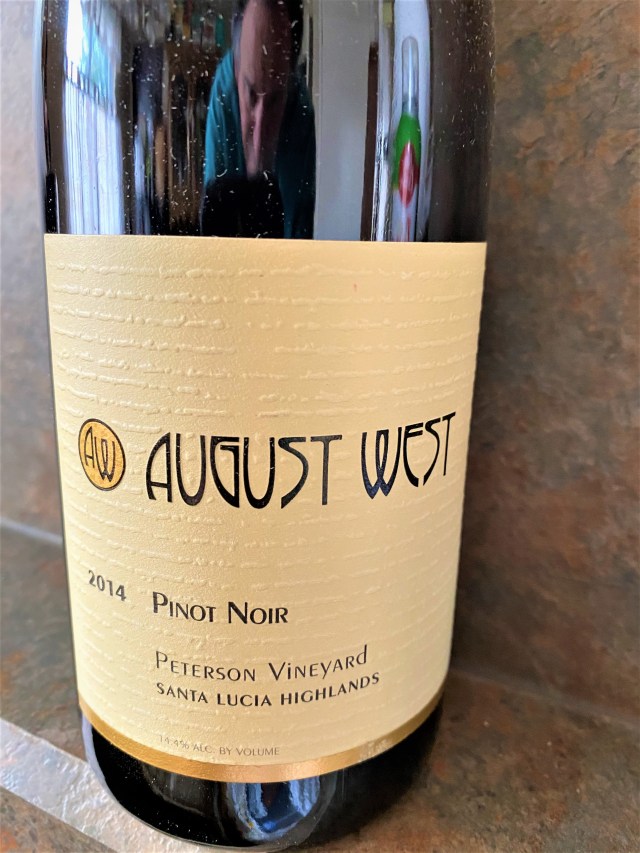
August West Pinot Noir SLH

The joys of receiving wines through a wine club, is that one never knows what to expect, and it might not be what one was thinking about.   The second bottle of wine that I unpacked from “A Taste of Monterey” would have made my ears perk up and piqued my curiosity.  A Pinot Noir wine from the Santa Lucia Highlands in Monterey County definitely would make me happy.  It is just always interesting to find out about a wine, especially from a new winery, and trust me, there are plenty of wineries that are new to me. 

August West Wine produces Pinot Noir, Chardonnay and Syrah wines from their partner’s vineyards at their winery in San Francisco.  Wines are typically released in January, April and September of each year, and one must be on their allocation list, normally to get the new wines.  One of their partners is the Graham Family Vineyard in the Russian River Valley appellation, in the sub-appellation of Green Valley and the vineyard was founded in 2001 by Howard Graham.  John Peterson is their second partner and he owns two distinct vineyards in the Santa Lucia Highlands.  Cortada Alta and is the highest vineyard in the appellation and was planted in 2014.

August West Wine Peterson Vineyard Pinot Noir Santa Lucia Highlands 2014 exemplifies the fruit from John Peterson’s first vineyard started in 2010.  It is just shy of ten acres located in the heart of the Santa Lucia Highlands.  2014 was a very tricky year as California was in the midst of its third year of drought.  Part of the vineyard was trimmed by deer who because of the draught discovered the vines as they were near the Salinas River.  The crop ended up sixty percent down from 2012 and 2013, but quality of the vintage was still the same.  The fruit was destemmed for fermentation and then aged for eleven months in French Oak, of which sixty-seven percent was new.  The wine is said to offer the classic appeal of Pinot Noir from the appellation and with all of the new oak, there will be extra “toastiness” and spice to savor.  There were one-hundred-forty-six cases of wine produced and six to eight years of aging potential.  This is definitely a wine that I would not have encountered on my own.  

Posted in Wine | Tagged , , , , , , | Leave a comment