Martin Estate Collector’s Reserve

Alas, fear not as The Wine Raconteur and The Wine Raconteur, Jr. were doing a yeoman’s job with all of the tastings at the Fine Wine Source in Livonia, Michigan. We were amassing our own personal shopping lists of wines to take with us, but there was still more work to be done.  Wine tasting can be a solitary task, but it is much more interesting with a friend. The geography lessons continued as we left the Alexander Valley to go southward to Rutherford, one of the finest sub-appellation AVAs in Napa Valley.

Rutherford AVA is in the heart of Napa winemaking, as it is located between St. Helena and Oakville. It is named after Thomas Lewis Rutherford, who married Elizabeth Yount, the granddaughter of Napa’s pioneering winemaker and vigneron George C. Yount (as in Yountville). Cabernet Sauvignon is the variety that is planted the most in Rutherford and then followed by the other four grapes when wanting a rich Bordeaux blend; Merlot, Malbec, Cabernet Franc and Petit Verdot.  While reds dominate there is some interest in Chardonnay and Sauvignon Blanc as well. Rutherford’s vineyards are on the flatlands of the valley and they receive excellent sunshine, but is also blessed with a cool, damp morning fog that keeps the grapes from overheating and lets them acquire the complexity and balance acidity necessary for great winemaking. Deep, well-drained sandy loam soils is the signature for most of Rutherford, except for clay soil found closer to the banks of the Napa River and Conn Creek.

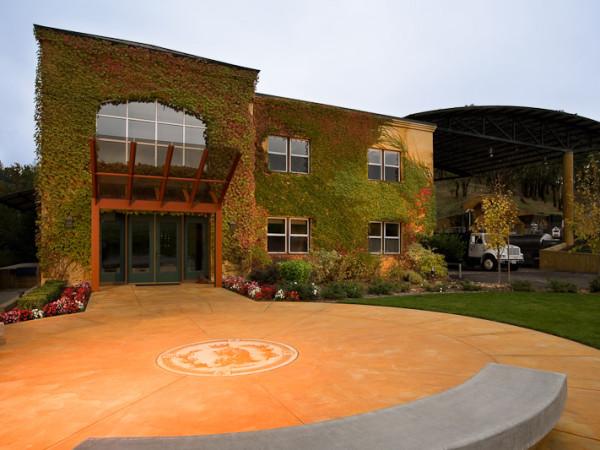
The history of Martin Estate goes back to 1836 when the Mexican Government deeds twelve-thousand acres of Napa Valley land to Captain George C. Yount, this was known as the Caymus Grant.  Henry Harrison Harris arrives with his family from Missouri and in 1870 purchases over one-hundred acres from the estate of the late Captain. In 1887 he breaks ground for his wine cellar in Block B of the original Caymus Grant, which is the heart of Rutherford. The winery began yielding two-hundred-thousand gallons of wine, and Harris retires around 1909 and leases the vineyards to his French neighbor Georges de Latour.  Prohibition ended the production of most of the wineries and in 1941, Douglas Pringle purchases the estate and then deeds it to his wife, who renames the estate Puerta Dorada and turns the estate into an elegant country chateau. In 1996, Greg and Petra Martin discovered the forgotten estate and purchase it for their daughter and the untouched land around the chateau becomes Puerta Dorada.  In 2002, a small artisanal limited production winery is completed, and after 115 years of dormancy, the H.H. Harris Wine Cellar became Martin Estate and they had their first vintage of Estate grown, produced and bottled Cabernet Sauvignon.

Martin Estate Cabernet Sauvignon Collector’s Reserve Rutherford 2015 is one of the oldest historic estates in Napa Valley, hidden by ancient valley oaks and a mystery to most, including its location. Privately owned, the property has twelve acres planted in 1996 with seventeen-thousand tightly spaced vines of Cabernet Sauvignon, Petit Verdot and Cabernet Franc, utilizing the expertise of their neighbor Chuck Wagner of Caymus Vineyards for selection of the vines and the oversee the development.  It was the first time the land around the chateau was ever planted, and they maintain their own in-house team for the now mature twenty-year-old vines.  Each grape cluster is handpicked and then hand sorted berry by berry. This is a state-of-the-art winery with French cement Nomblot tanks, Le Jeune fermenters, Radoux oak fermentation tanks, an Italian made basket press for gentle extraction of grape juice, and an assortment of French Oak barrels from assorted cooperages.  This wine was aged for nineteen months. Opulence is the word that comes to mind, as this wine surpassed most California Cabernet Sauvignon wines that I have had in fifty years. At five years of age this wine, even poured using a Coravin system was offering complex layers for the three sensory perceptions needing to really enjoy wines. It was the perfect way to end the red wines from our private tasting.  I noticed that Martin Estate wines are available by allocation, but the Fine Wine Source had plenty of wooden six packs tucked away, as well as individual bottles on the shelves.    

Posted in Wine | Tagged , , , , , | 2 Comments

Lancaster Estate Cabernet Sauvignon

It was a great wine tasting at the Fine Wine Source and it was still going strong for both The Wine Raconteur, Jr. and myself.  We had already had nine different wines from Burgundy, Bordeaux and St. Helena.  It was a great learning experience and we both knew that we were going to be leaving with some wonderful wines and there was still more awaiting for us.

Our next destination that our tasting was taking us to was Alexander Valley in California’s Sonoma County. Alexander Valley is considered one of the warmest parts of the County as it goes from the Russian River to the foothills of the Mayacamas mountains, which separate Sonoma from Napa.  The twenty mile stretch basically covers the benchlands and the gravel soil is the perfect area for Cabernet Sauvignon.  The region is known for the warm days and fog cover which helps the grapes retain acidity, a basic quality for fine wines.  The gravely soil, makes the vines work harder to achieve hydration, the plant is stressed and grows less energy-sapping leaves and creates thick-skinned berries with concentrated flavor. If you have ever had the chance to taste wine grapes at harvest time, you will fully appreciate the concentration of taste and sugar.  Alexander Valley has attracted some of the giants of the wine industry, as well as small artisanal winemakers as well.  Along with Cabernet Sauvignon, the Alexander Valley is known for Merlot, Cabernet Franc, Chardonnay, Sauvignon Blanc and Zinfandel.

Lancaster Estate Cabernet Sauvignon Alexander Valley 2016 is from a winery that was founded in 1995. The estate has fifty-three acres of vineyards on grounds that are very similar to terroir of the Medoc and hence the winery only grows Cabernet Sauvignon, Malbec, Merlot, Petit Verdot and Cabernet Franc; and eighty-three percent is planted with Cabernet Sauvignon. They even use satellite tracking for all of the plots throughout the growing season. The grapes are hand sorted and de-stemmed to be prepared for the crush and since the winery is located in the center of the vineyards, there is usually less than one hour from harvest to fermentation tanks; and each block or plot is done separately.  The grapes are cold soaked with skins for several days in Stainless Steel, and through maceration they only use native wild yeasts to ferment the wines and to maintain the terroir of the wine.  Then each separate lot is pumped to its own French Oak barrels to begin the aging process in their wine caves.  The wines are aged from eighteen to twenty-six months sur lie, in a mix of varied coopered barrels, seventy-eighty percent of the barrels are new each year, and they add one or two new cooperages each year as well.  The wine is hand stirred in the barrels once a week to lift the lees, for the first year, then after the racking is done without raising the lees.  The wines are bottled unfiltered to maintain the purity of expression.  Dark fruits and some floral notes enticed the nose, while flavors of dark fruits, leather and spice lead the taste with firm tannins and complexity, even at such a young age and the finish of terroir was long with some heat that I also enjoyed.  This was a beautiful bottle of wine and one that I am glad that I had the chance to try.    

Posted in Wine | Tagged , , , , | Leave a comment

Roberts + Rogers Louer Family Vineyard

With two Raconteurs just finishing off a couple of Classified Growth wines at the Fine Wine Source, one would think that the private tasting was over.  I mean it is pretty hard to surpass some lauded wines of the Medoc and we were both just enjoying the moment.  Even the owner came over to chat about some of the wines, and kibbitzing about wines is the perfect way to spend an hour or two, especially with good friends. I was surprised to look at our printed sheet that we were going to the New World after Saint-Julien we were going to St. Helena.

St. Helena s subregion of Napa Valley that received its AVA in 1995, is historic for its red wines, mostly Cabernet Sauvignon, but also some excellent Merlot.  The town and the district are named after Mount Saint Helena and there are nine-thousand acres of densely packed vineyards including Berringer (one of the oldest continuously operating California winery) and Charles Krug (who is often credited as the “father of Napa Valley.” It is one of the warmest appellations in Napa and it has also produced some excellent Zinfandel and some very interesting Sauvignon Blanc.  Longtime friends Roger Louer and Robert Young decided in 1999 to create a “first-class” Cabernet Sauvignon wine brand with fruit from Howell Mountain from a vineyard jointly developed by the two men.  The first vintage was in 2004, and released in 2007 was for three-hundred cases.  The original and still current winemaker Barry Gnekow described the first vintage as “this wine is so big it will be coming into its own in about thirty years, but is drinkable now.” In 2009, Roger Louer produced the Louer Family Reserve Cabernet from his personal estate and sourced from the areas of his thirty-four-acre estate.  It was released for the first vintage under the Roberts + Rogers Winery label in 2012.

We had the chance to try back-to-back Roberts+ Rogers Winery Cabernet Sauvignon Louer Family Vineyard St. Helena 2015 and 2016.  Then even though it was not one of the listed wines for the tasting, we then also did the 2017 Vintage.  While these wines are considered to be bargain priced for pure Cabernet Sauvignon wines from St. Helena, they really held their own, even after following the Medoc wines. While there is a dearth of actual production notes, just by following the trend from the first wine’s history, I would venture to say that there is at least twelve months if not more aging in oak. The 2016 and 2017 were big, just like one would expect from a Napa Cab, hitting all the right notes.  It was the 2015, which had the toughest position as it followed the wines of the Medoc that totally captured the two Raconteur’s attention, not to mention the shopkeeper who decided to have a little indulgence of it himself.  This black cherry laden wine was not only big, it commanded attention, but it also was so mellow with layers of complexity that I had stars drawn next to this wine, as I knew that I wasn’t going to let it slip away.  My associate in crime, also had the same realization and if I didn’t try the 2015, the other two wines would have caught my attention, but in reality, they came in second neck and neck.

Posted in Wine | Tagged , , , , , | Leave a comment

Happy Easter

Wishing everyone a very Happy Easter this year from our family to you.

Tales of Easter will be forthcoming.

Posted in Uncategorized | 1 Comment

Chateau Branaire-Ducru

The Fine Wine Source did something to The Wine Raconteur and The Wine Raconteur, Jr. that I have never encountered before.  We had tastings from two classified growths from the Commune of Saint-Julien, and to me this is rare, because seldom have I even encountered two different wines from this commune on a wine carte, unless the restaurant has a spectacular cellar (and I have been fortunate to have been in some restaurants like that, but I don’t possess a wallet that would allow me to be that grand).  I say this, only because in my world this is a very rare situation and I was going to make the most of the tasting.

The Commune of Saint-Julien is situated between two other communes that are considered powerhouses of the Medoc, namely Pauillac and Margaux (both of which have First Growth wines).  In the old days, the northern part of Saint-Julien which part of abuts with Chateau Latour were referred to as the masculine half of the commune, because Cabernet Sauvignon was so dominant, while the southern part of the commune was referred to as the feminine half, because the wines were more mellow and Merlot seemed to shine more as the vineyards got closer to Margaux.  There are a few plots that have been delineated as part of Saint-Julien, even though they are found in Cussac-Fort-Medoc and Saint-Laurent-Medoc. Until recently, I only had the fortune to have had five classified growth wines and a few other wines from Saint-Julien.

Chateau Branaire-Ducru Saint-Julien 2010 is a Fourth Growth from the 1855 Classification of the Medoc. The estate was founded by Jean-Baptiste Braneyre in 1680 and realized that Cabernet Sauvignon was the variety for the land, over the years his name on the estate changed in spelling to Branaire.  Patrick Maroteaux, and ex-banker became the current owner of the estate in 1988 and he even increase the vineyard to fifty hectares.  The property at one time was part of Chateau Beychevelle, but was split off in the 17th Century to cover debts of the owners. Under the new ownership the winery underwent a complete renovation and modernization. The wine is Cabernet Sauvignon (usually the highest percentage found in the wines of Saint-Julien) with Merlot, Cabernet Franc and Petit Verdot in the mix and the wine spends eighteen months in oak, and then rests in the bottle after that, before it is released.  On the average, the wines from this chateau are traditionally felt that they needed ten years of cellaring, before they really show their charms. We had a chance to enjoy this wine at its considered prime and even being poured using the Coravin system, this wine was excellent.  The fruit and the tannins had combined into a complex treat that just made me smile and made me reflect on how fortunate I was to enjoy wines like this so early in my life and to let my tastebuds and memory revel in the moment.   

Posted in Wine | Tagged , , , , , , , , | Leave a comment

Chateau Langoa Barton 2009

It was indeed a pleasure doing a tasting with The Wine Raconteur, Jr. with me at the Fine Wine Source in Livonia, Michigan.  My Bride and I have been members of the wine club there, and now so have our dear friends.  I get a different perspective watching him do a wine tasting, but he seems much more focused than I, but then again, maybe I just think that I am more cavalier, as I don’t get a chance to observe myself.  He has also had the experience to absorb the world of wine tasting, since everyone is a sommelier or has interest in being a sommelier or they just want to sound like a sommelier.  Actually, I think that it is very cool, it is just that this old dog really doesn’t want to learn any new tricks and I am quite content speaking from the knowledge that I have acquired over fifty years of tasting and drinking. I think that I can speak for the two of us, that I do think we were having a grand old time.

Chateau Langoa Barton is located in the Medoc and is a famed appellation on its own right, though it is sometimes overlooked, because it is sandwiched between Pauillac and Margaux.  Saint-Julien may not have a First Growth from the 1855 Classification, but it is home to eleven classed growths.  Almost every hectare in the Commune of Saint-Julien is covered with vines except for one strip of land that borders the Gironde. The commune is rather small and there are only two villages located there and they are only two kilometers apart from each other.  Saint-Julien is also bordered at parts by the Commune of Saint-Laurent which carries the appellation of Haut-Medoc, except for a few plots that are allowed Saint-Julien status.  The appellation laws require that the wines carrying Saint-Julien must only be made from Cabernet Sauvignon, Merlot, Cabernet Franc, Carmenere, Petit Verdot and Malbec.  It is the grounds that differentiate Saint-Julien from Pauillac and Margaux, even though vineyards may back up to each other, the taste is enough to entitle the commune to be its own entity.  The wines are historically considered long-lived and very elegant.

Chateau Langoa Barton Saint-Julien 2009 is a Third Growth of the Medoc, and the last time that I had some wine from this estate was from their 1966 vintage.  Hugh Barton was an Anglo-Irish wine merchant who in 1821, purchased Chateau Langoa and a portion of the Leoville estate, which became Chateau Leoville Barton.  The estates have been in the Barton family ever since. While the soils of the two estates are almost identical of gravel over clay soil, and they are managed the same way, with traditional plowing, hand harvesting and fermented plot-by-plot.  The make up is different.  Chateau Langoa Barton is fifty-seven percent Cabernet Sauvignon, thirty-four percent Merlot and nine percent Cabernet Franc on their seventeen hectares.  This vintage was a blend of fifty-four percent Cabernet Sauvignon, thirty-four percent Merlot and twelve percent Cabernet Franc.  I could not find how long the wine was aged, but I did find that they used sixty percent new French Oak for this vintage.  I am sure that I may have had a goofy look on my face as I was admiring this wine, it was just sublime, a classic Saint-Julien with its mellow tannins and dark fruit.  I kind of nursed this glass, a little longer than usual, because the finish was nice and with a very long count.  What a wonderful avocation in my senior years.

Posted in Wine | Tagged , , , , , , , , | Leave a comment

Chateau Maucaillou

There we were two Raconteurs of different eras, enjoying a private tasting at the Fine Wine Source in Livonia, Michigan.  I have to admit, that learning about wines, is much easier today, even in the Detroit area, compared to when I was starting out.  There were few and far between wine shops that had the caliber of wine selection that I now found at my local shop.  I like to still refer to those days as the Dark Days, when if you wanted to learn, you had your job cut out for you.  Back then Detroit was a cocktail or a beer town and only a few restaurants did more than give lip service to wine, but one could persevere, if there was a desire.  The wine I am going to talk about, the last time I had it, was from a vintage forty years earlier.

The wine is from Moulis-en-Medoc, which is a small village in the Haut-Medoc and is definitely overshadowed by its neighbor Margaux, which is how I first encounter wines from this village. The AOC laws are quite strict, especially governing crop density and other agricultural concerns, as well as the grapes must come from six specific parishes.  There are no classified growths, but offer values that will remind one of a nice Margaux wine, as the wines here are usually a mix of Cabernet Sauvignon with Cabernet Franc, Malbec, Carmenere and Petit Verdot.

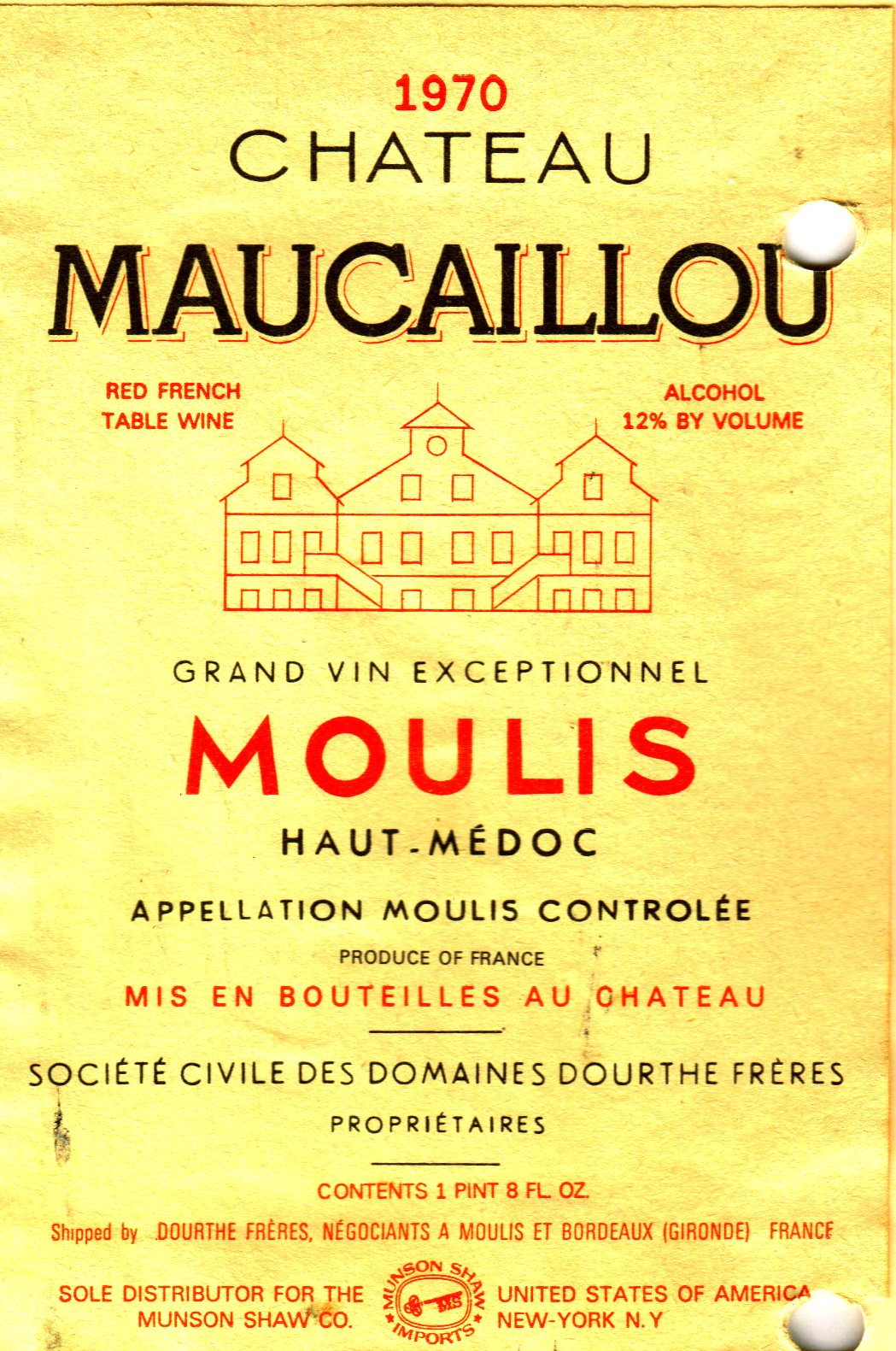
Chateau Maucaillou Moulis 2010 is claimed to have the oldest vineyard in the Medoc with recordings of ownership going back to the 15th Century. Commercially, the history goes back to 1871 when the negocient family Petit-Larouch built cellars there and four years later a chateau. In 1929 the Dourthe family purchased the estate and took the winery from two hectares to eventually thirty-two hectares. The estate is basically ninety percent planted with Cabernet Sauvignon and Merlot and the balance is Petit Verdot and Cabernet Franc. Malolactic fermentation takes place immediately after the initial fermentation while the juice is still in Stainless Steel.  The wines are then aged for eighteen to twenty months in French Oak, of which more than half are new.  The winery also produces several secondary labels to their flagship Chateau Maucaillou.  This was a beautiful and classic glass of Medoc wine, and I am sorry, but that to me, is a great way to describe a wine; that was how I was taught and I will continue to use that as a wonderful descriptor, after all, I am a Street Somm.

Posted in Wine | Tagged , , , , , , , , , | Leave a comment

Claude Dugat Gevrey-Chambertin

The Wine Raconteur and The Wine Raconteur, Jr. were both at the Fine Wine Source doing a special wine tasting.  I was totally intrigued watching him make his quality notes into his iPhone and I am barely able to make phone calls on mine, though I am kind of getting better at using it as a camera.  I was watching my man just typing his notes quicker than I can type on a real keyboard, but it is second nature to the younger generation.  Hell, when I went to school, most boys did not take Typing or Home Economics, just like most girls did not take Wood or Metal Shop, way back in the old days, when they still taught Penmanship, Civics and English.  We had just tasted two different bottles of Gamay wine and the third wine was a name that is famous in Burgundy, and as a side note, there was a famous restaurant in my youth called The Chambertin.

Delving into Burgundy (Bourgogne) is a bit more daunting compared to Bordeaux.  Gevrey-Chambertin is a perfect example of just looking at the tip of the iceberg, as the old saying goes. The village was originally known as Gevrey, but in 1847 the local parish allowed the village to append their most famous, even back then “Le Chambertin” and the village became Gevrey-Chambertin; almost immediately, some of the other villages followed suit and appended their local famous vineyard, and that explains why so many of the villages are hyphenated. Gevrey-Chambertin, which is located in the Cotes de Nuit district, is home to nine Grand Cru vineyards and eight of them have appended “Chambertin” to their name, and the village has the most Grand Crus of any village in Burgundy. Then once you have learned the nine Grand Crus, you then have to realize that there are twenty-six Premier Crus, and one can occasionally witness arguments among some of the more passionate, that some Premier Crus should be elevated to Grand Cru status.  I usually just sit back, sip my wine and observe and listen, and do not attempt to add my two cents. There are about four-hundred-fifty hectares in Gevrey-Chambertin, fifty-five hectares are Grand Cru, eighty-four hectares are Premier Cru and the balance are listed as “village wines.”  Even the village wines get to glow and bask in the sunshine for being part of the “King of Burgundy.”

Claude Dugat Gevrey-Chambertin 2018 is one of the seven wines, all produced using Pinot Noir from this producer. The Domaine was founded in 1955, when Maurice Dugat purchased the Grange de Dimes, a 13th Century structure that had been used to store agricultural tithes for the church, and he converted it to a winery and cellar.  He renamed it the Cellier des Dimes and it is the background on his wine label. I also took the liberty and found a photo on the web of the building. The Domaine is small, as he owns half of its holdings and leases the rest. Claude Dugat runs the Domaine with his family, and his three children run a small negociant business La Gibryotte.  This Domaine should not be confused with his cousin Bernard Dugat who is well regarded and owns Domaine Dugat-Py. The initial process for all his wines begins with complete destemming and fermentation begins relatively quickly.  The cap is punched down twice a day with very little to no pumping during this process. The “village wine” is aged in a mix of new and one-year-old casks. As for the taste, I had forgotten how special and wonderful a classic Burgundy can be.  I have been drinking so many special New World Pinot Noir wines that I was just in awe of this wine, it has been far too long since I had a wine like this and all I could think while I was tasting this, was that I might not be worthy to try his three Grand Cru and two Premier Cru wines, but if I had a chance, I definitely would.

Posted in Wine | Tagged , , , , , , | Leave a comment

Two Gamay Wines

I hardly need any prodding to go to my wine local shop, The Fine Wine Source, but I had promised that I would come back for a real tasting, and they asked if I could bring someone else, since my Bride could not attend.  I called my trusty friend The Wine Raconteur, Jr. (a name that he gave himself) and asked him, if he would like to attend with me.  He answered in the affirmative, though we had to arrange it between times that his Bride and his daughter both wouldn’t need his expertise. We drove up separately and the tasting did take a little longer, as they kept finding some additional wines for us to try, and of course we both left with a cardboard carton to carry our choices with.

The first two wines that we tried were made from the Gamay variety, and neither one was a Beaujolais, the wine that immediately comes to mind when Gamay is mentioned.  The same Beaujolais and Beaujolais Nouveau that became the marketer’s dream in the Seventies to the Nineties.  I remember once attending a restaurant that had a barrel flown in, and the barrel could not be tapped until a certain time; it was a fun evening. While Gamay is thought of, as a French grape, it is believed to have originally come from one of the old Germanic States in the 14th Century.  The Dukes of Burgundy were so unenthused that they tried to outlaw the grape from being grown, because it was so different from the grapes that had brought Burgundy fame, even back then.  They eventually kind of banished the grape to the granite soils just north of Lyon, and that terroir was perfect for Gamay.  There are ten villages or Crus in Beaujolais that do an excellent job with Gamay, as well as some parts of the Maconnais.  The grape also is found in the Upper Loire, Switzerland, some of the former Balkan nations and then has done well in some parts of the New World as well.

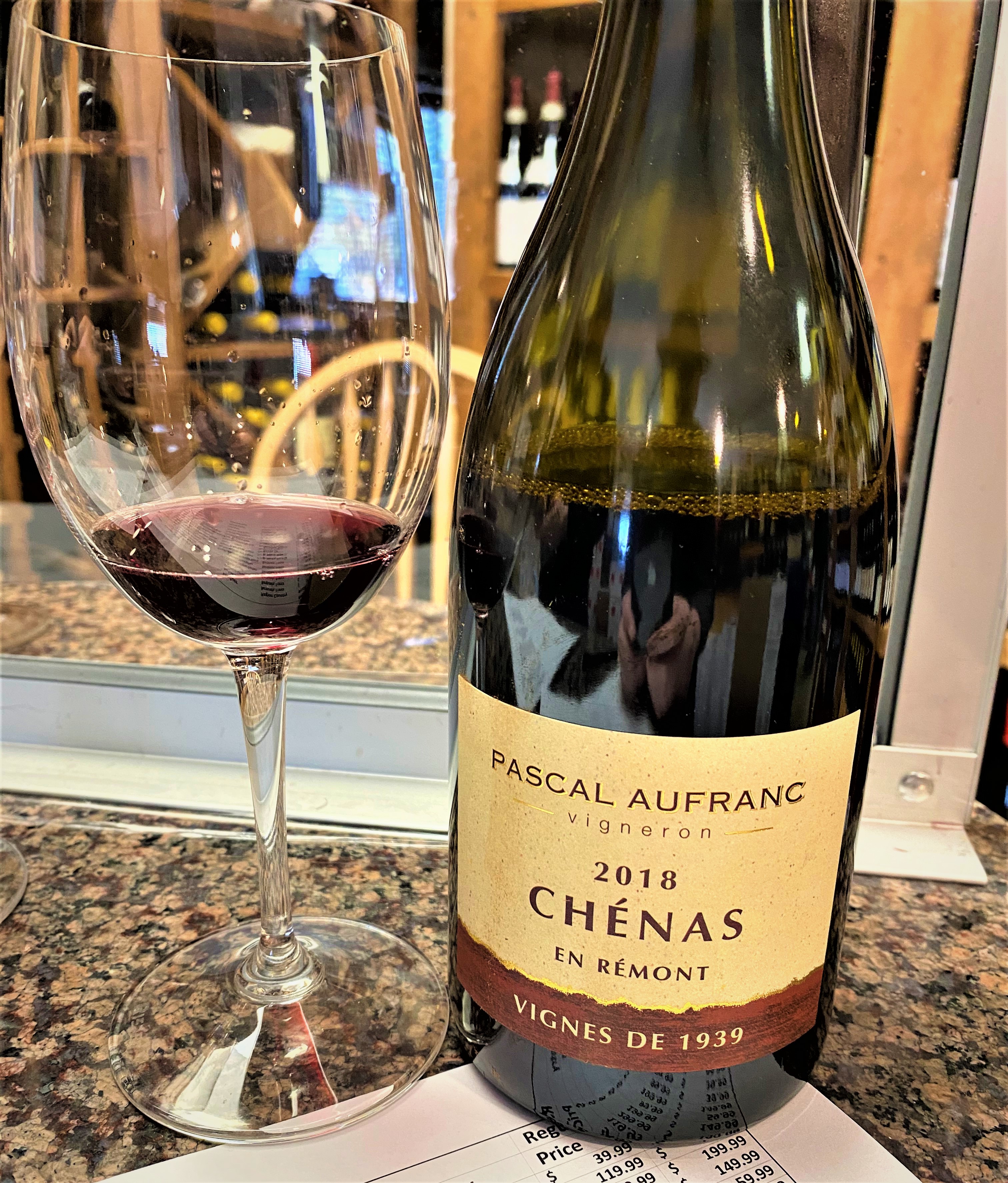
Our first wine was Domaine Pascal Aufranc Chenas Vignes de 1939 2019 from the Terroirs Originels group.  Terroirs Originels unites artisan winemakers to allow them to make their estate made wine from South Burgundy (Cote Beaujolais and Cote Maconnais) and use one central warehouse for sales, logistics, marketing etc. that may prevent a small vigneron from fulfilling his dream of his own winery and they have been doing it for about twenty years.  Pascal Aufranc vineyard “En Remont” is a secluded vineyard at the end of a path and surrounded by woods and fields. Chenas is one of the Crus of Beaujolais, established in 1936, and this vineyard “En Remont” which is less than four acres contains seventy-year-old vines that are grown in a soil of sand, granite and quartz. The wine starts with eight to ten days of maceration with whole clusters, and the juice is then aged for eight months in concrete vats on fine lees with light filtration. There were six-hundred-fifteen cases produced of the wine. A big red garnet colored wine offering red fruit and some spices like cinnamon and a nice finish highlighting the soft tannins and terroir.

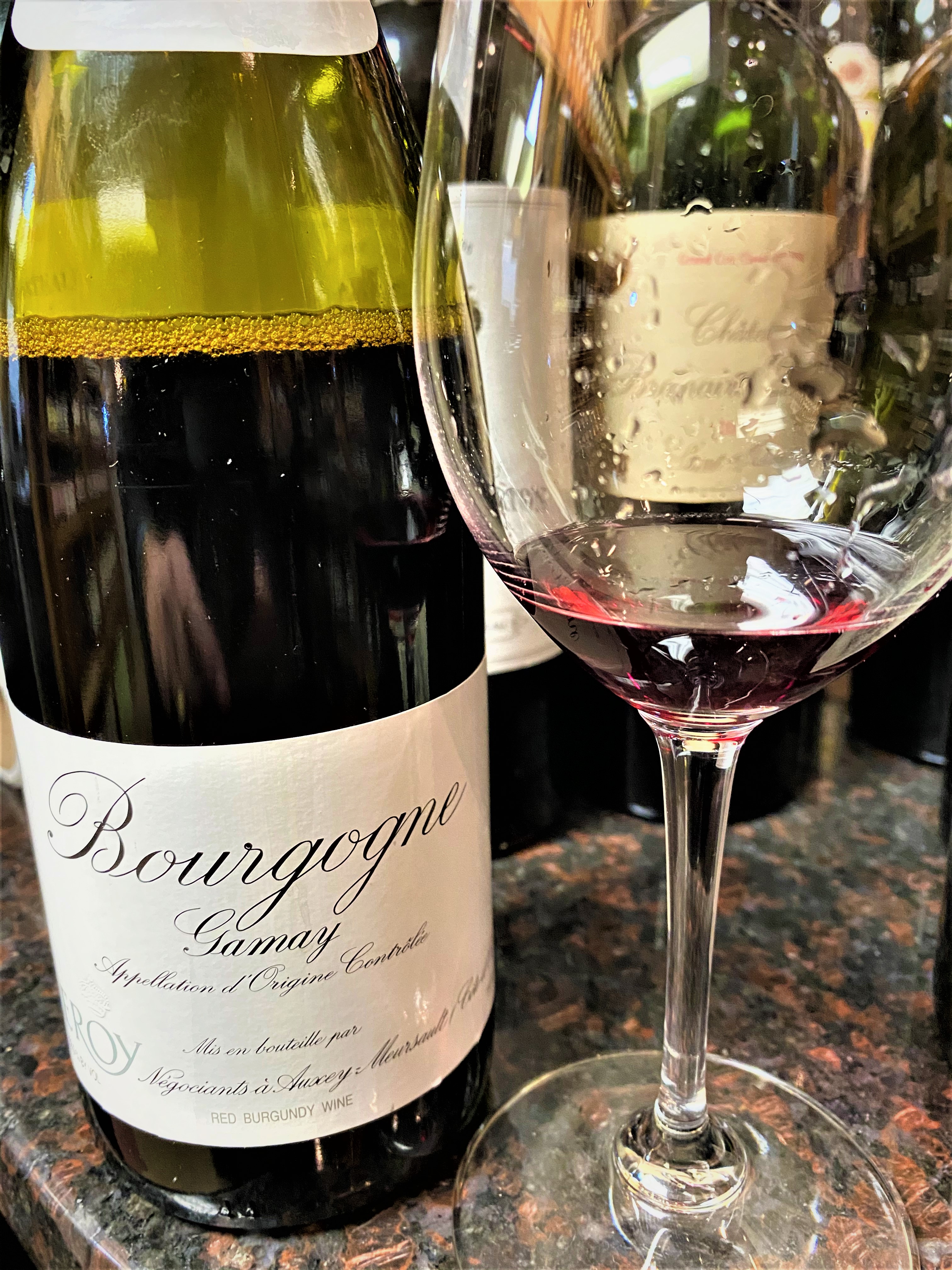
Maison Leroy Bourgogne Gamay 2019 was our second wine that was pure Gamay. Domaine Leroy is both a negociant and a wine producer based in the Cote de Nuits and offers wines from basic representation to some of the most iconic vineyards in the world, second only to Domaine de la Romanée-Conti. The Domaine was founded by Francois Leroy, a wine merchant in 1868 and his heirs have been with the company ever since and involved with the affairs of the Burgundy region. Maison Leroy is used for all non-estate wines, those that are from the negociant side of the business, but still under their watchful eye. This wine was a lighter Gamay wine both in color and in taste and body, a more understated and reserved finish, not the red cherry and strawberry notes that most people associate with Gamay.  A very interesting glass of wine.

Posted in Wine | Tagged , , , , , , , , , , , | Leave a comment

Chateau La Croizille SEGC 1983

Once in a while, out of a clear blue sky, we get really fancy and it is just the two of us.  My Bride has been working daily, in fact she never missed a beat, because she is considered an essential worker.  Of course, she has a job, that makes her a road-warrior, but that has more or less ended in the last year, and I think that may be the hardest part of her acclimating to her new work environment.  She has taken over the library with all of her computers, monitors, telephones and printers.  It looks like another year, of her not physically touching base with her clients in the Upper Peninsula and that was a trip that she really enjoyed.  The good news, is that there may be a real Board Meeting that will be held in the fall, we shall see.

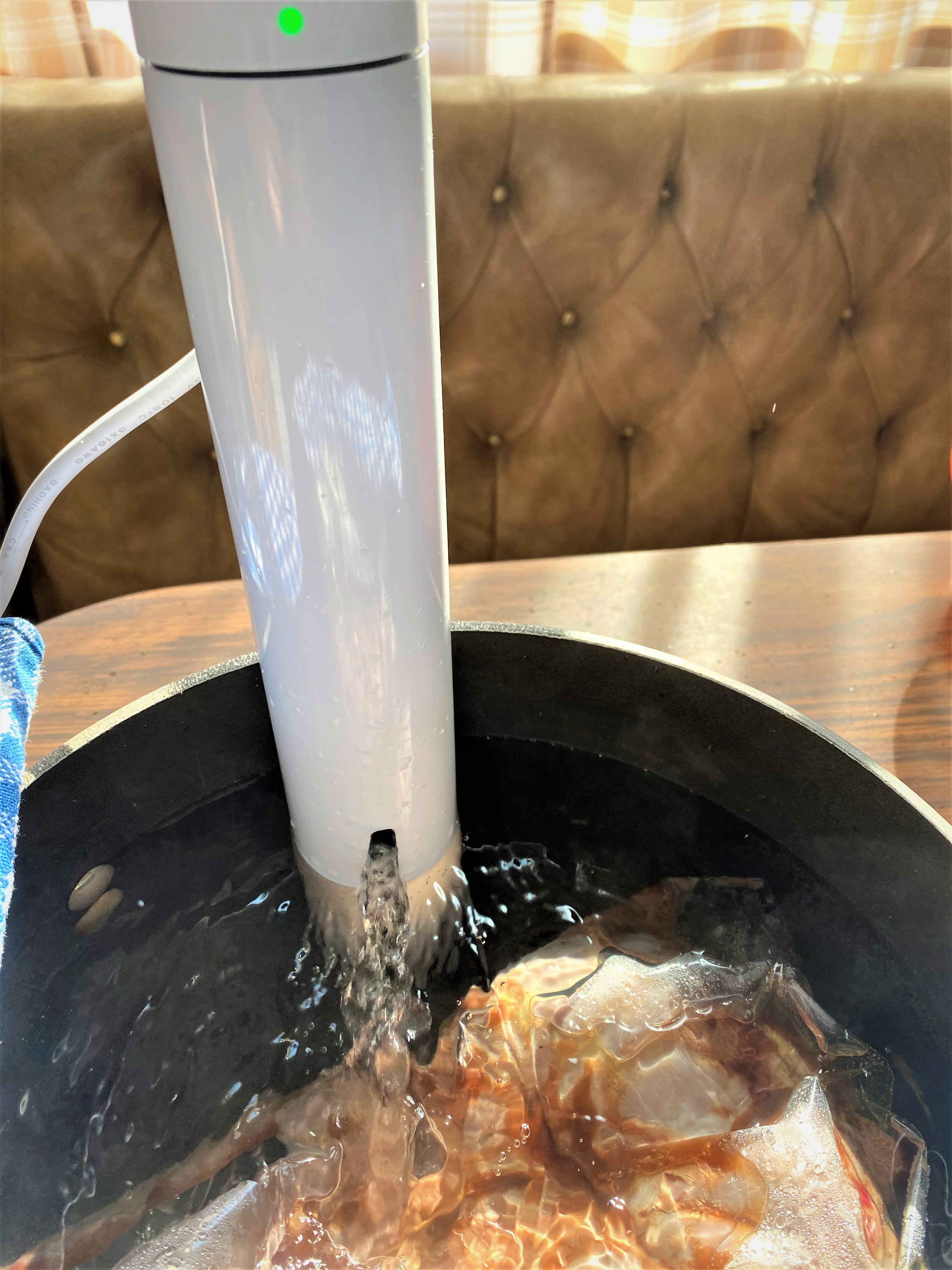
The reason that I said that we were getting fancy, is that she wanted to practice again using her Joule Sous Vide immersion circulator.  The concept is low temperature cooking where the food is placed in a plastic pouch or glass jar and cooked in a water bath for a long period of time to get the meat at the proper temperature and then it is finished using the broiler or a pan.  It was a bit frustrating, because the unit is controlled by a cellular phone, and at first, it wasn’t connecting properly, even after reloading the app and making sure the Bluetooth was set.  I suggested that perhaps she should do a hard close on her phone and then turn it back on, and we were finally in business.  We were going to have Filet Mignon medallions at Medium Rare setting with no guess work.  She took a cooking pouch and made a marinade and the meat had to cook for almost five hours according to the controls that were now on her phone.  She also decided on making a version of Israeli Couscous with mixed vegetables.

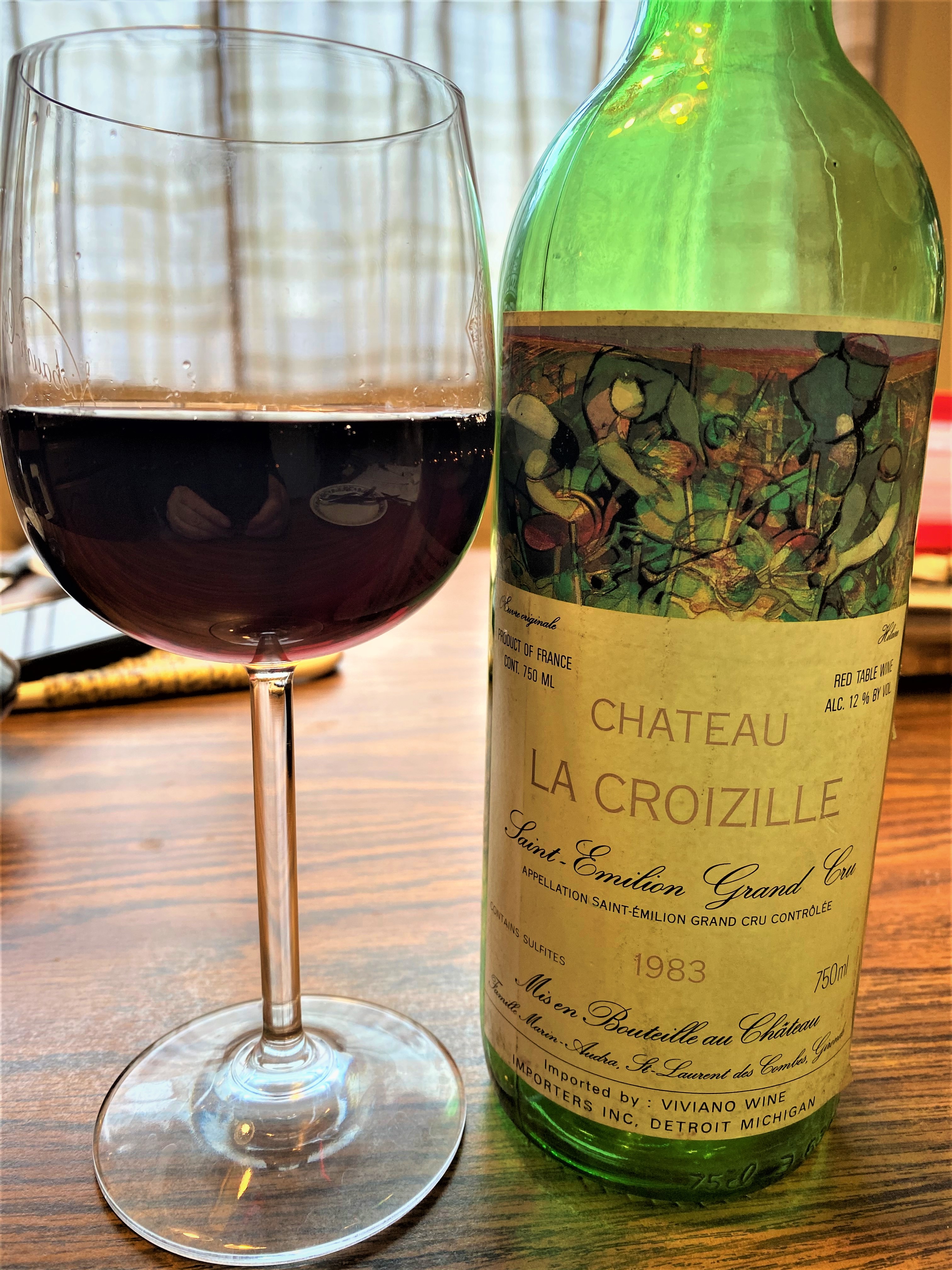
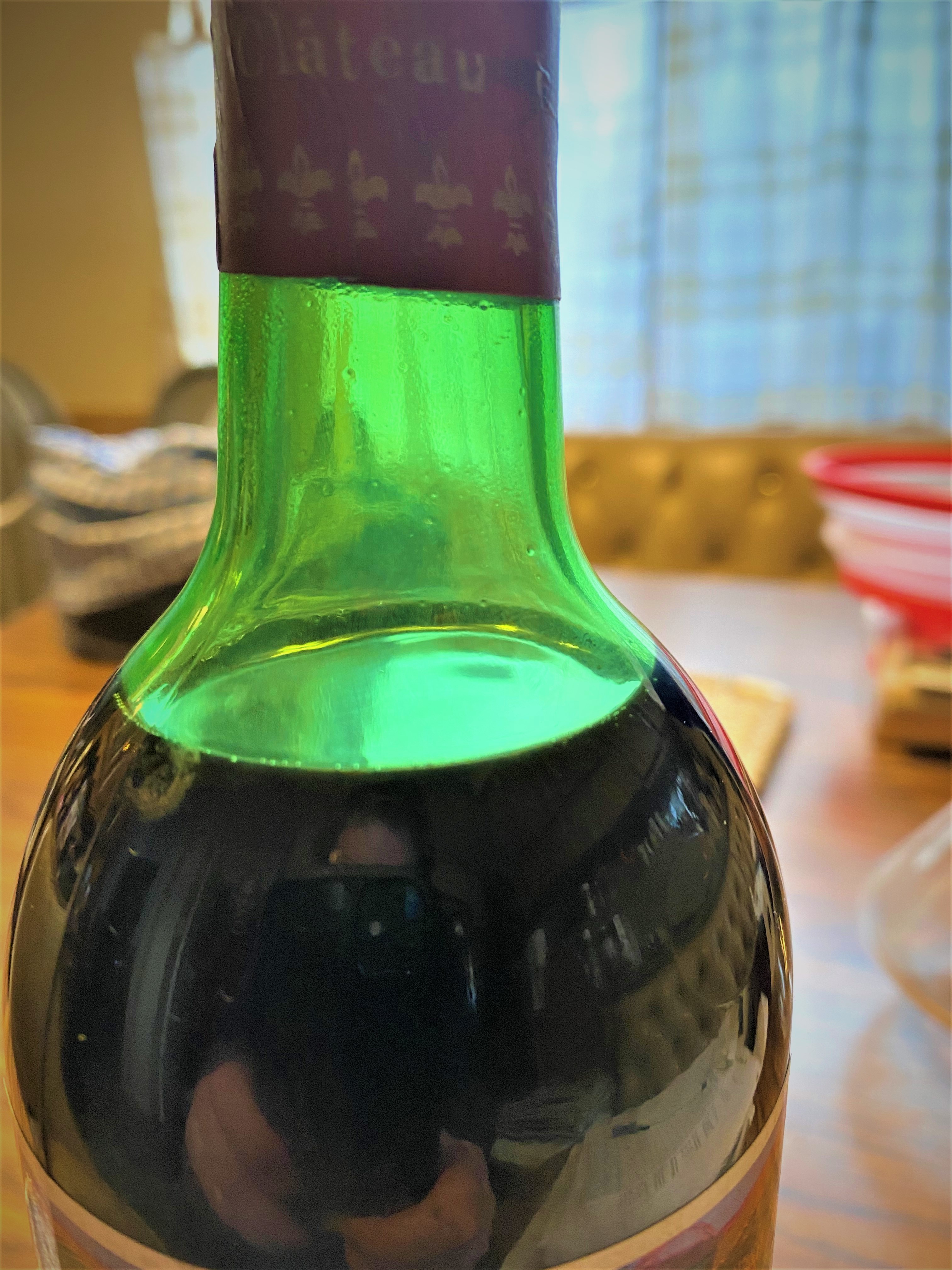
I decided to go down to the cellar and find something interesting for the filets.  I found a bottle of Chateau La Croizille Saint-Emilion Grand Cru 1983.  My thoughts were that this forgotten bottle should be opened up, to see if we had neglected it for too long, since I knew that we had plenty of back-up options.  The other thing that I immediately noticed was that there was still a price tag, the price had been scraped away, but the price tag was from the shop that we bought all of the wine and liquor for our wedding and this bottle would have been perfectly aged for that night of celebration.  Now that I am a pseudo-authority and maven on wines after my crash course on ullage, I used that knowledge to look at the bottle. The capsule top, was a bit spongey (and I am sure that is not the proper term, but it works for me) and the ullage level was low, usually a bottle of wine is filled up to the capsule, this is not always true, because some wineries still fill the bottles manually; whereas this bottle had the wine level now below the shoulder of the glass.  I removed the foil and the top of the cork was blackish, and I wiped it away and did an old fashion smell test and everything seemed proper so far.  I then went and got my Durand corkscrew, because I felt that I needed the best tool for an old cork.  The first step with the screw was fine, but the second stage with the metal foil apparatus was difficult, to insert, as it seemed that the cork was welded to the bottle. I finally got the second part of the tool inserted, and I turned and twisted, finally placing the bottle on the floor and slowly I was getting the cork to uncork.  This was perhaps the hardest cork removal in some fifty years, and when it finally worked free, only part of the cork was removed and it basically crumbled as I was looking at it. The final step was to get a decanter, a funnel and a coffee filter and I poured the wine into the filter, as I had created a hole in the cork, but it was still adhering to the glass in the perimeter.  The good news was that the room was immediately filled with a charming aroma of an aged Bordeaux, and we had wine and not wine-vinegar.  

Chateau La Croizille Saint-Emilion Grand Cru 1983 is one of many of the hundreds of wines that carry the Saint-Emilion Grand Cru designation.  In 1955 Saint-Emilion created four designations, similar to the 1855 Classification of the Medoc.  In Saint-Emilion there are: Premier Grand Cru Classe A with four chateaus, Premier Grand Cru Classe B with fourteen chateaus and Grand Cru Classe with sixty-seven chateaus.  Some wags have opined over the years that there are more Grand Cru designations than there are just standard Saint-Emilion designations. There is not any early history on this chateau that I could find, but it was bought in 1996 by the De Schepper – De Mour family who have had Chateau Tour Baldoz since 1950. The estate has five hectares of vineyards and produce only one wine and the indicative blend is seventy percent Merlot and thirty percent Cabernet Sauvignon. They use new oak barrels every vintage and the wines are aged from eighteen months to twenty-four months.  All I can say, is that we were pleasantly surprised by the mellowness of the wine and so glad that it held up so well.

Posted in Dining, Wine | Tagged , , , , , | 2 Comments