We had an invitation out to the families to come for a celebration for seven celebrants, including myself. My Bride as always was intent on getting everything perfect. Of course, time and schedules for some people is not understood. If it was me, I would put the food out at the designated time, and for those that consistently arrive late, they can make plates of leftovers and nuke the meal in the microwave, and they can enjoy soggy salads. My Bride started out the meal in the living room with fruit, vegetables, dips, hard cheese, warmed Brie with a fig topping, and of course a selection of crackers. We started with Famille Joly Vignobles de la Coulee de Serrant Les Vieux Clos Savennieres AOC 2019. Famille Joly is known for its age-worthy wines made from Chenin Blanc, especially from their monopole Coulee de Serrant vineyard. The area was originally planted by Cistercian monks in the 12th Century, Famille Joly acquired their property in 1961. The estate is now biodynamic and Nicolas Joly who took over his parent’s winery is a major proponent of this farming technique. The appellation for Savennieres does allow for some sweet wines, Botrytis once defined the region, but not now. The appellation laws also require low maximum yield restriction; hence the wines are very concentrated and have very long life. The original appellation laws were written in 1952 and updated in 1996 and standard Savennieres wine is dry. There are only about thirty winemakers in the area. The estate is three hectares, and they produce all three of their wines from this property. The vines for this wine are about five to thirty years of age, and they are cuttings from their own vines from the monopole which were planted in the 1920’s. The vines are planted in slopes ensuring good airflow on schist soil of quartz and sand. No synthetic chemicals have been used since 1984. It may take a couple of months for the harvest, as the grapes are picked as ripe. The winery is basically hands-off in production, no rinsing of the grapes, no temperature control during fermentation and total Malolactic Fermentation, only local yeasts, and even very little racking, and not fining. The wines are aged in a mix of wood (and very little new oak) and Stainless-Steel tanks. There is no standard rule for aging and the wine is finished usually in six to eight months, when they decide it is. The wine is a pretty golden-yellow and offers notes of melons, orange zest, pears, tobacco, and wet slate. On the palate there are tones of delicate fruit, roasted pineapple, salt and beeswax; very complex a dry savory wine with tinges of sweet fruit and a nice finish of terroir.
For the dinner, the marinated salmon finished first, along with the vegetables. Those that wanted to have some immediately were encouraged, while the last course was still cooking. We morphed from one white wine to another at this point and we served Chateau Marjosse Blanc Entre-deux-Mers 2021. Their signature wine is the white, they also produce a red with a Bordeaux AOC. The chateau is owned by Pierre Lurton, who is also the managing director of Chateau Cheval Blanc and Chateau d’Yquem. He began winemaking there for the Deleuze family in 1990 when the estate had twelve hectares, and later after some other commitments he bought the estate in 2013 and began upgrading almost immediately. The estate is now sixty-five hectares, and the white wine vines average over thirty-five years of age. The wine is a blend of forty-five percent Sauvignon Blanc, forty-five percent Semillon, and a ten percent blend of Sauvignon Gris and Muscadelle. The grounds are sloping hillsides that rise to about sixty meters on sand with clay and limestone. The juice in vinified in temperature controlled egg-shaped cement vats and used five-hundred-liter oak barrels. The wine is a pale straw-yellow colored wine that offers notes of green apple, grapefruit, citrus, and white flowers. On the palate tones of green apple and grapefruit that are bright and crisp; very youthful and alive and refreshing.

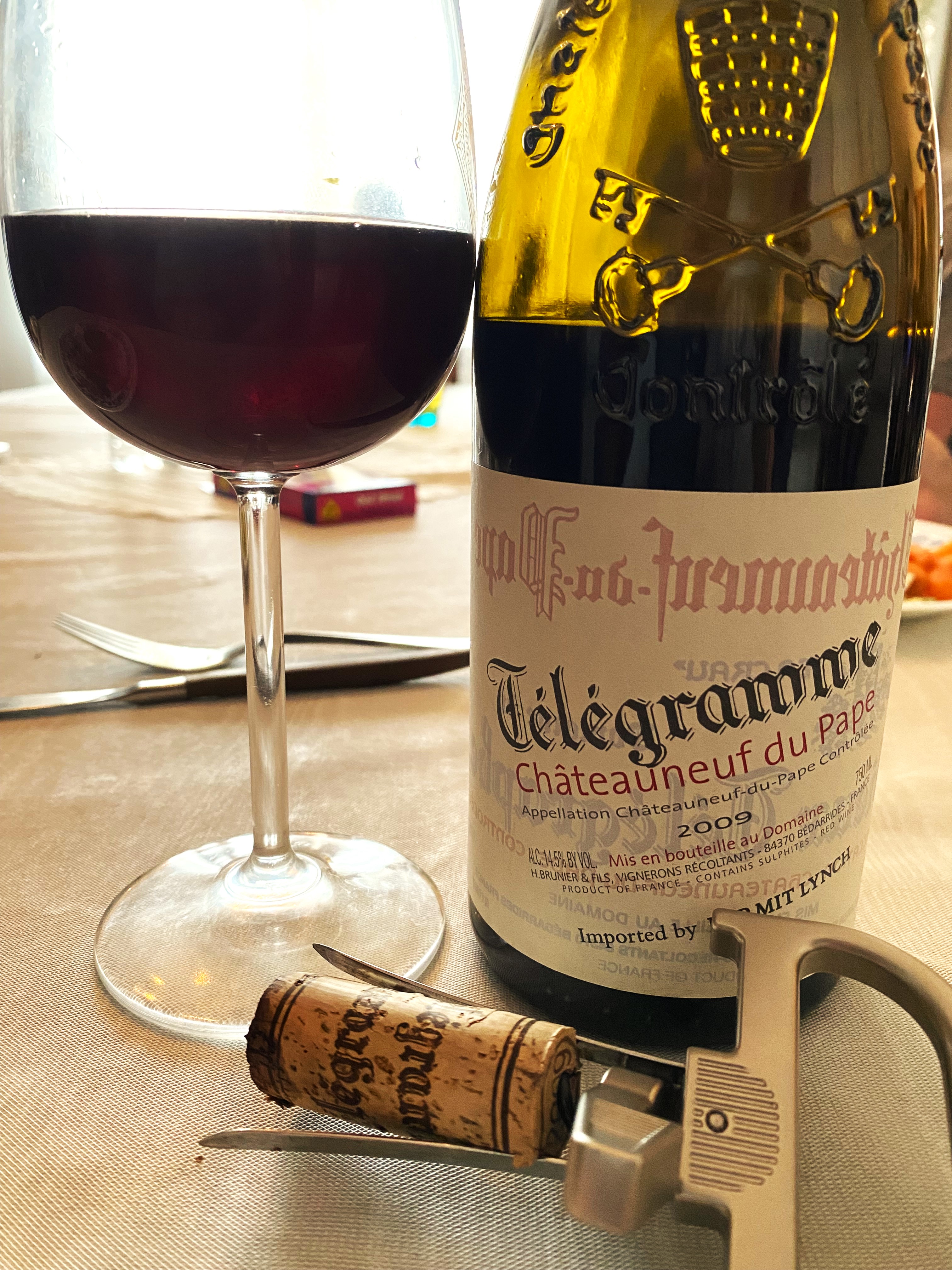
Then the roast tenderloin was finished along with Armenian Pilaf and root vegetables. I had selected for this part of the dinner a bottle of Vignobles Brunier Domaine du Vieux Telegraphe Telegramme Chateauneuf-du-Pape 2009. Chateauneuf-du-Pape actually means “new castle of the Pope” and goes back to the Fourteenth Century during the time of Pope Clement V, the same Pope that is honored on the wine from Graves Chateau Pape Clement. Pope Clement chose Avignone as his new seat and the town has been historical ever since. While the name is drenched in history, up until the early Twentieth Century, the wines were usually lumped into a general Avignon wine. Baron Le Roy of Chateau Fortia, drafted a document centering on quality wine production conditions, and this document became the precursor of France’s appellation system. Originally thirteen varieties were approved for production and after a 2009 review, eighteen varieties are now approved. The other unique proviso about Chateauneuf-du-Pape is that they drafted a law forbidding flying saucers from taking off, landing, or flying over the vineyards and it is still enforced to this day. The domaine was established by Hippolyte Brunier and produced its first wine in 1900. It has grown to become one of the largest land owners in Chateauneuf-du-Pape with almost one-hundred-hectares. There was a real telegraph involved in the Brunier story. In 1898, Hippolyte Brunier had just one hectare of vines to make a bit of family wine, with his vineyard situated at one of the highest points in between Chateauneuf-du-Pape and Bedarrides. Its altitude made it the perfect spot for the communication tower built in 1793 by Claude Chappe to transmit telegraph messages between Marseilles and Paris. Hippolyte’s grandson, Henri, was the first to put the Domaine’s bottlings under the Vieux Telegraphe label. Today, even though the communication tower itself has long gone the name remains. Vieux Telegraphe’s second-label Telegramme is made with young vines, under thirty-years of age. The wine is a blend of eighty percent Grenache, ten percent Syrah, six percent Mourvedre Monastrell) and four percent Cinsault. The grapes are hand-harvested, with double-sorting at the vine, and a third sorting at the winery. They are de-stemmed, with about thirty days for Initial Fermentation in temperature-controlled vats; followed by pneumatic pressing and then Malolactic Fermentation. The wine is aged for about sixteen months in French Oak foudres, bottled without filtration or fining and released after eighteen months. A deep ruby-red offering notes of blackberry, figs, and rose petals. On the palate there are tones of rich fruit preserves, anise, and tea with a nice long finish of fruit and terroir. A totally delightful way to enjoy my birthday dinner with the other celebrants.


 The Wine Raconteur
Nice selection of wines! I really like the Chateau Marjosse, and the Joly Coulee de Serrant is heaven. You sure know how to celebrate!
Lauren,
I really enjoy my wines at home, as it is never as dear as when we are out and about. I guess that is the true reason to create a cellar. Plus we still enjoy tasting new wines. LOL
– John