Almost Normal? Part Two

The end of an era of elegance and class came to an end; instead of Cary Grant we now have Stanley Kowalski. Years ago, Ronald Reagan called for the Berlin Wall to be razed, today there is nothing as dramatic, but supposedly the State is back to normal.  Restaurants can start full capacity indoor seating and extended hours, but now they have to find the employees to make this happen.  Everywhere one looks, there are signs for hiring, but the number of people filing for unemployment is rising, this is all beyond the Economics that I took in college. While the science that demanded businesses to shutter was never shown, the science that allowed the all clear was never shown here either.  Though political recall petitions in a couple of states allowed the normalization from the powers that be without any further ado.  I bring this all up, because my Dinner Club that I used to write about ten times a year, just had their first abbreviated meeting since the lockdown began. It was abbreviated, because the restaurant informed us that they would be shutting down at eight in the evening sharply, which eliminates several parts of the meeting.
The club has been around for about one-hundred-thirty years and originally it was held in a member’s home, because by the constitution of the club, membership is limited to forty-four members.  The club survived the Great Depression by holding the meetings in restaurants, because homes that large and formal were disappearing and no one could afford the staffs to maintain such a lifestyle.  Several other traditions over the years have also disappeared from the club, and finally one of my favorite traditions was deleted by a quick vote during our first meeting back.  With the club originally being held at a member’s home, a coat and tie were de regueur for the meetings, and they voted to change the wording to “country club dinner attire.” I expect by next meeting, I will see some members in shorts and tee-shirts.

Normally, the menu selection is limited to three choices by the hosts, as the dinner tab is shared by three members; due to some quick decisions, the first meeting was a “Dutch Treat” event, years ago, the tradition of the hosts picking up the drinks for the evening was also terminated.  Even with my club, traditional values have gone by the wayside.  The restaurant had paper menus and each member could select, what ever entrée, he wanted and our waitress did a fine job of getting all of the orders properly, as well as the individual bills, albeit with a twenty percent gratuity added per tab, which is fine, because if it had been a hosted affair, the same gratuity would have been applied.  I have always enjoyed the St. Louis Style Baby-back Ribs that they make, so that was my choice along with their version of jumbo well-done and seasoned French Fries, Garlic Toast, Cole Slaw and a Chocolate Sundae.  When I asked about the wines, our waitress informed me that they now had a Shiraz, so I took a chance on such a great offer, after having my traditional Whisky Sour during the cocktail hour.  

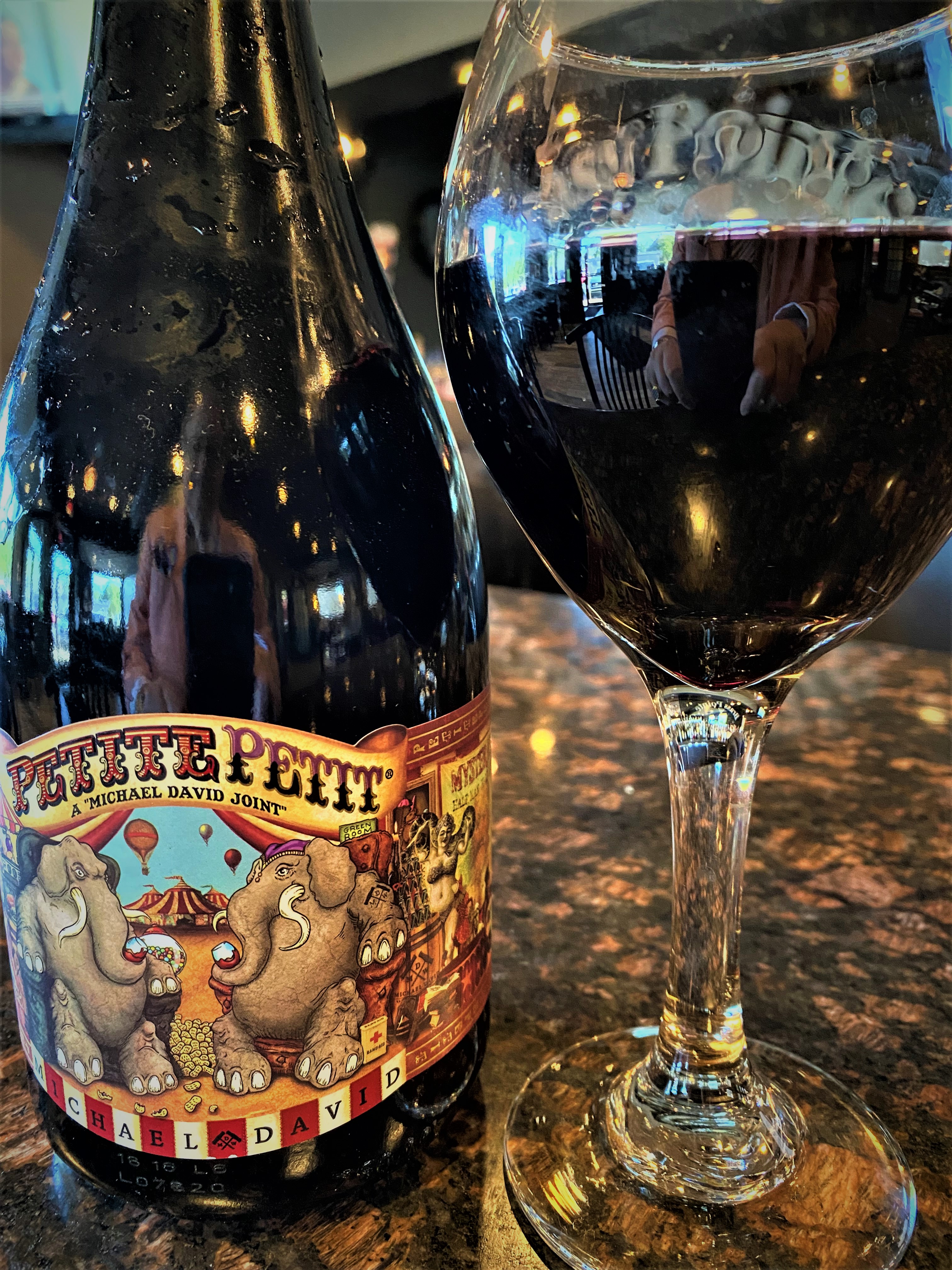
I had the Michael David Winery Petite Petit Lodi 2019.  Michael and David Phillips represent the fifth generation of grape farmers in Lodi. During Prohibition, the family skirted the law by growing grapes and creating solid bricks of concentrated juice with explicit warnings detailing the steps not to take in order to ferment and produce wine from the concentrated juice brick.  It was technically legal, and a clever way to survive the first failure of the Nanny State.  The winery now farms seven-hundred-fifty acres of vineyards and all the vineyards are certified organic and since 2011 they are certified as sustainably grown.  There most popular brand is The Seven Deadly Zins, and beyond their popular priced wines the brothers also have a reserve collection of red single-variety wines.  The wine I had was a blend of eighty-five percent Petite Sirah and fifteen percent Petit Verdot.  The wine was aged for twelve months in French Oak, with twenty percent new. The wine was a classic fruit bomb of deep colors, dark fruit, figs and vanilla.  It was kind of in the middle of the road, it was not dry and it was not sweet, but it was great with the ribs.  It looks like the next meeting will be a “Dutch Treat” again, until we can get a schedule going again for the hosts.  More tales to come.    

Posted in Dining, Wine | Tagged , , , , , | Leave a comment

En Primeur Reds-Part One

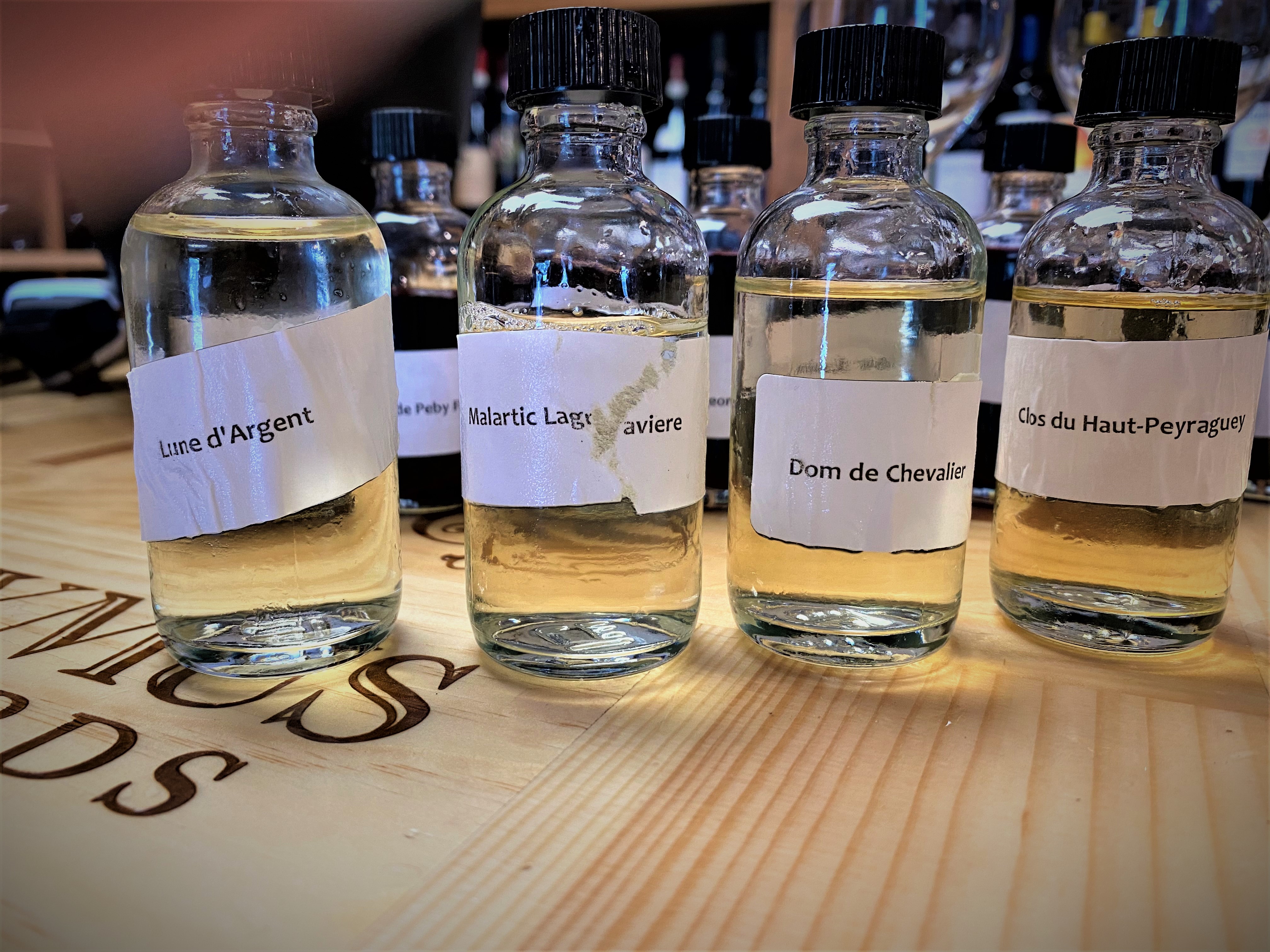
There I was at my local wine shop The Fine Wine Source and I was doing a wine tasting with one of the employees and kibbitzing with the owner of the shop as well, as he already had a chance to taste the En Primeur wines of 2020.  This was a special event for me, as I have never had the chance to try a wine straight from the barrel, and that is what these small dram bottles represent.  I am sure that there is a more technical term, but a dram bottle works for me and I think it is rather self-explanatory.  For a Street Somm, it is a very heady experience.  Part of the En Primeur season is for the wineries to determine the future retail of the wines, predicated on how they are rated by the major critics and others in the industry, they also sometimes sell wines ahead of time, known as futures.  When I was in college, way back when, I was once offered three bottles of Chateau Mouton-Rothschild 1973 for the princely sum of fifteen dollars a bottle.  At the time that this was offered Chateau Mouton-Rothschild was the top of the Second Growths by the Classification of the Medoc and Graves of 1855 and they never even mentioned the Classification on their labels.  The 1973 vintage not only featured art work by Picasso for the label, but lo and behold the label said “Premier Cru Classé” and that poor student when he got the wines had, he felt, the coup of the century.  Looking back, I still feel that way, and I still have one bottle in my cellar.

Of the sixteen wines that I got a chance to try, courtesy of The Fine Wine Shop, over the years I had actually had five of the wines represented.  In the very early days of my education of wines, I had envisaged that one day I might have a chance to try every bottle of the Classification of 1855, and so far, that hasn’t happened, but I have had many of them, and I think that I have a working knowledge of what the great Communes represent.  Since for the most part, it has been on my dime, and I was just a working man, I think that I did alright.  Just so that I don’t ramble on and on, I will write about the first six red wines and then I will follow up with the other six wines in two days.

Chateau Beaumont Haut-Medoc 2020 is one of the largest properties in Bordeaux, located in Cussac, which is between Margaux and Saint-Julien.  It is a blend of Cabernet Sauvignon, Merlot and a dash of Petit Verdot.  This was a good solid Bordeaux from the old school, but there was a trace of menthol, and I am not sure if it is because it was so young out of the bottle, but I thought I should mention it.

Le Merle de Pepy Faugeres Saint-Emilion Grand Cru 2020 is a stand-alone vineyard inside of the larger Chateau Faugeres.  The Chateau and grounds are now owned by Silvio Denz of Lalique.  The wine is pure Merlot.  It was a beautiful glass of wine, of course I am partial to Merlot and Saint-Emilion wines for fifty years, but this wine had big tannins, a solid Merlot with an amazingly long finish. 

Chateau Le Boscq Saint-Estephe Cru Bourgeois Exceptional 2020 by Famille Dourthe. A blend of Cabernet Sauvignon, Merlot and Petit Verdot.  James Suckling rated this wine at 91-93.  This was a well made and a very chewy wine, that is one of those rare affordable wines from Saint-Estephe and a pleasure to drink.

Chateau de Villegeorge Haute Medoc Cru Bourgeois 2020.  This from Vignobles Marie-Laure Lurton.  A blend of Merlot, Cabernet Sauvignon, Cabernet Franc and Petit Verdot.  This wine was very young and chewy, but I thought it offered great potential, especially for an affordable wine.

Chateau Tour Saint Christophe Saint-Emilion Grand Cru 2020.  This is from the Vignobles K Group.  A blend of Merlot and Cabernet Franc.  This was a nice full and rich wine, quite a bit of heat at the opening an a very nice long finish.  Once again, my bias is showing, but I think that this is a very nice wine, worthy of some cellar time.

Chateau Dauzac Margaux Fifth Growth 2020.  One of the older vineyards and chateau going back to the 12th Century.  A blend of Cabernet Sauvignon and Merlot.  This is one of the earliest Classified wines that I had as a teenager and then it kind of disappeared from the horizon for me.  This was a beautiful wine, as it even opened up in the glass between the first and the second taste, it was very impressive for such a young wine that is probably going to see more time in the barrel.

Posted in Wine | Tagged , , , , , , , , , , , , , , | Leave a comment

En Primeur Blanc

In the spring time as the saying goes, a young man’s fancy turns to amour, but in Bordeaux, the amour is en primeur.  What is en primeur?  To put it in easy-to-understand language, because I am not an authority, it is the futures market of Bordeaux.  Wines that may only be six to eight months in the barrel, and not even close to being matured, are blended by Master Vignerons to create what the hope will be a close approximation of what the finished wine will taste like.  It is the season that will actually predetermine what wines of that vintage will be selling for.  The major buyers and reviewers and other very fortunate people are invited for this event, and it is an event that people end up telling their grandchildren about, because they are wined and dined, sometimes at the most fabled chateaus in Bordeaux.  The chateaus also hope that they will receive orders with a prepayment, and cases of wine will be placed in “bond” or “hold” until the wine is properly aged and bottled.  It is a great incentive to raise capital for the chateau, as there could be another year before some wines will actually be ready for retail.  The other benefit, is that from the en primeur, an actually pricing structure starts developing for that vintage year, and the pecking order of all the communes and rated wines are adjusted from the season.

The last two years, you may have noticed that traveling was rather hindered, and the en primeur season was reinvented.  Instead of people drinking wine from the barrels and making their educated guesses, the wine was bottled and shipped to key buyers, distributors, etc.  My local wine shop The Fine Wine Source was scheduled to attend en primeur, that did not happen.  He was invited to taste the freshly drawn wines, which were in small dram bottles, and he actually attempted to get me an invite to the local tasting, but that idea was declined, but he was given sixteen assorted dram bottles, so that his help (and me) could taste the wines at the shop.  There were a couple of false starts, but it happened, and I was as giddy as a young man going on his first date. 

In the Bordeaux Blanc wines there were three white wines, to taste and then after all the reds we tasted one dessert wine:

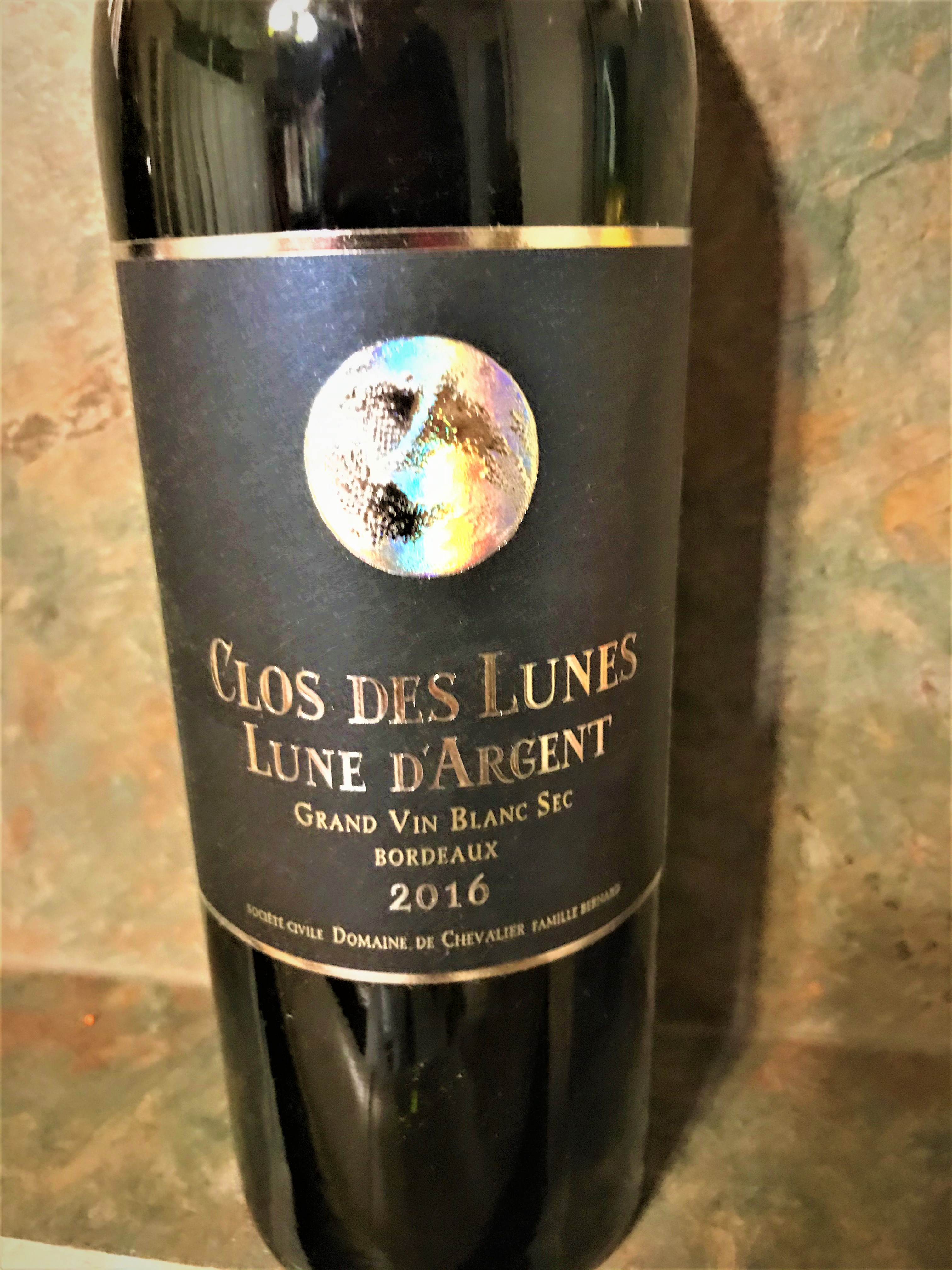
Clos de Lunes “Lune d’Argent” 2020, Famille Bernard Bordeaux Blanc.  A blend of seventy percent Semillon and thirty percent Sauvignon Blanc.  James Suckling 92-93.  My thoughts were dry, with notes of banana and a nice long finish.

Chateau Malartic Lagraviere Blanc 2020, Pessac-Leognan region of Graves, both the red and white wines of the Chateau were Classified in 1959.  A blend of seventy-two percent Sauvignon Blanc and twenty-eight percent Semillon.  James Suckling 95-96.  My thoughts were that this was very creamy with notes of dried apples and green melon with a nice flinty finish.

Domaine de Chevalier Blanc 2020, Famille Bernard Pessac-Leognan region of Graves Bordeaux Blanc.  This wine is also a Classified wine in 1959.  A Sauvignon Blanc and Semillon blend.  James Suckling 96-97.  A very pretty wine with notes of cloves and Briar fruits and a nice flinty finish.

Clos Haut-Peyraguey Sauternes First Growth 2020 owned by Bernard Magrez.  A Semillon and Sauvignon Blanc blend.  This was a big rich Sauternes with pineapple and stone fruit notes and a very long finish, really a wine to enjoy.    

Posted in Wine | Tagged , , , , , , , , , , , , , , | Leave a comment

Armenian Red Wines with Roasted Lamb

I can guarantee that if you are invited for a lamb dinner at an Armenian home, you will most assuredly get lamb.  Armenians do not use yearling and definitely not mutton.  For all of the suffering that the Armenians have endured, their table is always open for company and guests.  Lamb is the meat of choice, and how ever it is butchered, the results are always tasty, and from the section of the Old Country that my grandparents came from, you also knew that the lamb would be hot and spicy.  Just like the wines that we were serving, which are grown on the mountainsides, lambs were also raised on the mountainsides.  It is only natural that Noah’s Ark would land on Mount Ararat, one of the three famous mountains of Armenia and the people are hardy from the start, as they planted among other things; grapes and olives. 

My Bride was making a Roast Lamb and the entire lamb was slit with X’s, just deep enough to stuff a clove of garlic in each X.  As you can imagine a roast of lamb requires plenty of cloves, and when the meat is fully roasted the garlic has imparted its spiciness and that rich sweet roasted garlic is a wonderful by-product to enjoy as well.  The lamb is roasted with root vegetables like potatoes, carrots, turnips and parsnips and they absorb the rich broth that the roasting produces from the meat.  There was also Armenian Pilaf which is a staple in our house, almost for any dish, especially for the big parties and even the non-Armenians are upset when we don’t have it.  For the uninitiated, it is browned egg noodles and rice steeped in chicken broth and butter, until all the broth and butter have been absorbed by the rice, and yes, my family has always made this with garlic as well.  The recipe has been toned down a bit, from the early days of my youth, because there was so much butter used back then, that as a kid, I would scoop out left over pilaf from the refrigerator, put it on a plate and eat it cold, it was so rich, another factor of why I was a fat kid growing up.

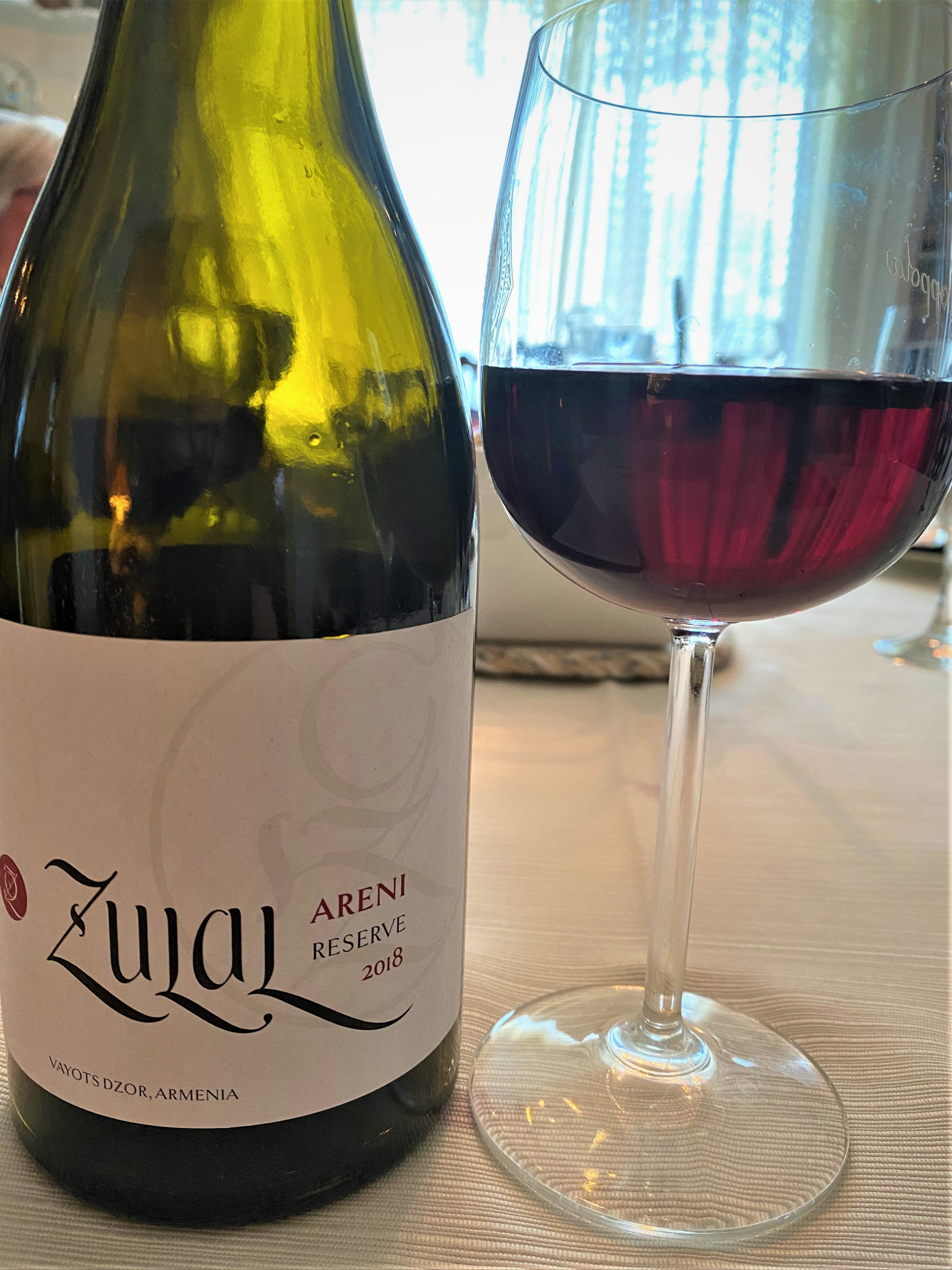
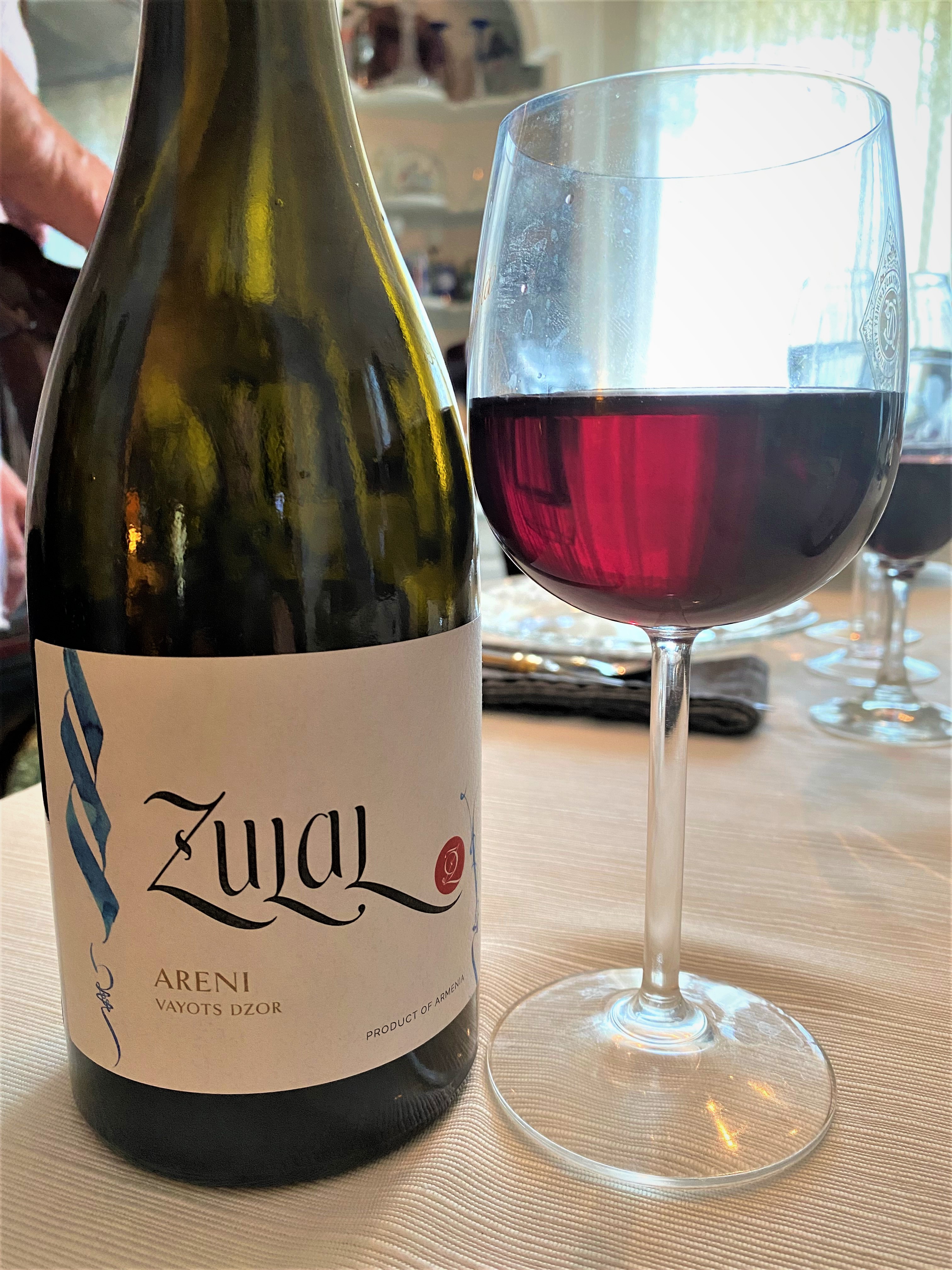
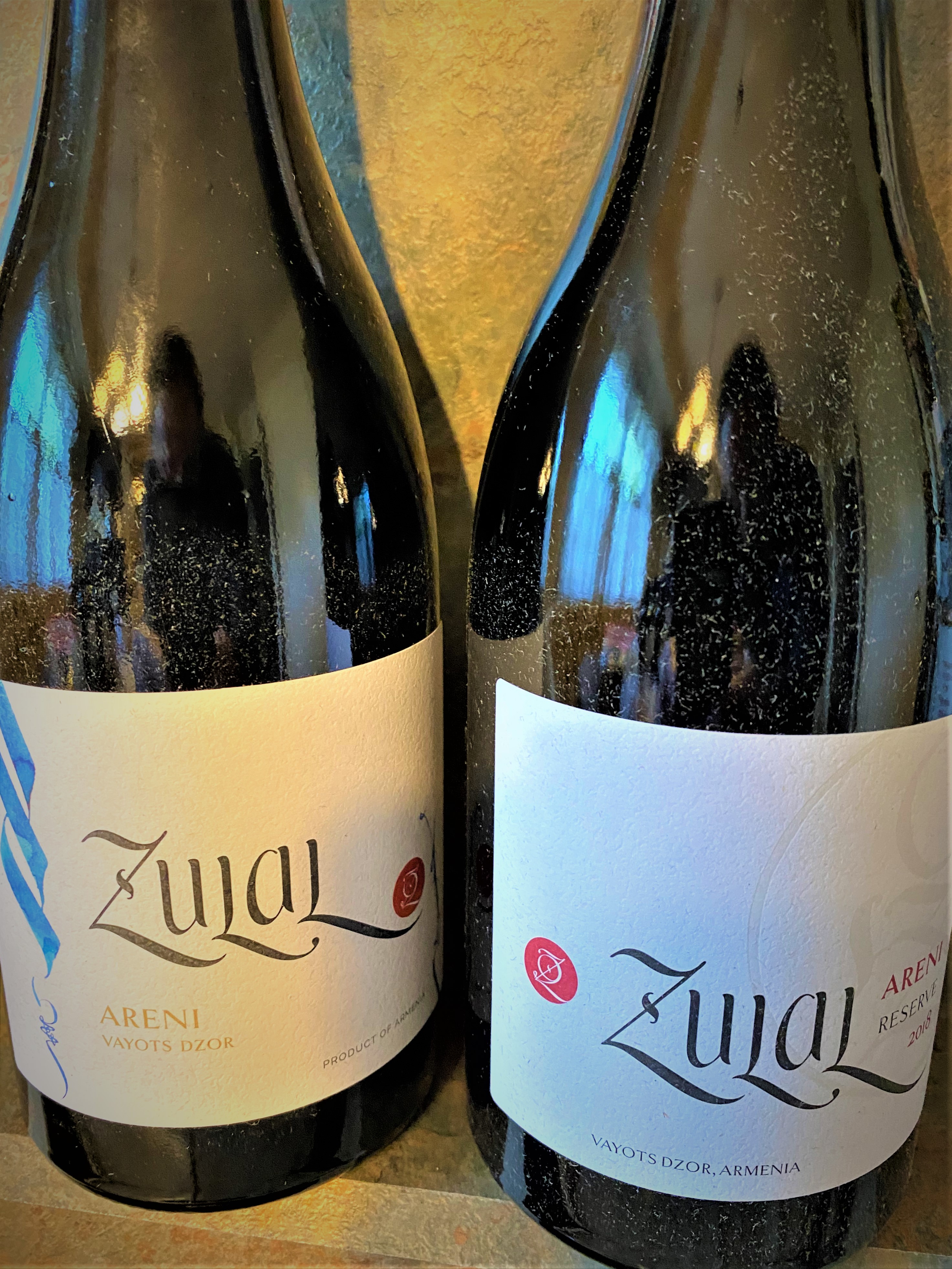
Of course, besides the food, the focus was on the red wines that were furnished as samples by Storica Wines.  We were going to serve the last two wines, which were both red, side by side for comparison.  Both of the red wines were from Zulal Wines and the winery was founded by Aimee Keushguerian who learned winemaking from her father at Keush Winery.  Zulal which is Armenian for pure was founded in 2017, and Aimee and her father are striving to identify some of the indigenous grapes that have survived on their own in Armenia.  The winery is a mountain winery, and there are plenty of people that are always looking for mountain wines, because not only for the volcanic and limestone soil, but that the grapes have to struggle and stress to grow, and the grapes are smaller, and the winemakers have to work extra hard to prune the leaves, to allow just the right amount of sunlight on the grapes to allow them to ripen properly. The first wine that was poured was Zulal Wines Areni Classic Vayots Dzor 2019.  Areni is one of the major wines of Armenia and is a thick-skinned varietal that grows in small tight bunches.  The fruit is hand-harvested from the vineyards in Aghavnadzor from ungrafted vines that average from fifty to one-hundred years of age.  This wine is fermented and aged in Stainless Steel to accentuate the bright red fruit character and nose.  There were four-thousand cases produced of this wine.  This was the first Armenian red wine, and their first tasting of Areni and thought it had a light nose, moderate tannins and a medium finish, a couple of people suggested that it reminded them of a light Pinot Noir.  The second wine that we were serving side by side was Zulal Wines Areni Reserve Vayots Dzor 2018, but the fruit for this wine was from vineyards in Aghsafi.  The Reserve wine was aged for twelve months in neutral oak barrels and three-thousand cases were produced.  The winemaker suggests buying a case, and drinking half of the case when young and then finishing the case a decade later when it has mellowed.  Once again, this was their first tasting of an Areni Reserve and they mentioned the deeper color of the wine, some thought the wine was like a Rioja and some thought it was like a Syrah, so we had split decision of the wine.  The mention of dark berries and spices were mentioned and the wine had a nice finish.  Five of the six, enjoyed the Reserve over the Classic, but it was a bigger wine.  The food and the wine were enjoyed by all, and if any of the guests encounter an Armenian wine in their travels, they will have positive thoughts about the wines, just like the thoughts that they formed from the wines that we had from Storica.      

Posted in Dining, Wine | Tagged , , , , , , , , | Leave a comment

An Armenian Bubbly and a White

Now that I have some history with Armenian wines, shall I proselytize? I know it sounds glamorous to say that I have received wine samples, but I feel that it is a heavy burden to do my best to feature these wines.  I have participated in some virtual wine tastings, where the people were drinking the wines before the tasting, and I think that is in poor taste.  I feel that I have an obligation to give these wines the same consideration and respect, as if they were First Growths.  Maybe, I am old-fashioned, but I have to use my own personal code of ethics.  Not to mention, that as an Armenian, I want to be able to spread the news about Armenian wines, because most people have not heard of Armenia or that they are pioneers in wine making from ancient times.  There will be arguments pro and con, about who was the first, and it may never be settled properly, but I am betting on the Armenians.  The first Christian nation in the world, and still a Christian nation surrounded by non-Christians.  The history of the Armenians is a long one, and they still perform mass in Old Armenian, as this was the mass that was taught to them by the Apostles.  They also unfortunately suffered a cruel fate in the Twentieth Century and the word “genocide” was coined for the barbaric massacre of men, women and children; and unfortunately, Man’s memory can be conveniently short and another genocide was perpetrated against another religious group, and later included others as well.

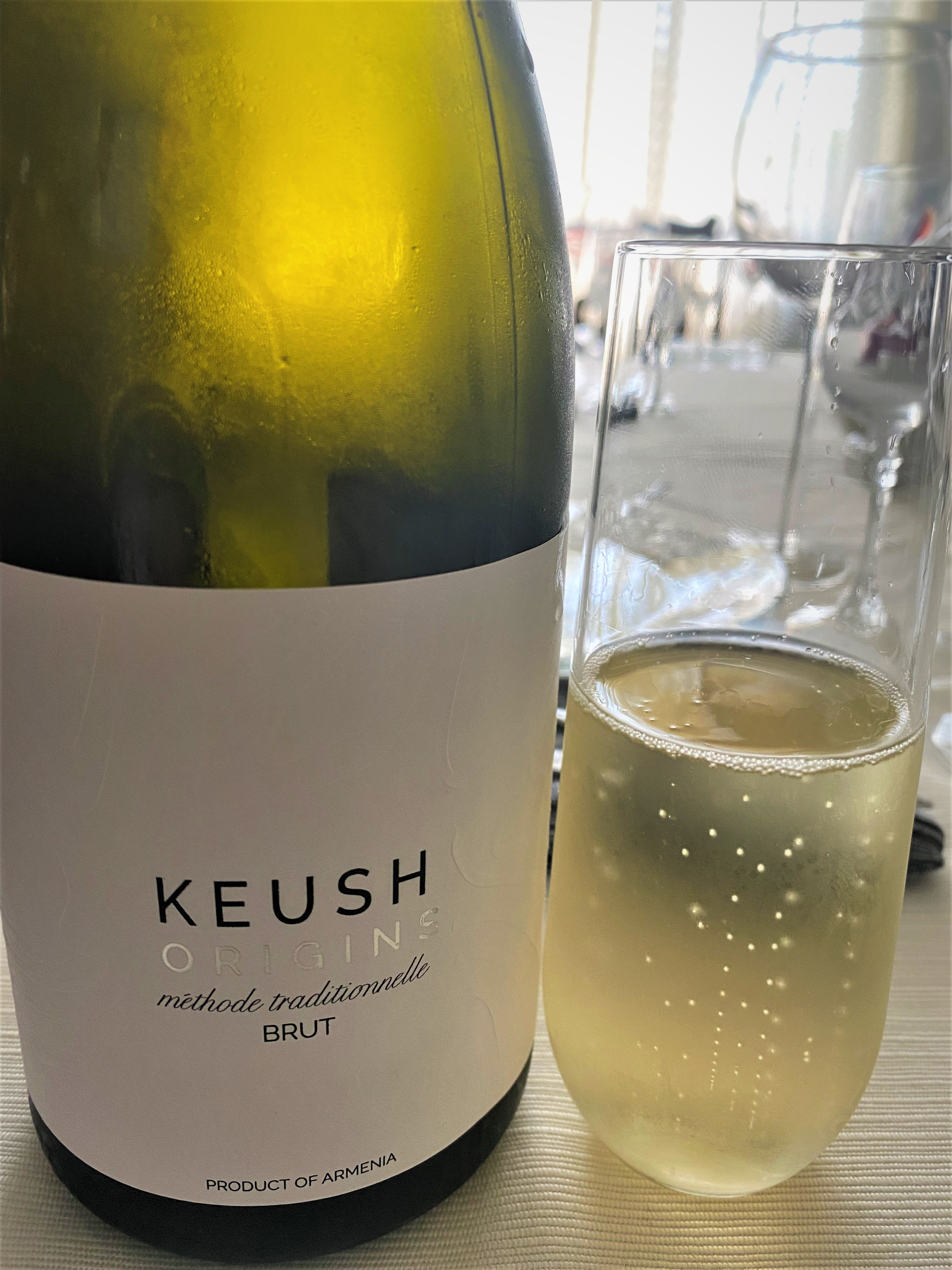
Armenians love to eat and to share, when I was a kid, the tables always looked like they were going to collapse from all of the weight of the food that was on them, and that was only if just a couple of friends stopped by, otherwise if it was a crowd, one just had to get more tables.  I and my Bride decided that Lahmajoon would be the perfect opening dish.  For a lack of a better term and easy for everyone to envisage, it is a personal size pizza that is topped with triple ground lamb or beef in a tomato paste, spices and parsley on its own unique dough.  I remember my grandmother making these by the hundreds, with barely a couple left for lunch the next day.  My family has always been partial to adding red pepper flakes for some extra zing. This appetizer was going to paired with Keush Origins Vayots Dzor NV.  Keush LLC is based in Yerevan, the capital of Armenia.  The wine is from Vayots Dzor, a mountainous region in southeastern Armenia, and one of the oldest documented wine producing regions in the world.  Keush Winery is located in Khachik and the vineyards are limestone and volcanic rock.  Vahe Keushguerian is an Armenian born in Lebanon and was in the wine business in San Francisco for many years.  He then moved to Italy and had a wine business there for over ten years.  His first trip to Armenia was in 1997 and he bought land and planted vineyards on original ungrafted vines and finally moved his family there in 2009 and founded the winery in 2011.  The grapes are sourced from the village of Khachik and it is the highest elevation of any grapes used in the Northern Hemisphere for Methode Traditionelle sparkling wine.  The wine is a blend of sixty percent Voskehat and forty percent Khatouni (Khatoun Kharji).  Voskehat an ancient Armenian varietal translates to “golden berry” and is a late ripening grape that requires more time in the sun, and in a mountainous region, it gets that quite easily.  Khataoun Kharji another indigenous Armenian varietal translates to “Madam Kharji” and is a yellow green grape that offers alpine flowers, citrus and pineapple.  The fruit is hand harvested, aged on the lees for twenty-two months and secondary fermentation is in the bottle.  There were four-thousand cases produced. At first, my Bride thought I should have done the pairings different, for this part of the meal, but she agreed, especially after hearing the others enjoy the Lahmajoon with the Keush Origins.  The consensus of the group was that the wine had a nice floral nose, and everyone enjoyed the notes of lemon peel, golden apple and pear and a nice decent finish with mineral traces. For a wine that was made with two grape varietals that they had never heard of, or had before, this wine received rave reviews, and we were off to a great start.

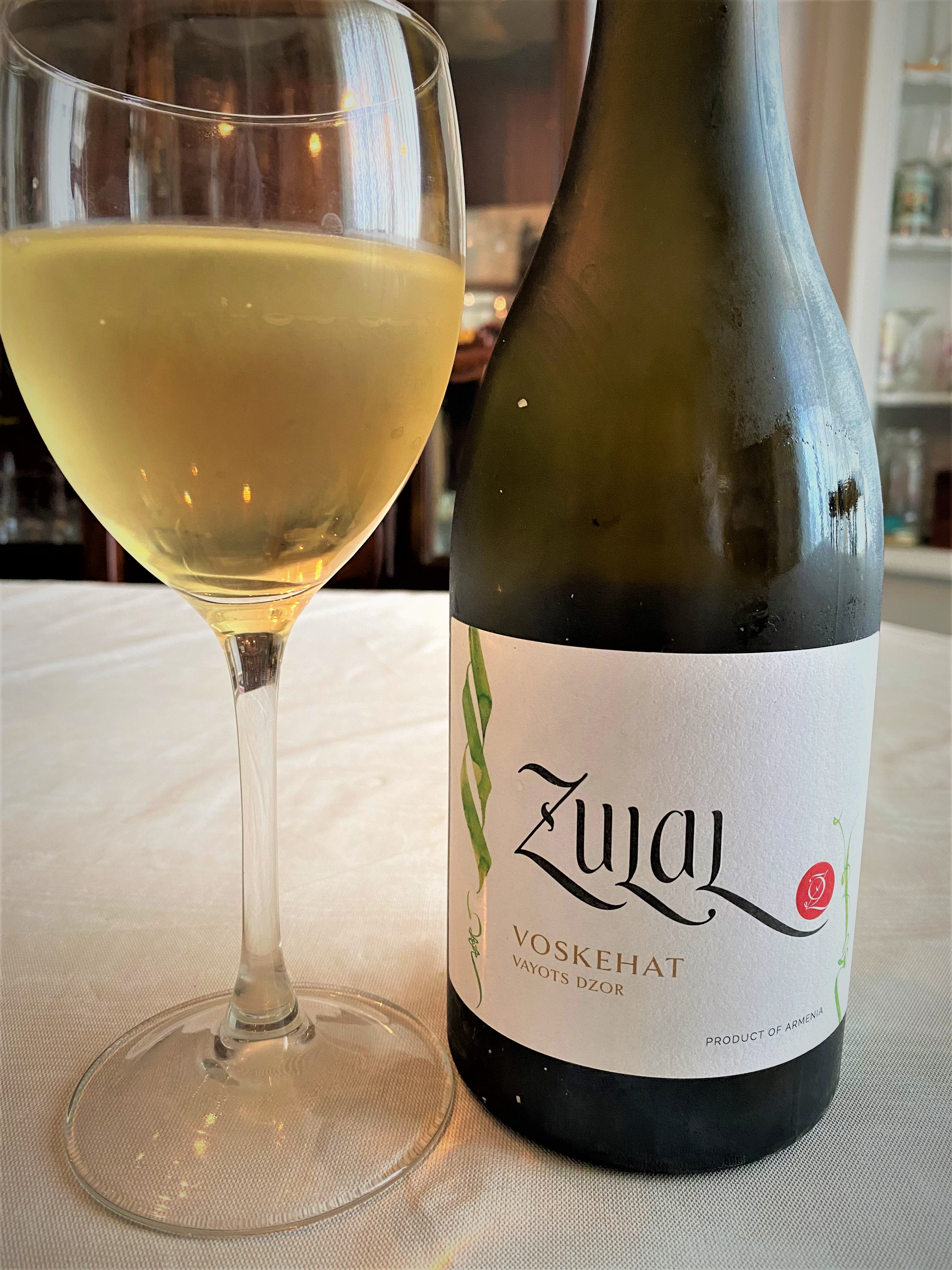
Then we had Cheese Boereg, an appetizer that is made with layers of Phyllo dough that is folded over White Brick cheese.  I guess depending on the cheese used, this dish could be sweet, but the version I know is savory, and it has been a mainstay ever since I can remember.  It is also a hit, with anyone that tries it, and thankfully the Armenian caterer makes the dishes very similar to how my grandmother made the dishes, so unfortunately no one bothers to make these dishes from scratch.  This appetizer was paired with Zulal Voskehat Classic Vyots Dzor 2019.  The Zulal and Keush wines are imported by Storica Wines who offered the samples for my review.  Storica Wines are interested in the growth of Armenian wines, especially with indigenous grapes, some of which have a six-thousand-year history with Armenia and its winemaking.  Zulal means pure in Armenian.  Zulal Wines was founded by Aimee Keushguerian in 2017 and the fruit is sourced from about forty grape growers in the villages of Aghavnadzor and Rind, as well as the Arpa Valley in Vayots Dzor region. Voskehat is one of the most recognized varietals in Armenia and some of the vines are Pre-Soviet era and definitely pre-phylloxera and the average age of the vines are fifty to one-hundred years of age.  What saved this varietal is the demand by the Soviets for brandy and their version of Sherry known as “kherez.” The wine undergoes natural fermentation in Stainless Steel to preserve the acidity of the wine and is bottled directly from the tank, with a production of three-thousand cases.  While they were enjoying the savory Cheese Boereg, I was explaining that this was pure Voskehat and this was a winner both in pairing and with drinking. The consensus here was that it had a nice floral nose, with enjoyable salinity (brightness) with notes of apricots and a nice finish of flint, is what they all agreed on.  

Posted in Dining, Wine | Tagged , , , , , , , , , , , | Leave a comment

An Armenian Wine Dinner is Planned

When I am on social media, I very seldom put my two cents in, on someone else’s post.  I think some people think that it makes them appear better than the original poster.  Well, a little while ago, I did put my two cents in, but only because I have a long relationship with the poster, way back when we were just blogging, using the same publisher and since then we seem to be all over the place.  I mention all of this, because this blogger was discussing a sample wine that she was reviewing from Armenia.  Of course, my ears did perk up and I listened to her podcast or at least it was a video.  She is much more adept at using all the tools that are potentially at our finger tips.  As for me, I am lucky to have figured out how to do download or upload my photos and articles.  I mean I am old school, though I did teach myself how to type on an electric typewriter, way back when boys went to drafting class, while the girls went to typing class in Junior High School.  I got sidetracked again, what happened was, I complimented my colleague on a good job pronouncing some Armenian words, now this is from a guy that went to Armenian School two afternoons a week, back in the early Sixties.

My compliments eventually attracted the distributor that had sent the Armenian wine out as a sample.  The distributor asked me, if I would be interested in some samples to review.  I explained that I had reviewed many Armenian wines at a fund raiser, and that unfortunately the people that did the arrangements for the wine tasting, did not consult anyone in the wine trade, and the wines did not sparkle and I was embarrassed when it came to write my reviews and I did include a caveat of what I thought caused the problem.  I also sent links to my articles, as I like to be upfront about such things.  I also directed the distributor to my page where I wrote about my concerns about samples, as I do not go out seeking samples, which seems to be the way quite of few of the “influencers” do it.  I guess the distributor still felt safe enough, dealing with this crazy Armenian to offer to send me some wines to sample.  I mean the wines arrived almost overnight and there were four wines waiting for my reviews.  There was a Sparkling Wine, a White Wine, a Red Wine and a Reserve offering of the Red Wine.

I was flabbergasted (boy is that an old-fashioned word) and I had to figure out what to do with the samples.  Even the distributor was curious, because in a couple of days, I was asked how I liked them, and I said that they were still in the carton; I kind of work slow, but methodically.  After discussing the situation with my Bride, we decided to have an Armenian dinner, so I explained it to the distributor, so that she wasn’t in the dark and thinking that I was not grateful.  We also decided to invite the two best characters in my writings “The Caller” and “The Wine Raconteur, Jr.” and we had to work out a date that would work out for them and their spouses.  We would start off with the Sparkling Wine with one appetizer and then go to the White Wine with another appetizer.  The two Red Wines I thought would be perfect with the main entrée of Lamb and Armenian Pilaf.  “The Wine Raconteur, Jr.” and his wife were making debating between two desserts, and one would be Paklavah.  I joked with him and I had hoped that they were going to use commercial Phyllo Dough for the fifty-two layers and he confirmed that.  I was glad to hear that, because I can remember when my mother (who was not Armenian) first helped my grandmother and the old lady next door to make Paklavah, the older women nixed my mother’s rolling-pin, because, the dough had to be rolled using a broomstick cut at the right length.  I don’t think the broomsticks ever left our old homestead. Instead they made a Muhallabiyeh and instead of Hibiscus and Rose, they went with a Pomegranate glaze topping.  I am excited, because this way, I now have six reviewers for each wine, for the following articles.  I can smell the food already, and I am thinking about the wine as well.    

Posted in Uncategorized | Tagged | Leave a comment

Black Star Farms Club June 2021

Back in the dark ages, when we could visit wineries, we ended up joining the wine club at Black Star Farms, because of the excellent customer service that we encountered there.  Actually, it now looks like Michigan is opening up again, but it may be insane, because the whole state has been “stir crazy” from the lockdown and people are going everywhere, just because.  The good news is that the wineries have continued doing what they do, although they did lose a steady stream of wine tasting visitors and sales.  Though they have been selling as best as they can through the cyber world. The good news from the winemaker is that 2021 looks extremely promising with the bud break occurring in early May, and the they were able to skirt a couple of potential frost threats, so there should be a long growing and ripening season this year.

 Black Star Farms is rather unique in that it has vineyards and tasting room facilities on both peninsulas, so that they are kind of surrounding Traverse City which is kind of the focal point for all of the wineries in the area.  In 1998 Black Star Farms purchased Sport Valley Farm which was a one-hundred-twenty-acre equestrian facility, and the stylized black star was part of the architectural décor in the main house.  In their Twentieth year, they were honored to receive the 19’th Annual Canberra International Riesling Challenge (CIRC) -Best Wine of the 2018 Challenge and only the second time an American wine came out on top.  There were 567 Rieslings from six countries (Australian, New Zealand, USA, Germany, France and the Czech Republic).  The Black Star Farms Arcturos Dry Riesling 2017 scored 98 points, in addition to taking home Best Dry Riesling and Best American Riesling.  In fact, all six of the Riesling wines that Black Star Farms submitted took home medals, showing a consistency across vintages and styles.  The fruit is sourced from both of the proprietor’s vineyards and from local grower partners in both the Old Mission Peninsula and Leelanau Peninsula.  The winery has three series; the premium Arcturos, A Capella and the Leorie Vineyard labels for sparkling and fruit wines.

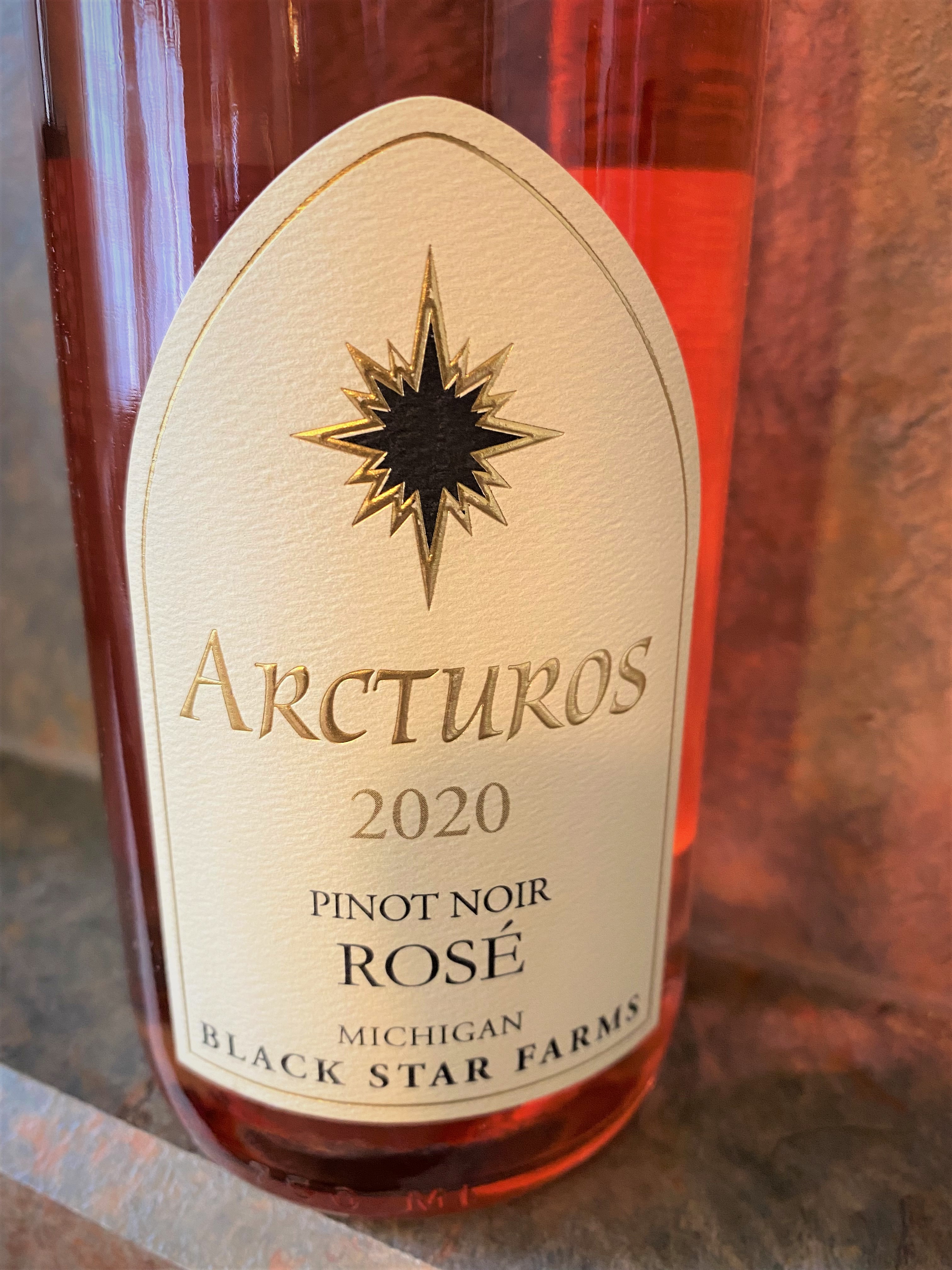
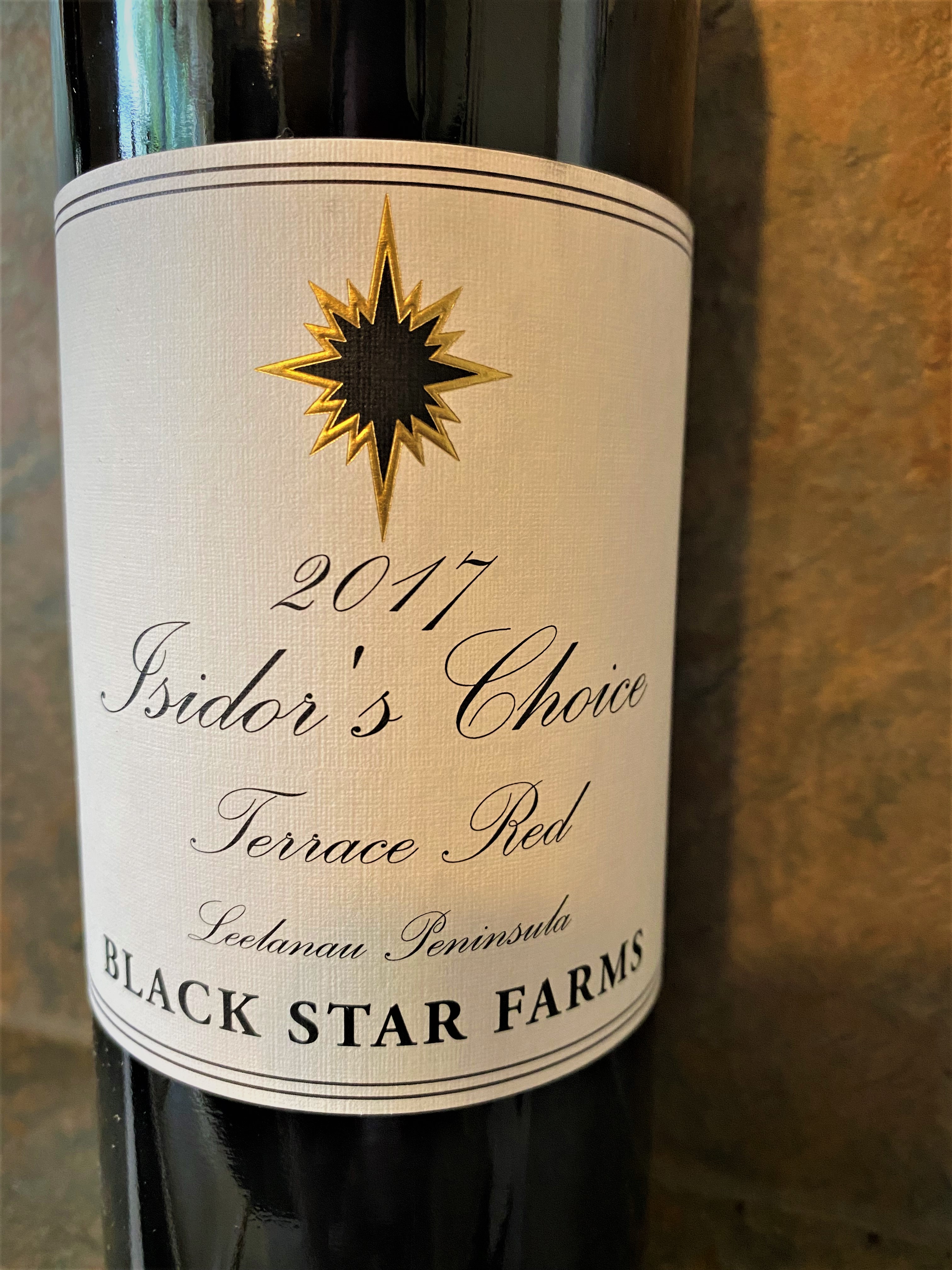
The Black Star Farms Arcturos Pinot Noir Rose Michigan 2020 is a “dry wine made in a fruit-driven style.” Pinot Noir is the red varietal that the winery has had the most success with, which is interesting as it is one of the fussiest grapes around.  This wine I can venture to say was completely done with Stainless Steel, as they were going for the classic fruit flavors of strawberries and ripe cherries, with a trace of terroir and a bright finish.  The perfect summer time wine that can easily be paired with lots of casual dinners and should be enjoyed in a couple of years.  The Black Star Farms Isidor’s Choice Terrace Red Leelanau Peninsula 2017 features fruit harvested from one of their partner-growers.  The wine is a blend of Teroldego and Lagrein, both grapes which are more known in Northern Italy, and for this version of the blended wine, they also added Cabernet Franc and Merlot to soften the “savage” character of the main two varietals.  I would have to say that this wine probably saw some oak aging, though the winery is a bit shy on information I say this, because they feel that it has aging potential of ten years or so.  They say that the two Italian varietals have great color and a “wild” fruit profile that they liken to wild blueberries that have been dusted with white pepper, and then mixing it with the two classic French varietals they say that the wine will offer a broad and complex dark fruit character with plenty of spice and girth that will pair well with big food flavors.

Posted in Wine | Tagged , , , , , , , , , , , | Leave a comment

Two Different Mimosas

There is just something civilized about having a Mimosa, perhaps it is just tweaking the nose of the people that say “a meal without wine is just breakfast.”  Now I know that some people disagree with me, as they are partial to having a Bloody Mary, and I even know one person that is very partial to a Bloody Caesar, and we can forgive him.  Hell, I can even remember back in my youth when the Canadians would invade our home in the summer, the afternoon drink of choice was the Red Eye, a mix of Molson’s Canadian and Tomato Juice. As always, I am rambling again and I may eventually lose my train of thought, so I better get back to having a Mimosa.

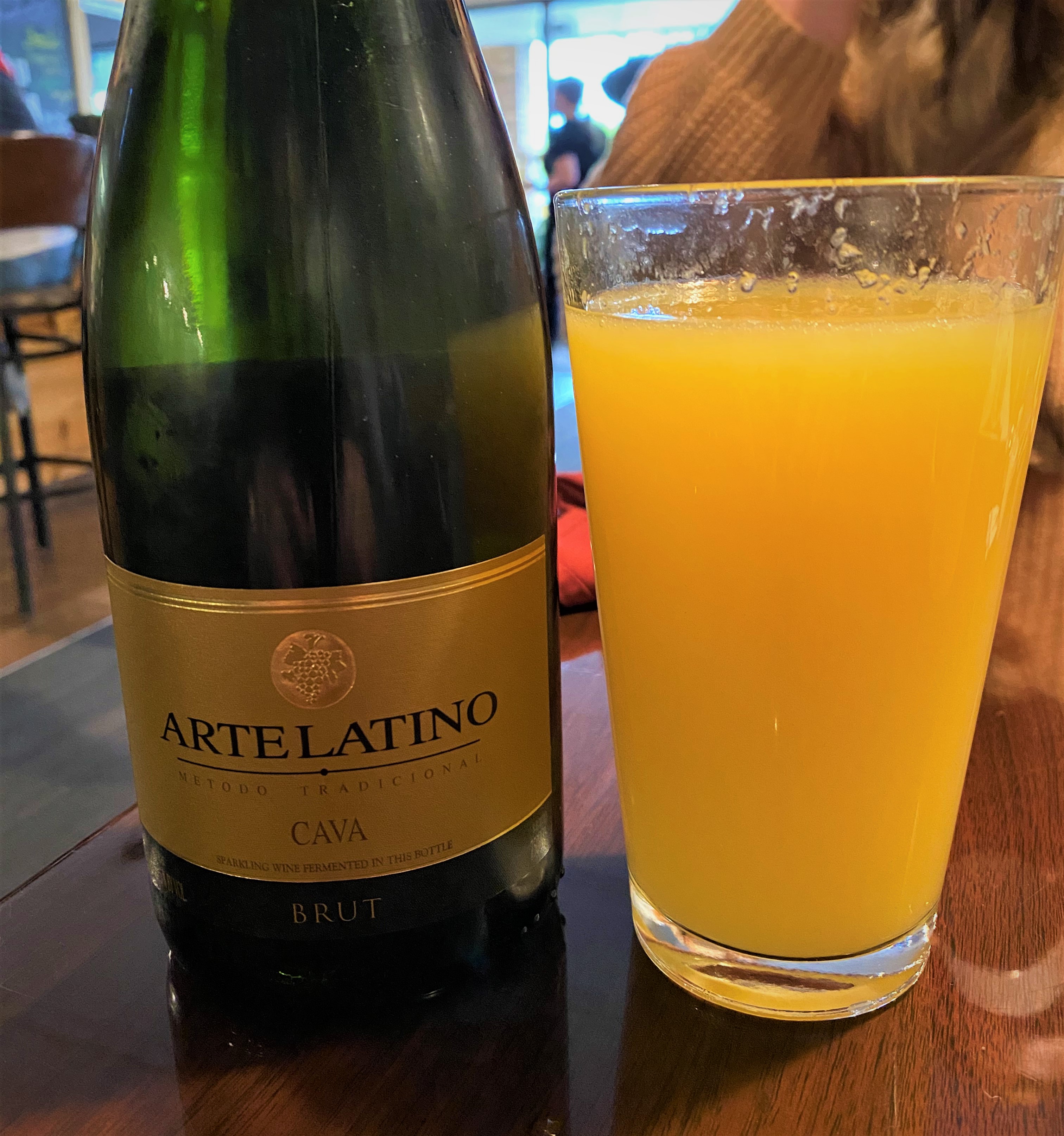
As we are trying to support the local independent restaurants during our lockdown period, one day we went out to our favorite Cajun Bistro for brunch, and while the place lost something with “social distancing” the food was still great, even without the party atmosphere of the French Quarter.  We expected to have some of their “Manmosa’s” which is what they call their party size Mimosa, about double the usual size.  In today’s political clime, I guess the term may be considered sexist, but no one there seems to mind. They normally use the standby that plenty of restaurants use, which is Wycliff Brut California Champagne from the William Wycliff Winery, which is under the umbrella of the Gallo Winery group. As I heard the traditional pop of a cork, I knew that they had changed the bubbles, and our waiter said that he had just opened a couple of bottles at once, because the others were not as adept at uncorking bubbly when the Wycliff was a screw cap. Our waiter told us that the restaurant was having problems getting their usual wine orders and they had to substitute.  We were given our Manmosa drinks in a tall glass with orange juice on the side to mix with the Jaume Serra Arte Latino Cava Brut, made in Catalonia by J. Garcia Carrion.  J. Garcia Carrion is the largest winery and the second largest fruit juice producer in Europe.  They were founded in 1890 and produce wines in ten different DO regions of Spain, and also more wines and brandies outside of the DO regions.  Their major label is Don Simon was created in 1980 and one of the first box wines in Spain, the label is now used for their Sangria, juices and soft drinks.  Jaume Serra is made in the Traditional Method that is required for Cava and is a blend of Macabeo, Parellada and Xarel-lo.  While this wine is listed as a Brut, it was more Sec and when mixed with the orange juice, it was a rather sweet drink, but sometimes one has to roll with the punches. 

We actually had a chance to have brunch at the Michigan location of The Cheesecake Factory, and it was our first time there.  I am also happy to say, that they had a good rendition of the Lemon Blueberry Ricotta Pancakes that my Bride did not have when we were in Las Vegas, so she was very happy.  I was curious to see if they had a proprietary bubbly that they were using, but they went to the Columbia Valley in Washington State.  The Mimosa we were being served was made with Domaine Ste. Michelle Brut NV from Chateau Ste. Michelle.  Chateau Ste. Michelle is the oldest winery in Washington State and they have grown into an umbrella association with other wineries around the world.  The Columbia Valley is on one side of a mountain chain and the land is very arid, almost dessert like and irrigation is the key to their success in growing wines.  Domaine Ste. Michelle Brut NV, is a blend of Chardonnay, Pinot Noir and Pinot Gris, and is made in the classic “Methode Champenoise.”  It was a delicious wine and made a delicious Mimosa. 

Posted in Dining, Wine | Tagged , , , , , , , , , , , , , , , , | Leave a comment

Almost Normal?

It has probably been over a year, since anyone has attended a wedding, though I am seeing some announcements now.  It is amazing how fifteen days can put everyone into such an upheaval.  People are starting to come out into the sunlight and that is grand.  I am writing this, because we actually attended our first wedding in ages.  I am sure that attendance was down a bit, because some people are still afraid and they may be afraid for the rest of their lives.  The structure was a bit different, as they had a public wedding at an open-air chapel on the grounds of the catering hall, and then there was going to be blessing of the bands and vows, the following day at a church, but that was going to be a private, immediate family event.  It could be, that the church did not have the capacity for the attendees, as they were still doing “social distancing” as they were under different rules than the airlines. It was odd to see banquet tables that should be for eight, but usually for ten, are now seating six.  Everything is an adventure and a new way to do things.  Of course, I have never been normal, since I was a clothier my entire career, I tended to favor interesting garments, because I never had to work in an office setting, and I was so looking forward to Spring and Summer attire. My Bride has been enjoying getting some new clothes as well, just in case we can start doing things again.

I have always made it a habit to eat before going to a wedding, as I have never had good luck with catering halls, and this goes back even to my student days, when my friends were piling on the food at the buffet lines.  I could never do that.  It was a buffet, which is fine, and everyone was enjoying the food, and I did pick at some of the food, but since I had eaten, I was fine, and yes, I know that I am not totally there, about my phobia of MSG and catering halls, by why take a chance with another reaction?  The other part of the wedding that my Bride was keeping abreast about, was the dancing.  The hall had an adjacent tented patio that was a very large smoking lounge, but the patio was also going to function as a dance hall, until our governor was caught breaking her own rules about socializing and lo, and behold there was dancing inside the hall, and if one was vaccinated, even masks were not required.  Now, my only mystery about weddings, is why do they play beautiful dance music during the cocktail reception and dinner, and then when it comes time for actual dancing, there is no dance music available, even when requested. To make up for it, the music does get louder.

My one constant that I find about catering halls and companies is that they go out of their way to find the most profitable wines for themselves at the expense of those that try to enjoy wine. The wine selection was Liberty Creek Merlot, Cabernet Sauvignon, Chardonnay and Pinot Grigio and all were non-vintage and what I would classify as jug-wine. These are all massed produced California wines and I tried two of the wines and they both were much sweeter than I had expected, but perhaps that is what is wanted by young couples at weddings.  Now, I call them jug-wines, but they actually come in magnum bottles, because I am sure that size is more convenient compared to the old gallon jugs that one still sees every now and then.  Liberty Creek as best as I can ascertain is an independent wine maker offering eleven different wines basically for restaurants, caterers and hotels.  Almost all of the wines have a California appellation, though a few have an American appellation.  The wines are entered into competition and they have won awards in their classification, and they are also known as being some of the most affordable wines from California.  I did notice that a lot of wine was being poured, so I guess they have researched and know their designated market very well. 

Posted in Dining, Wine | Tagged , , | Leave a comment

Dessert at Vertical

What can I say about a stellar evening of food and wine at a wine-centric restaurant like Vertical in Detroit?  Since Vertical is owned by the people that own my local wine shop and wine club The Fine Wine Source, we were actually counting the days to when they could open again.  It is always great to support local businesses, as a former retailer, I have always supported this concept, even before it was in vogue. I just enjoy going out for dinner, as fine of a cook as my Bride is, she needs to let someone else cook for her as well.  We normally don’t have dessert any more, but we were also buying some time, in hopes that we would see the owner show up, as we had been talking to his daughter that spends her time at the restaurant.  Instead of our usual Crème Brulee we opted to have something a bit interesting, so we had a Basil Cake with house-made Strawberry Ice Cream and these ethereal wispy meringue wafers, just a touch of sweetness and calling for a couple of dessert wines.  We split the cake and the wines and we had our own cups of coffee.

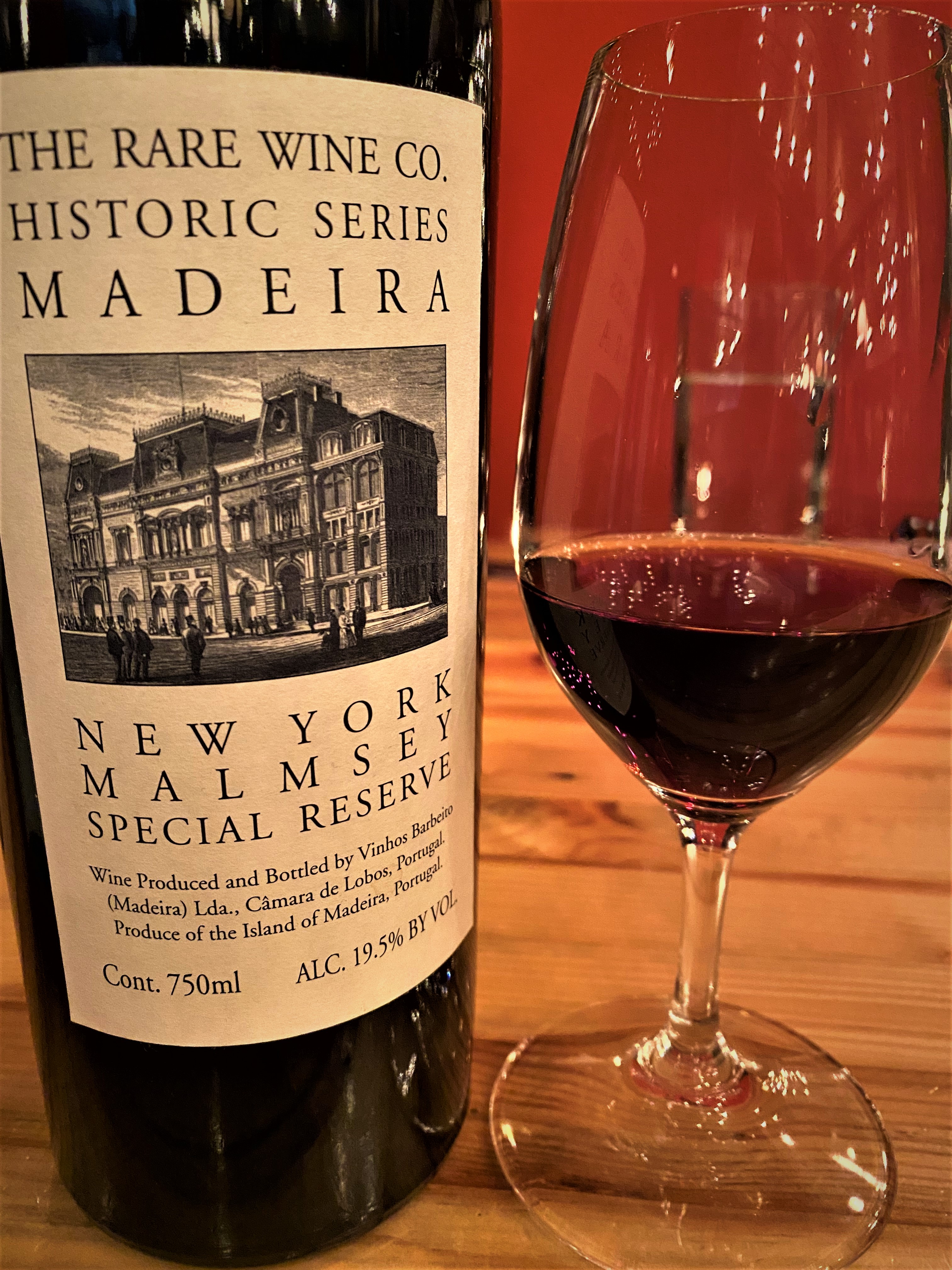
We started with a glass of The Rare Wine Company Historic Series Madeira New York Malmsey Special Reserve NV made by Barbeito in Madeira, Portugal.  It may be one of the longest names for a wine and it is a classic caramel-based wine that can possibly live forever, even after opening with just a classic cork as a stopper.  The Rare Wine Company was and is the pre-eminent source of Vintage Madeira from the 18th, 19th and early 20th centuries and in 1998 they began working with Vinhos Barbeito to create a series of Madeira wines with the proper blending of wines from ten to sixty years.  The use of different cities with old engravings on the labels tie the historical connection of America to Madeira, as the Old South preferred dry, the North preferred the sweeter Madeira like the Boston Bual and the New York Malmsey.  Malmsey is a fortified wine made from a group of varieties of the Malvasia grapes under the rules of Portugal’s Madeira DOC.  Malmsey is the sweetest and richest example of Madeira and contains more than twice the residual sugar of a Madeira Sercial or Madeira Verdelho. The name Malmsey is probably a bastardization or a second corruption, in nicer terms, of mariners trying to pronounce the Portuguese name.  This was a beautiful dessert wine that was sweet, but not cloying and very balanced.  With a nose of figs and dates and a touch of orange peel, the wine was very rich, with notes of fruit and a nice long count finish. 

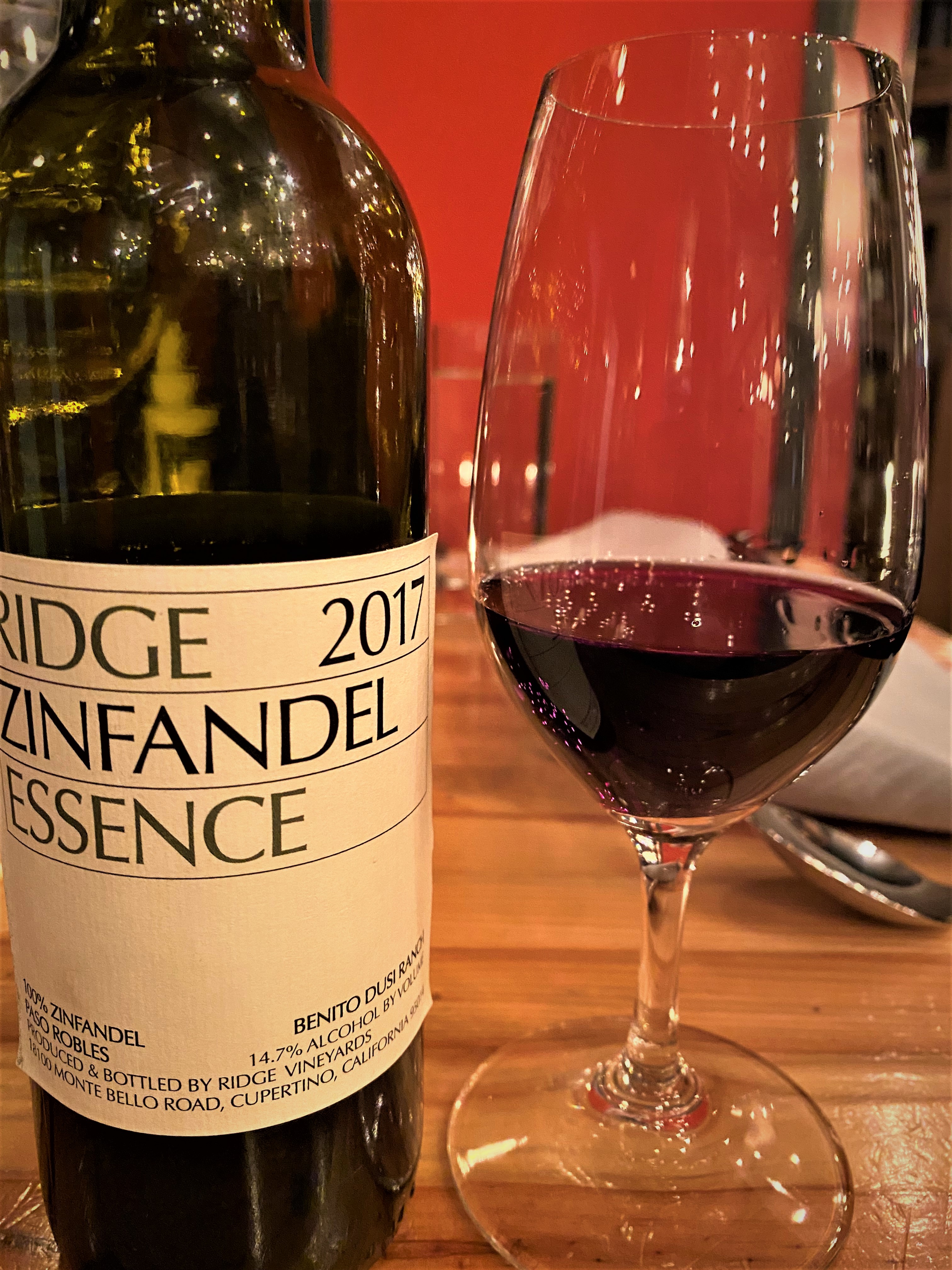
The other dessert wine that we shared was Ridge Vineyards Zinfandel Essence Benito Dusi Ranch 2017, that was quickly sold out and the only other vintages that I have found was from 2003, 2001 and 1986, but this was the first from the Benito Dusi Ranch.  Ridge Vineyards is one of the old and famed California wine producers, founded in 1962 and based in the Santa Cruz Mountains, but they also have vineyards in other parts of the state.  They are famed for their Cabernet Sauvignon based “Bordeaux” blends, as well as their Zinfandels, Petite Sirah, Carignan, Grenache-Mataro blend and a Chardonnay.  The Benito Dusi Ranch is three miles south of Paso Robles and the only vineyard for Ridge in the Central Coast.  The ranch is twenty-five acres of Zinfandel planted in 1922.  The grapes for this wine were picked at extreme ripeness, the free-run juice was fermented quickly, and then the press wine with the increased sugar content was added back and it naturally stopped fermentation.  The fruit was hand-harvested, destemmed and crushed, using only native yeasts.  The juice was aged for eleven months in air-dried American Oak, of which sixty percent was new.  There were fourteen and a half barrels produced of this wine.  On the average, this type of wine occurs maybe once every five years.  The wine was a deep garnet, with a nose of dried cherries, plums and spices.  The taste was opulent with black cherries, terroir and a lively-fresh acidity that finished with a very long count finish that just totally impressed this old jaded wine drinker, and my Bride was very excited by it, as well.  Our dinner experience at Vertical was wonderful and we look forward to the next time.    

Posted in Dining, Wine | Tagged , , , , , , , , , , | Leave a comment