Le Petit Smith Haut Lafitte

We were doing some tasting at The Fine Wine Source in Livonia, Michigan and little did I know that my Bride thought she needed a few more presents under the tree for me.  So, she had an ulterior motive, but we also know that she enjoys tasting wines.  Chateau Smith Haut Lafitte in the Pessac-Leognan region was rated a Grand Cru Classé during the 1959 Classification of the Graves for its red wine; today it is also considered one of the finest examples of white Bordeaux. The second wines are labeled as Le Petit Smith Haut Lafitte; the red was introduced in 2010 and the white in 2013; and the juice is selected from lots identified during the blending of the Grand Vins.  The estate is seventy-eight hectares of organic vineyard on a low hill of stones and pebbles, which offers great drainage and reflects sunshine to the vines as well.  The vineyard is farmed organically, and produces its own compost, even using a horse to plow the white wine vineyard; they also maintain their own apiary system, a vine nursery and inhouse cooperage.  Grapes have been grown and cultivated on the property since 1365 on a gravel plateau that was termed as a Lafitte back then.  The current name comes from a Scottish wine merchant George Smith that built his manor house on the grounds.  In 1958 the estate was purchased by the Louis Eschenauer company who invested in the property.  Since 1990, the property has been owned by Florence and Daniel Cathiard and besides the estate they also own Caudalie company, whose beauty care products are made from grape seeds and vine cuttings.  Les Sources de Caudalie is a well-known “Spa Vinotherapy” set among the vineyards, and a similar facility is in the Cheverny region of the Loire Valley.

We started off tasting Chateau Smith Haut Lafitte Le Petit Smith Haut Lafitte Blanc Pessac-Leognan 2020 and was originally labeled as Le Petit Haut Lafitte Blanc.  The Stealth Cellar is their energy-plus facility and they do all the winemaking for the estate, using the same process for all of their wines.  The yield for the white wines comes from twenty-nine hectares and three white wines are produced from this lot.  The wine is a blend of eighty percent Sauvignon Blanc and twenty percent Semillon.  The fruit is hand picked into small crates and pressed in an oxygen-free environment, to preserve the aromatic potential of the grapes and fermentation takes place in French Oak barrels of which fifty percent is new after a cold settling of the juices.  The wine is aged for ten months on the lees with constant batonnage.  The wine is a light golden-yellow wine and offered notes of grapefruit, orange rind, honeysuckle, vanilla, and almonds.  On the palate the tones of citrus, honeysuckle, vanilla, and almonds blended in a medium body wine that was rich and creamy and finished with a minerally terroir.  The estate makes this wine to the same standards as their Grand Vin, but with less barrel aging.

Then we followed with a tasting of Chateau Smith Haut Lafitte Le Petit Smith Haut Lafitte Rouge Pessac-Leognan 2020 and this wine was originally labeled as Le Petit Haut Lafitte Rouge.  The estate uses more than one-hundred hand pickers to select the grapes, and the picking dates are influenced by a row-by-row imaging from the Oenoview satellite system.  The also employ a Vistalysis optical scan for each berry, to remove lesser-quality fruit. The estate is famed for having one of the largest underground cellars in Bordeaux.  The fruit is from a thirty-hectare lot, that furnishes all the red wines produced for the estate.  The wine is a blend of sixty percent Cabernet Sauvignon and forty percent Merlot.  The grapes are sorted twice, before and after destemming; and are not pressed before undergoing fermentation in vats.  Tannins and color are extracted by punching down and/or pumping over for a period of fourteen months, with twenty percent new barrels.  A deep garnet colored wine offering notes of black fruits, licorice, and dark chocolate.  On the palate there were tones of plums, cherries, currants, chocolate, licorice with a sense of smoky, silky tannins and a nice medium count finish.  Even though this wine was medium-bodied it was so lush and rich, easy to see it in the cellar for twenty years.  We ended up with a nice wooden six-pack of each.         

Posted in Wine | Tagged , , , , , , , , , | Leave a comment

Christmas 2023

We had a very busy morning on Christmas, not only did we open our presents and she sneaks a couple that I didn’t know about; she also lectors at her church, and then she did a Christmas Mass and delivered communion as a Eucharistic Minister at a senior citizen home.  We then drove to the other side of the world, or at least it seems, to have a Christmas brunch at the home of another sister.  At first, because of my Bride’s volunteer work, it didn’t seem if we would have time to get there, as they had somewhere to go, later that day, but it was later, than originally thought. 

My sister-in-law has a husband that enjoys being in the kitchen, and he also can bake up a storm.  So, when we got there, now you have to understand that the greater Detroit area is huge and it can take an hour or so, to get from one community to another using the highways.  One group of relatives had already dined and there was plenty still waiting for us, as there was a fresh Quiche Lorraine just coming out of the oven, along with bacon, pancakes, and French Toast.  And we were having Mimosas.  I gave our one nephew a lesson in the fine art of making a Mimosa.  Fill the glass with your choice of sparkling wine and then add a tincture of orange juice.  They were using La Marca Prosecco DOC NV. The company was founded in 1968 as a cooperative of wine growers in the Veneto and Friuli-Venezia Giulia region of Italy.  Since its beginning it has now grown and comprises nine cooperative wineries predominately in the Prosecco DOC region. These wine growers comprise some nine-thousand hectares of vineyards of mainly Prosecco (or Glera when the grape is not from the DOC district) as well as a few other grape varietals for some of the other wines that they produce. La Marca uses the Charmat Method and they do a great job with it.  In 2007, Wine Spectator magazine listed La Marca as being one of the “Top 100 Wines of the Year.” The wine is an easy crowd pleaser and never disappoints.

When we got there, another bottle was opened and it was Mawby Vineyards and Winery now known as Mawby Sparkling Us Brut Michigan NV. You can find Mawby out near Suttons Bay and whether you know it as L. Mawby Vineyards or M. Lawrence, one thing is for sure you will have a fun time visiting the winery and tasting/drinking the wines.  I have probably written about Mawby the most of all the wineries in Michigan and part of that is because my Bride has fallen in love with their products.   In 1973 Larry Mawby founded Mawby Vineyards with a small parcel of land.  He had a passion to make wine and that passion led him to now only making sparkling wines from the Nineties on to date.  In 2009, he began a partnership with the Laing Family; but I have often heard with respect from the other wineries that Larry Mawby is considered the “Godfather” or the “Dean” on winemaking in the region.  The Us NV was a classic blend of Chardonnay, Pinot Noir, and Chambourcin aged in Stainless Steel.  The grapes are hand-harvested, and whole-cluster pressed, using only the initial pressed juice and the three juices are blended before Initial Fermentation.  The wines then are produced in the Charmat Method then later blended with some reserve wine, aged and with an added dosage to maintain a certain finish and bottled.  A soft golden color that offered notes of red fruit, and on the palate the notes of ripe fruit was apparent.   I would recommend this wine to anyone that likes a nice traditional tasting sparkler with some fruit in the finish, but dry and crisp.

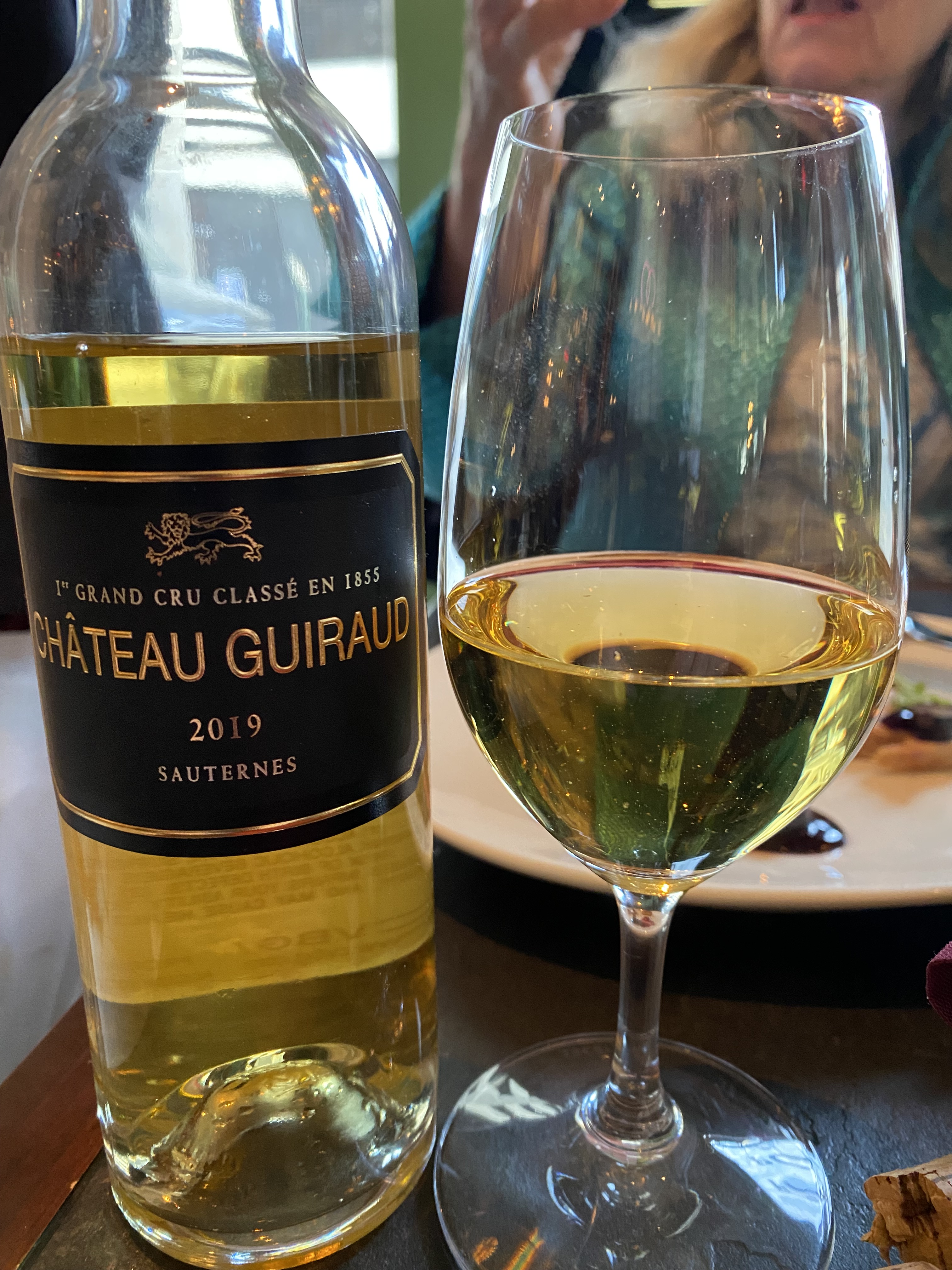
We eventually got home and it was just the two of us to rest and enjoy the evening.  My Bride wanted to make one of our favorite dishes when we go out, and though she will admit that it isn’t as fine as from the restaurant, it was still delicious and hit the spot.  She made for the two of us her interpretation of Coquilles St. Jacques al crème de Xeres, or Sea Scallops sautéed with mushrooms and garlic, pan-sauced with Sherry and cream with rice.  I had also selected a wine the day before to make sure it was chilled Le G de Chateau Guiraud Bordeaux Blanc Sec 2018.  Chateau Guiraud is classified as a Premier Cru in the 1855 Classification of Sauternes and Barsac.  It was originally known as the Noble House of Bayle, but it was bought by Pierre Guiraud in 1766 and passed through many generations of the family until it was bought by a group of French winemakers in 2006.  The Chateau has two-hundred-ten-acres, of which the majority of the land is planted with Semillon and the balance is Sauvignon Blanc. While most Bordeaux Blanc Sec wines are predominately Sauvignon Blanc, Le G de Chateau Guiraud is fifty/fifty.   The fruit is manually harvested using small baskets and fermentation is for about three weeks.  Eighty percent of the wine is aged in the barrels from the last vintage of Chateau Guiraud and twenty percent is done in Stainless Steel. The average aging in the barrels is seven months with regular stirring of the lees.  This is a very lush and full-bodied white wine with a delicate gold tinge, a very refreshing wine that leaves one chewing the wine to appreciate the suppleness of the fruit and the terroir that lingers and beckons for another taste.  The perfect way to end our Christmas Day.

Posted in Dining, Wine | Tagged , , , , , , , , , , , , , , , , , , , | Leave a comment

Christmas Eve 2023

Since my Bride is one of five sisters, the desire to do holidays is always at the forefront.  One sister is exempt, because she doesn’t live in the state, and one just doesn’t.  There was a bit of drama, as to whether the hostess of Christmas Eve was going to have to cancel, because she was sick, and we were going to have the dinner at the last minute; but sister was given a conditional bill of health that it was just a cold; because it could have been worse. 

We brought some wines to share for the evening, and during the appetizer portion of dinner, one of the wines we brought with a nephew in mind was Weingut Krayer Johannisberger Klaus Auslese 2015.  The first mention of the Johannisberg vineyards was in 817, but it was in the 12th Century that the region was named after John the Baptist.  This region of the Rheingau, Johannisberg has four Grosse Lage (great location); Schloss Johannisberger, Klaus, Holle and Mittelholle. The vineyards are made up of loess and loam soils derived from the nearby Taunus mountains.  The Klaus vineyard is just under one hectare of south-facing land on a slight incline at the foot of the hill.  It has deep calcareous loess and gravel deposits.  The winery was founded in 1866 and family run.  Auslese is a later picking of the grapes and they show the noble rot that is prominent for the region.  A golden colored wine that offers notes of white fruit, elderflower and saffron.  On the palate, this is an off-dry wine with tones of peach, apple, and apricot, fresh acidity; a lighter, softer wine with a decent count finish of fruit and mineral terroir.

One of the main courses for the dinner was an air-fried turkey, my brother-in-law likes to cook, but he also likes toys and gadgets and he replaced his deep-fried turkey of days gone past, for this new version, and the turkey came out very moist; as I got first taste, because my Bride volunteered me to carve the bird.  One of the wines that I thought would be interesting was Roberts + Rogers Mendocino County Red Wine Blend NV, a special proprietary wine that was blended by Roger Louer, Jim Lufty of The Fine Wine Source and Remy Lufty of the restaurant Vertical Detroit. The juice is a blend of two different years, hence the NV status and a blend of Petite Sirah, Zinfandel and Merlot. As an aside, Jim told me that there are probably about sixty different varieties, as he was referring to all the different clones that have been planted, as well as the “California Blend” that is found in older vineyards, which is a nice way of saying that some of the old vines that were planted have been mis-identified or forgotten about and could almost be anything, but those old vines do add character.  A very pretty garnet color with notes of red fruit and spices.  On the palate a big fruit forward wine of black and red cherries, good tannins, well balance with a finish of terroir. A good solid red with a limited production of two-hundred cases that is affordable.

The dinner was also having a roast, so I decided to bring along a bigger red, as well, plus I wanted to see how it was cellaring, because I remember that we bought the last case of this wine in Michigan.  Now I make no bones about the fact that I am not a jock, and that I really dislike watching professional sports, but on occasion I will try to play most sports. The only two sports that I won’t even play as I don’t understand the games is Basketball and Soccer, because they just appear to be organized chaos to my mind’s eye, but I can appreciate the quality efforts of any true athlete. Now just because I don’t follow sports, there are still some athletes that one automatically hears about when they are good, and one basketball player was Yao Ming who stood 7’6” and was actually well coordinated and a star, in fact he retired from sports in July 2011 and began a new career as a winemaker in November 2011, barely enough time to realize that he had retired. Yao Family Wines owns no vineyards in Napa Valley, but they do have a tasting room in St. Helena, with contracts with vineyards in Coombsville, Atlas Peak, Oak Knoll District and St. Helena, but the wines carry the Napa Valley AVA. The Yao Family Wines Yao Ming Cabernet Sauvignon 2014 was the perfect wine to end the evening with. The wine was almost entirely Cabernet Sauvignon, but there was 5% Merlot, 3% Cabernet Franc and 2% Petit Verdot, and of the Cabernet Sauvignon there were three different clones and each was vinified separately before the blending. Here was a wine that was aged for eighteen months in French Oak, of which 65% was new, and they had created a wonderful drinking wine, and, it was stated that the winery feels that ten to fifteen years of cellaring would be easy for this wine. There were twenty-eight-thousand cases produced of this wine and the wine was really aimed for the Chinese market, which was just starting to get hot at the time.  This was a dark black-garnet colored wine with notes of black and violet fruits, vanilla, and spice.  On the palates there were tones of blackberry, black cherry, cassis, and plum, woven with spices, and the tannins were soft and supple and very integrated with a nice long finish of fruit and terroir.   

Posted in Dining, Wine | Tagged , , , , , , , , , , , , , , , , , , | 2 Comments

An Afternoon with Ms. Yoga

It has been crazy trying to keep up since probably October, any semblance of a chronological order or sequence, so I am just going to write about wines without any time consequences.  There is something called the “cloud” that I never asked for, that is going crazy with my photos, but that is fine, as I think that I will live. 

When Ms. Yoga was in town we decided to stop and have an afternoon snack in Plymouth.  You have to understand that Ms. Yoga likes to nosh, so charcuterie boards are perfect for her.  Actually, years ago, Ms. Yoga lived in Plymouth, when I first met her, but the city is totally changed since those days.  Ms. Yoga decided that she was going to enjoy a Louis Jadot Steel Chardonnay Vin de France 2022.  Louis Jadot began as a negocient in 1859 based in Beaune, one of the centers of the Burgundy region of France.  The Louis Jadot firm has a portfolio of wines from the basic regional wines to some of the most lauded vineyards in the region.  The firm was acquired in 1985 by the owners of US wine importer Kobrand, which still owns the company and imports Jadot’s wines into the USA.  This particular wine carries the Vin de France appellation which has replaced the old Vin de Table or Table Wine, which became the kiss of death to most merchants and to the buying public as well.  This is a bulk wine that caters to the crowd that wants a Chardonnay instead of a French Chablis.  It is also proclaiming that it is a Steel Chardonnay, so there is not oak aging, so it is an easier and less costly wine to produce, and the grapes only have to be from France to appease the appellation laws.  It was a pretty golden-yellow wine that offered notes of citrus, green apples, and white florals.  On the palate, the wine had tones of green apple, a touch of lemon-lime, a trace of almonds, quite crisp and refreshing with moderate acidity and a medium body with finish of some fruit and alcohol.  An easy drinking Chardonnay with and easy to understand with a charcuterie board.   

My Bride has been on a sparkling wine kick, but not a Champagne girl.  She had Da Luca Sparkling Rosé Sicily NV.  This was another bulk wine made using the Charmant Method or the Tank Method.  I am going to venture that the wine was made using Moscato grapes, as it was made for quaffing and casual dining.  A coppery-pink wine with plenty of medium size bubbles and offering notes of strawberry and cream.  On the palate there were tones of strawberry and raspberry, with traces of cream and a short finish of fruit and minerals.  I think it would have been more refreshing on a summer afternoon, but it was pleasant enough to please my Bride.

As for me, I went with Bieler Pere et Fils “Sabine” Coteaux D’ Aix-en-Provence 2022.  In 1992, Philippe Bieler founded Chateau Routas in Coteaux Varois, a small appellation in the middle of Provence. A few years later, two of his children became involved, they had a chance to sell the Chateau and founded Bieler Pere & Fils.  The Coteaux d’Aix-en-Provence appellation was originally a VDQS in 1956, as it was unofficially known as Coteaux du Roy Rene (Rene D’Anjou who loved the local wines back in the 15th Century.  The region was granted AOC in 1985.  The wine is a blend of 32% Grenache, 23% Syrah, 17% Cinsault, 11% Cabernet Sauvignon, 9% Rolle, 5% Grenache Blanc and 3% Counoise.  Each block of grapes or vineyards are fermented separately using different yeasts and different lees treatments.  Each tank of grapes is treated with nitrogen gas, so that there is no air contact with the juice, until it is fully blended and then bottled to maintain the fruit.  A pretty pink/salmon shade that offers notes of peaches, white cherries, raspberries, tea and Provence herbs.  On the palate tones of red fruits, stone fruit, tea, and spices in a brightly acidic wine that finishes with fruit, rose petals and wet stones.
Posted in Dining, Wine | Tagged , , , , , , , , , , , , , , , , , , , , , , | Leave a comment

Champagne and Sparkling Wine for the New Year

We were still tasting French Champagne at my local wine shop The Fine Wine Source in Livonia, Michigan.  All the wines were from the House of Louis Roederer of Reims in 1776, and then later a nephew Louis Roederer took over and renamed the house after himself; and still family owned.  In 1845, they were far-sighted enough to purchase several grand cru vineyards to add to the estate, instead of solely relying on the local growers for grapes.  Today they own six-hundred acres of land in the Montagne de Reims, Vallee de la Marne and the Cotes de Blancs.  By 2012, they had achieved a twenty-five percent managed biodynamically estate, and Cristal is made from biodynamically farmed grapes.

What better way to bring in the New Year than by tasting Louis Roederer Cristal Brut Millesime 2015.  Louis Roederer attempted to capture foreign markets and was a favorite of the Russian royal family.  They went so far, as to create a special bottle that was clear and had a flat bottom (no punt), because Tsar Alexander II was paranoid and thought that the traditional style bottle could be used to hide explosives.  The wine is produced using about sixty percent Pinot Noir and forty percent Chardonnay, and portions of the blend are aged in oak barrels for a time.  This vintage also saw fruit harvested from all forty-five estate plots where the vines are at least twenty years of age.  Cristal wines are released under the Vinotheque label, which is a combination of late disgorging and extended lees aging, as well as further time cellared in the bottle.  It is aged for six years on yeast and a further eight months in the bottle.  A beautiful golden-yellow wine with very energetic tiny bubbles and it offered notes of red fruit and yellow fruit, wheat, yeast, and almonds.  On the palate the tones of lemon and mandarin are immediate, blended with nuts and spices, bracing and refreshing, silky brioche, great salinity, some oak, perfectly balanced and all leading to a great long finish of fruit and chalky terroir.  I don’t drink Champagne that often, so I had to write my notes quite quickly and I also listen to the professionals when they discuss the wines as well.

The last tasting was Roederer Estate L’Ermitage Brut Anderson Valley 2017.  Roederer Estate was created by Louis Roederer Champagne in Anderson Valley in 1982 and their first release was in 1988.  The sparkling wines are made using Pinot Noir and Chardonnay with the Methode Traditionnelle.  The estate is six-hundred-twenty-acres of vineyards farmed with organic and biodynamic methods; the estate grown fruit is able to ripen slowly and retain acidity, which is key to the production of sparkling wine.  Only the first pressing of fruit (roughly seventy percent) is used.  Fermentation is done in Stainless Steel tanks, and the wines are blended with oak-aged reserve wines and spend a minimum of two years on the lees, prior to disgorgement.  L’Ermitage is Roederer’s prestige cuvée and only made in exceptional years from the estate’s best Pinot Noir and Chardonnay and the first vintage was 1989.  The wine is a golden-yellow with fine tiny bubbles and offers notes of yellow apple, pear, white flowers, brioche, and hazelnuts.  On the palate a crisp wine with tones of pears, brioche, acidity, and a soft finish of fruit.         

Posted in Wine | Tagged , , , , , , , , , , , , , , , | Leave a comment

Champagne to Ring in the New Year

I had the chance to do a wine tasting at The Fine Wine Source in Livonia, Michigan centering on Champagne.  Champagne is that mysterious sparkling wine that gets bundled with all of its distant relatives.  To be Champagne, the wine must come from the designated district of Champagne, otherwise in France the wines are either called Cremant or a Sparkling wine.  The name is now protected world-wide, though there are a few wineries in the United States that have been grandfathered in as “American Champagne.”  Five wines were offered at the tasting and all were from the Reims based house of Louis Roederer.  Although founded in 1776, it was in 1833, when Louis Roederer took over the company from his uncle and renamed the house after himself.  

We began the tasting with Louis Roederer Champagne Collection 243 NV.  Collection 243 is based on the year 2018 and the fruit is harvested from three of their estate vineyards, as well as from some of their contract grower estates.  It is a blend of forty-two percent Chardonnay, forty percent Pinot Noir and eighteen percent Meunier.  This juice is also blended with their “Reserve Perpetuelle” created in 2012.  This collection is fifty-nine percent of 2018 vintage, and thirty-one percent Perpetual Reserve of 2012,13,14,15,16,17, and ten percent Reserve wines aged in oak from the same years.  A pretty golden color with shimmering highlights from the constant flow of tiny bubble.  The wine offered notes of yellow fruits, citrus, white florals, and baked pastries.  The palate produced tones of plums, lemons, and jasmine in a taut structure with a refreshing salinity and a nice finish of tart fruit and limestone terroir.  

We then went with Louis Roederer Champagne Brut Vintage 2015; which is also the year that the Champagne region was recognized as a UNESCO World Heritage Site.  It was a year of some record breaking hot and sunny days, and followed by a second half of August which brought some welcome rain and created juicy and concentrated grapes.  The fruit came from two Crus: Verzy and Chouilly; and from their “La Montagne” estate vineyard.  The wine is a blend of seventy percent Pinot Noir and thirty percent Chardonnay, with thirty percent of the wine aged in oak.  A yellow wine with golden tints and lively bubbles, this wine offered notes of currants, plums, peaches and a dash of pepper and spices.  On the palate tones of concentrated red and yellow fruits, with some cocoa, big acidity, some salinity and a finish of fruit and terroir.

We then had a chance to compare it to the Louis Roederer Champagne Brut Rosé 2015.  Champagne Rosé is the appellation for Champagne tinted pink by the dark pigment contained in the skins of Pinot Noir and Pinot Meunier grapes.  An extraordinary vintage for Champagne and the fruit for this wine comes from two Crus: Cumieres and Chouilly and from their La Riviere estate vineyards.  The wine is sixty-two percent Pinot Noir and thirty-eight percent Chardonnay with eleven percent of the wine aged in oak.  The rosé was created by a long, gentle infusion of Pinot Noir, and adding some Chardonnay juices to the Pinot Noir during maceration, to ferment together for the perfect integration of the two grapes.  The salmon-colored wine with fine energetic bubbles offered notes of currants, blood orange and a touch of cocoa.  On the palate the tones of blood orange were prominent, with florals blending with saline for a tangy and ending with a finish of fruit and terroir.       

Posted in Wine | Tagged , , , , , , , , , , , , , | Leave a comment

Christmas Dinner 2023 with Two Raconteurs

It just wouldn’t be Christmas without The Wine Raconteur, Jr., a sobriquet that he gave himself, when he guest wrote a couple of articles for me.  We met when I was posting a job at his college and he immediately responded and we have been pals ever since.  Even our Brides get along, and they probably both think that I am daft, but that is a common perception. He wanted to host, to make it easier for his children to do their thing, after dinner, they would probably be bored at our house.  So, we brought the wine.

We started out with some appetizers, assemble charcuterie snacks, mixed olives, and freshly roasted nuts.  And I brought out a bottle that my Bride and I have been waiting to have, but it had to be with the right couple that could appreciate the wine.  I brought a bottle of a rather unknown white wine that carries the Appellation Bordeaux Controlee, which would not be all that remarkable, except that this wine is Chateau d’Yquem “Y” Ygrec Bordeaux 2017 and not Chateau d’Yquem Sauternes that was famous and still has representation in the wine cellar of Thomas Jefferson.  Chateau d’Yquem is by far the most famous dessert wine in the world and has definitely made the Sauternes district of Bordeaux prime real estate.  In the Classification of 1855 of the Medoc, it was the only estate to be rated as Premier Cru Supereiur and it still is, and while most say it will be great for a good fifty years, there are others that feel that it is the longest-lived wine and may be eternal.  The Yquem estate was owned by the King of England in the Middle Ages and has been producing late-harvest wines since at least the late 1500’s.  It is a two-hundred-ninety-acre vineyard situated on the highest hill in Sauternes.  Possibly the ideal setting to produce sweet wine; a warm, dry topsoil of pebbles and course gravel over a subsoil of clay that retains water reserves which aids the development of “noble rot” and the property has about sixty miles of drains to prevent waterlogging.   There have been nine vintages that were never produced in the last century, because the wine did not meet the specifications required.  The estate was under the Lur-Saluces family from 1785 to 1999 when it was sold to the luxury brand LVMH.  Y or Ygrec is a rather rare wine for the estate as they produce about ten-thousand bottles each year.  It was originally made at the end of the harvest with the last bunches of grapes since 1959 and in 1966 the selection of the grapes changed and the wine is basically Sauvignon Blanc (eighty percent) picked at the beginning of the harvest and a small amount of Semillon with Botrytis (twenty percent) and in 2004 the brand was to be produced every vintage.  They now have a state-of-the-art vat room just to make this wine and it is vinified first in Stainless Steel vats, and no Malolactic fermentation; and the aging on the lees take place in French Oak, of which half is new, for an average of ten months, and regularly stirred for the ten months.  There is no second label for either wine produced at the chateau.  A beautiful golden colored wine that offered notes of grapefruit and tangerine.  On the palate tones of peaches, apricots, and pears with refreshing salinity and bright acidity that finally ends with a fantastic finish of dried mango and pineapple and a wonderful slate terroir.  This was just beyond any White Bordeaux that you will ever encounter.  Dinner could have ended here. 

The second course was a Rosted Pork Tenderloin with a side of Smashed Potatoes, and both were exceptional. The wine we had was Familia Fernandez de Manzanos “Manzanos Red Wine 1955 Spain.” Bodegas Manzanos is a large wine producer in Spain, founded in 1890 and is now run by the fifth generation of the Fernandez de Manzanos family.  They are in the top three of Navarra and the top five in Rioja for production and they own ten wineries.  The original winery for the family is in the Rioja Alta zone back in 1890.  The newest generation has been going through all the facilities on all the properties.  Around 2020 they discovered a cache of bottles under canvases, forgotten and untouched since they bottled the wine 1961 Vino Tinto, so probably 1964/5.  They originally must have thought that the wine could use some additional maturation time in the bottle, and it was forgotten about in a hillside cellar.  History sometimes has a way of repeating itself.  A hidden cellar was discovered with three hundred some bottles of a 1955 vintage.  They contacted the Rioja Association who oversaw that each bottle was opened using inert gas and checked to have no flaws, poured into a Stainless-Steel vat.  Then new bottles, new labels and they ended up with about one-hundred pristine bottles of Familia Fernandez de Manzanos “Manzanos Red Wine 1955 Spain.” Some background on the wine.  This wine is a blend of Tempranillo and Garnacha (Grenache) from vineyards of  predominantly alluvial and clay-ferrous soils.  The fruit was harvested in the manner of the mid-Twentieth Century tradition of hand-picking in small baskets.  The aging was done in old oak barrels.  This wine offers a window into how Rioja wines were from that era.  The wine still had a nice garnet color with bright highlights to it, in the glass and it offered notes of dried fruits, spices, cocoa and an unmatchable nose of tradition and age.  On the palate there were tones of dried fruit, totally different from fruit-bombs that are the rage these days, and blended in with layers of sous bois (a descriptor that I seldom use, but for this wine, I guess it is imperative, and it is used to convey a wet forest floor – earthiness – an ethereal term) and old tobacco. 

For dessert The Wine Raconteur, Jr. made a Pear Tartine; he is much more elegant and refined than I am, and a far superior man in the kitchen.  I brought a bottle of dessert wine that took my breath away, and then the same thing happened when my Bride tasted it.  We opened a bottle of Roberts + Rogers Louer Family Cabernet Sauvignon Port Napa Valley NV.  I had no information about this wine, nor could I find any, it was like it didn’t exist.  I called and got ahold of Roger Louer, who I have met a couple of times at The Fine Wine Source and he gave me some information.  After the Cabernet Sauvignon vines were picked for the wines, they went out a picked whatever late-harvest berries were left on their St. Helena estate and they were reading around 25 brix and after fermentation they added brandy and got the wine down to nine percent sugar reading.  They only made one barrel of this wine, and they aged the barrel for one year.  They produced about forty cases, because they were the smaller 375ml bottles.  The wine was really made for their family and friends’ usage, but the wine shop and the winery have a long record of association and the shop got a few cases.   They have only produced this wine perhaps every five years or so, and I was told that in the future the bottles would read “Port-style.” The wine was a deep-dark red wine that offered notes of dried fruits, candied nuts, and spices.  On the palate there were tones of figs, black fruit, caramel, mocha, and nuts with a very long finish of dried fruit and nuts.  I just teased The Wine Raconteur, Jr. with tidbits of the wines I was going to bring, and his culinary skills paired flawlessly and it was a memorable meal. 

Posted in Dining, Wine | Tagged , , , , , , , , , , , , , , , , , , , , | Leave a comment

Merry Christmas 2023

My Bride and I wish everyone a Merry Christmas as we slowly adjust to our new found independence as retirees.  We are slow to change habits, like having everything done and out of the way before Thanksgiving.  A habit left over from my retailing days, as my hours would increase, and if I had a day or night off, I did not want to spend it in another store.  The other bonus to that scheme, is that all the costs were paid for in December, and then we could think about a well-deserved vacation in January or February.

We enjoy the Christmas season to spend time with family and friends and wish the best for everyone.  I even love the music, which so many seem to castigate with scorn.  I remember the last business I helped, they allowed their “manager” full reign and he wouldn’t play Christmas music, unless it was totally undecipherable as Christmas music.  I actually had to complain, to get the business to play music that the customers were expecting to hear.  Oh well, perhaps I am old-fashioned, but I do make a great curmudgeon. The customers enjoyed the music and even stated it, so not everything old is wrong.  

Also, after Christmas, comes the New Year, which we can celebrate with good cheer.  Then Orthodox Christmas appears in January and it is subtle and understated; and to me and many others it signals that the decorations can come down for another year.  As a retired retailer, I still enjoy the seasons, but Christmas should not appear until after Thanksgiving, I think it is appalling to see it appear after “Back to School” promotions in September.  Allow my Bride and I, once again a chance to wish you a Merry Christmas with plenty of good health, happiness, luck and love.      

Posted in Uncategorized | Leave a comment

Ms. Yoga Returns for Christmas

Ms. Yoga has arrived for one of her business trips and she had a chance to have dinner with some of her former business acquaintances, who have joined the ranks of retirement.  She came into town the other days, saw some of her family, went to have some appointments, met us all and then she was going to the west side of the state for more business.  She is always on the go.  She had asked me to make a dinner reservation for eight people at three on a Monday afternoon, and where she wanted to go, was not going to happen.  Since our state is still recovering from draconian shut downs, the restaurant industry has not recovered and everyone is still on abbreviated hours, as there are no longer employees left in the industry.  I finally found two places that would work logistically, and she chose one of the two.  She then went shopping the day before with one of her nieces and tried the restaurant ahead of time.

My Bride and I got to the mall, where the restaurant was, and we walked the premises upstairs and downstairs to get some our “steps” in.  We got to the restaurant about ten minutes early, but they wouldn’t seat us, until the specific time and after there was a few more to arrive for our party, as they had allotted us two hours for the dinner.  I thought it was rude of them, but I stayed civil.  We were finally seated and everyone tried to make some sense of the menu and we started out with some appetizers. To begin with, I ordered a bottle of Hess Select Chardonnay Monterey County 2021, part of the Hess Family Estates of Napa, which is now Hass Persson Estates; as Ms. Yoga loves Chardonnay.  Donald Hess began the saga in 1978 with an original purchase of nine-hundred-one acres of land in what is now Mount Veeder in Napa Valley and with land to remain underdeveloped in support of local wildlife.  In 2008, it was one of the first ten wineries to receive a Napa Green certification and they have continued to strive for other designations since them.  They have survived the Napa Earthquake, fires and mudslides, which all led to renovations and upgrades to the winery, the visitor center and the art museum for the now renamed Hess Persson Estate, to acknowledge his daughter Sabrina and husband Tim Persson.  They created the Hess Select division when they entered Monterey County.  This wine is a blending of their Chardonnay grapes, using seventy-five percent aged in Stainless Steel and twenty-five percent in new French Oak.  I have been a fan of Monterey County for Chardonnay and Pinot Noir wines, because of the ideal climate of cooling fog, coastal breezes and a longer growing season.  A pretty golden-yellow color that offered notes of pineapple, star fruit and vanilla.  On the palate there were notes of peaches, golden delicious apples with great acidity and balance, a crisp wine that proclaims Monterey and not Napa.  It was very refreshing and tasty, especially for a popular priced wine.         

For the main dishes, it was across the board from burger and sliders, to steaks and salmon.  Though for dessert, the flourless chocolate cake seemed to be the winner, and the coffee was done French-press.  My Bride is fond of this restaurant, as it is one of the restaurants that she meets her friends, as they go to the mall for their walking regimens.  I also ordered a red wine to go with all of the dinners, though this restaurant is very beer oriented.  We had a bottle of Franciscan Estate Cornerstone Cabernet Sauvignon California 2021.  Franciscan Estate was established in 1973 by Justin Meyer, who was the winemaker at Silver Oak Winery and with the help of Augustin Huneeus, owner of Quintessa Winery.  They began with two-hundred-forty acres in what is now the Oakville appellation, along with contracts across the Napa Valley.  They are famed for their flagship Magnificat Cabernet Sauvignon blend.  The winery is now owned by E&J Gallo who has become a buyer of quality properties these days.  I couldn’t find any production notes for this wine and because it carries a California appellation, I will surmise that it is a bulk wine production, but I was pleased with the wine.  It was a deep-dark red wine that offered notes of blackberry, plum and touches of black tea, and clove.  On the palate, a rich “jammy” wine of black fruit with a touch of caramel and chocolate and a decent finish of fruit.  For a popular priced wine, I found no objections to it, and the people at the table all seemed to enjoy it.              

Posted in Dining, Wine | Tagged , , , , , , , , , | Leave a comment

Fine Wine Source December 2023 Club Selections

As everyone is getting ready for the Holiday Season, I had to make a stop at my local shop, The Fine Wine Source in Livonia, Michigan.  Once a month, I enjoy getting the curated wines that they select for the club as well as to admire some one-of-a-kind wines that they occasionally get, that would get any wine lover excited.  The club membership, besides the monthly pair of wines, also gets the member case-pricing on any purchase, which is a great perk.  Plus, the staff is so knowledgeable, it is always a pleasure to stop there. 

The first club selection representing the Old World is The Furst Cremant D’Alsace NV which is produced by Cave Vinicole de Kietzenheim-Kaysersberg.  Cave Vinicole de Kietzenheim-Kaysersberg is a cooperative of one-hundred-thirty landowners in the villages of Ammerschwihr, Kientzheim, Kaysersbert and Sigolsheim and covers one-hundred-seventy hectares of vineyards.  This cooperative is part of a much larger cooperative of successive merger and is now called Bestheim.  Cremant d’Alsace is an appellation created in 1976 covering the sparkling (Methode Traditionelle) white and rosé wines of the Alsace region.  The wines must spend a minimum of nine months maturing on their lees, before disgorgement and the dosage; all vital and required steps to comply with the appellation.  The Furst is produced in concert with the Dopff au Moulin Estate with seventy hectares of vineyards, and currently in the thirteenth generation of wine makers.  The Estate is located in the historic Riquwhir at an altitude of 300 meters in the foothills of the Vosges Mountains.  The Estate is also credited with the creation of Cremant d’Alsace and the creation of the distinctive tall, slender Alsatian wine bottle.  This wine is a blend of fifty percent Pinot Blanc and fifty percent Pinot Auxerrois.  The wine is described as having cidery aromas notes, and that on the palate the tones of apple, pear, lemon zest compliments a delicate mousse, and ending with a savory finish.

The second wine representing the New World is Peirano Estate Vineyards The Heritage Collection Petite Sirah Lodi 2020.  In 1879 Giacomo Peirano, a grape farmer from Genoa, Italy immigrated to San Francisco in hopes of becoming a gold miner, he realized that he was too late and moved to Lodi, home of many mining camps.  He opened up a shop to cater to the miners’ needs, he was successful, and went back to Italy to fetch his wife and brought back Italian Zinfandel cuttings as well.  He bought a three-hundred-acre farm and planted seventy-five acres of vines.  The family has been successful to this day with five generations.  The wine is pure Petite Sirah and the fruit is hand-harvested and it undergoes a rotary fermentation, which constantly blends the skins and pulp with the juice to extract all the flavor of this variety.  After the Initial and Malolactic Fermentation is done, the wine is transferred to French and American oak barrels, of which fifteen percent are new; for about thirteen months.  The wine is described as inky-black and offers notes of blackberries, boysenberries, and dark plums.  On the palate the tones of blueberries, plums, blackberries, and dark chocolate blend with harmonious tannins ending with a finish evoking more blueberries.    

Posted in Wine | Tagged , , , , , , , , , , , , , | Leave a comment