Mawby Sparkling

It is almost a sin, if we don’t stop at MAWBY Sparkling while we are up in the Traverse City area of Michigan.   You can find Mawby out near Suttons Bay and whether you know it as L. Mawby Vineyards or M. Lawrence, one thing is for sure you will have a fun time visiting the winery and tasting/drinking the wines.  I have probably written about Mawby the most of all the wineries in Michigan and part of that is because my Bride has fallen in love with their products.   In 1973 Larry Mawby founded Mawby Vineyards with a small parcel of land.  He had a passion to make wine and that passion led him to now only making sparkling wines from the Nineties on to date.  In 2009, he began a partnership with the Laing Family; but I have often heard with respect from the other wineries that Larry Mawby is considered the “Godfather” or the “Dean” on winemaking in the region.  In conversations over the years with winemakers they all hint at, but never describe the heart and largesse the man has, as well as his love for the local wine industry.

While he is a passionate winemaker and a conservationist, he has whimsy and fun at the winery.  The tasting room is built on a hillside and parts of the roof line are almost adjacent to the slope of the hill, so there is a sign asking “No fiddling on our roof.” We have never been there when it hasn’t been busy, there are the tour busses, but mostly when I look at the parking lot, it is individual cars there to do some tasting and most of the time buying.  Because the winery makes sparkling wine in both the Charmat Method that is so common in the New World, but they also make wine in the Classique Method, but they stress that they do not make aerated wines.  The winery is open year-round, because some of the wines take from one to seven years to produce, and some of the wine is Non-Vintage which allows them to maintain a certain taste and style year after year, just like they do in Champagne, France.  While I have never been to France, I would venture to say that the tasting rooms there are not as jovial and carefree as at Mawby, and when one tips the host/pourer the sound of bells fill the air and everyone knows that somebody was happy with their experience. 

The day that we were there, they were serving tastings from ten different sparkling wines and three ciders (which are also sparkling), the wines just like the tasting room are never still.  I also didn’t pay any attention if there was a fee for tasting or a limit, because I knew going in that my Bride was on a mission to get some wine.  The first wine that we tried was from the proprietary “Winemakers Selection” and never to be repeated.  The Freestyle is a Semi-Dry Rosé made from fifty percent Chambourcin and twenty-five percent Marquette and twenty-five percent La Crescent (a complex hybrid developed by the University of Minnesota and released in 2002 and Saint-Pepin and Muscat Hamburg are two of the grapes that were used).  The wine had a distinct deep pink color and a nice sweet finish that most people could have without any problems.  The next wine was the Sandpiper Semi-Dry NV, which we have had before, and is only available at the winery, it is aged in Stainless Steel and undergoes two fermentations and it a blend of Chardonnay, Vignoles, Cayuga, Riesling, Pinot Noir, Pinot Gris and Traminette.  I think that this could be the perfect everyday sparkler as it would pair easily with most dishes.  We then tried the Green Semi-Dry NV also done in the Charmat Method and is a blend of Cayuga and Riesling in a more fruit forward taste and finish.  The Us NV was a classic blend of Chardonnay and Pinot Noir, aged in Stainless Steel, then later blended with some reserve wine, aged and with an added dosage to maintain a certain finish and bottled.  I would recommend this wine to anyone that likes a nice traditional tasting sparkler with some fruit in the finish, but dry and crisp.  We had the Grace Brut Rosé NV done in the Classic Method using Pinot Noir grapes which were pressed whole cluster and fermented in Stainless Steel and then blend with reserve wine, bottled and aged and at degorgement a small amount of Regent is added to the bottle.  This wine reminded me of the classic “Pink Champagnes” of my youth with some great taste and a very pretty soft pinky-salmon color.  The last wine that we did at the tasting was the Talis Brut Estate Grown Traditional Method NV, a blend of Vignoles, Pinot Noir, Pinot Gris and Chardonnay grapes that were hand picked and pressed whole cluster.  The juice was fermented in Stainless Steel and blended with reserve wines kept in a solera system of oak barrels, and then fermented and aged in the bottle with the classic degorgement.  The wine had the pretty soft “gold” color with a deep rich taste and finish, evoking some toast to the pallet.   A wonderful time was spent there and I guess the staff thought I was old, as they carried the cartons to the car for us and we were on our way home.

Posted in Wine | Tagged , , , , , , , , , , , , , , , , , , , , , , , | Leave a comment

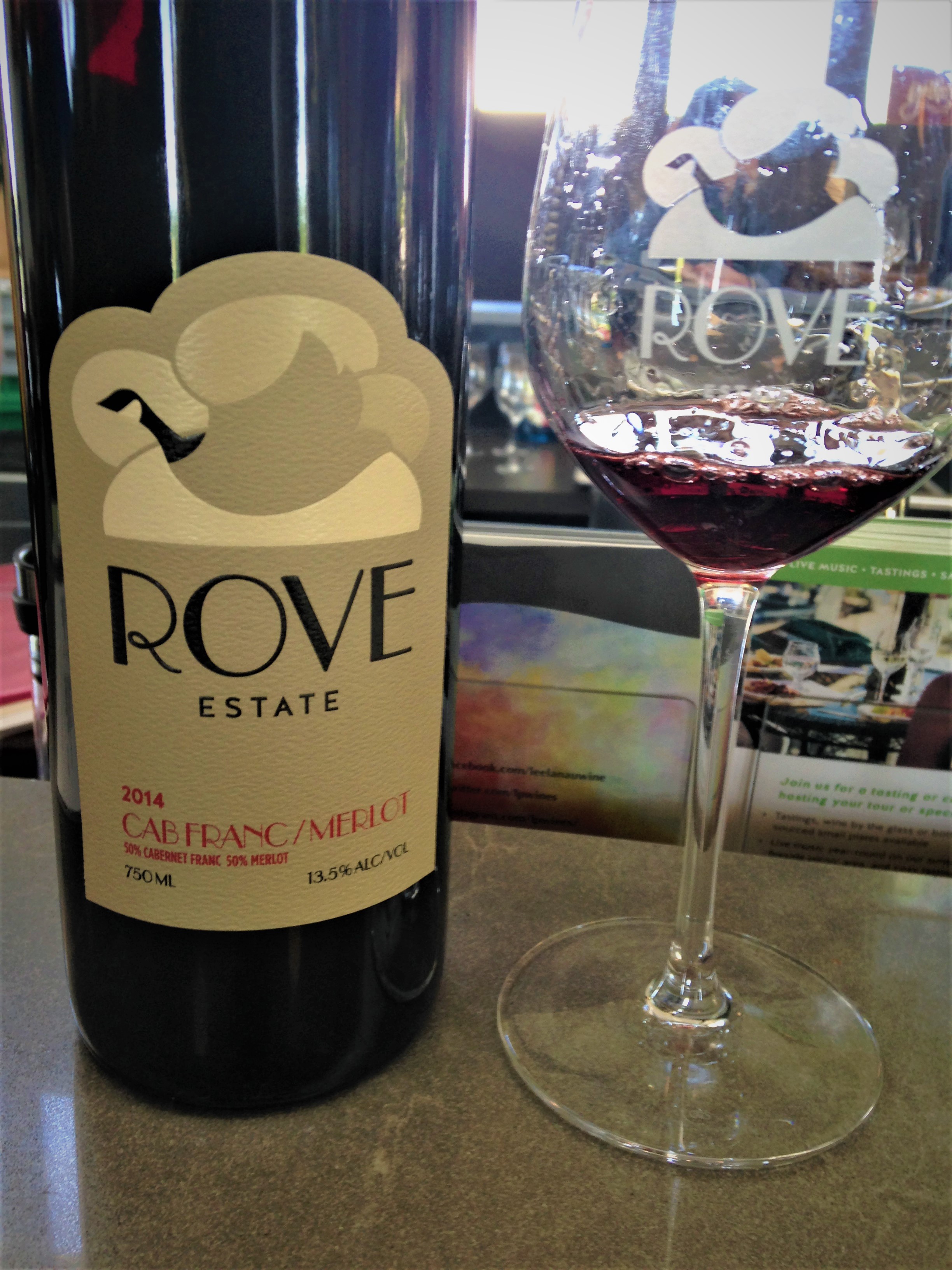
Rove Estate

Rove Estate sits at the highest point of elevation on the Leelanau Peninsula and a family owned farm for five generations.  Creighton and McKenzie Gallagher represent the sixth generation farming the family plot and the estate is named after the “Rovers” who had left Ireland around three hundred years ago and are part of the “Winegeese” from that diaspora.  The estate pays homage to their legacy.  Creighton had developed an appreciation and a passion for wine growing up in the Traverse City region.

In 2010 he was offered a chance to buy part of the family farm and fifteen acres of cherry orchards that needed to be replanted, and thus Rove Estate began.  Rove Estate Vineyard and Tasting Room opened in the Spring of 2016.  Not only are they a center for wine tasting, they offer live music year-round on the sunset patio and a fireside picnic area, they also have hiking/snowshoe/cross-country skiing amidst the vineyards depending on the season.  The winery offers a couple of different wine club arrangements and they offer five tastings for seven dollars, they also offered three different wine flights of four glasses of wine.  While and when we were there, they were offering seventeen different wines and three different ciders.  All wines are from estate grown fruit and all carry the Leelanau Peninsula AVA.

The first wine that we tasted was the Rove Estate Gewurztraminer 2017 that was aged for six months in Stainless Steel.  The wine offered the customary floral nose with a soft grapefruit tang and a short finish.  We then tried the Unoaked Chardonnay 2017 that was aged for six months in Stainless Steel.  This wine offered yellow apples and a very easy drinking crisp acidic Chardonnay.   The last white wine that we tried was the Riesling 2015, which like the other whites were aged for six months in Stainess Steel.  This wine had some rack time and offered some dried apricot, honey and peach and was what I would term as semi-dry with a medium length of time for a finish.  We then tried the Cuvee Rosé 2017 which was a blend of sixty percent Cabernet Franc and the balance in Merlot.  The wine was aged for ten months in two-year-old French Oak barrels.  A very soft nose and a delivery of red cherry and a little spice with a decent finish.  The last wine was the Cabernet Franc/Merlot 2014 which was half and half and was aged for fourteen months in French Oak.  This was the most robust of the wines that we tasted and it offered dark fruit and spice and a decent finish. 

Posted in Wine | Tagged , , , , , , , | Leave a comment

The Village

Officially it is The Village at Grand Traverse Commons and I really wanted to see this place and perhaps get a bite to eat, before a few more wine tastings, I mean sometimes I really have tunnel-vision or so it seems.  I enjoy things of beauty, age and grace and can truly revel in architecture from days gone by.  The Northern Michigan Asylum finished their first building in 1885, and some may think that is the perfect setting for me.  Northern Michigan Asylum eventually became the Traverse City State Hospital, as many institutions that were originally built for Tuberculosis Hospitals were no longer needed, once that disease was eradicated.  Over the years from the time of the Asylum to the Hospital, it grew to be a thousand plus acre site within Traverse City and it was rather self-sufficient with farms, warehouses, a power plant and other adjunct buildings.  Some forward-thinking individuals saved this entire complex from the wrecking ball and building by building they are slowly renovating and re-utilizing the structures for an assortment of uses.  We walked through one of the earliest renovations that now contain boutiques and shops and restaurants on the garden level of the building with an assortment of business in the floors above and this is right across from a three hundred acre park that was being used for a charity event while we were there, hence parking was tough, but we had the good fortune to find something rather close as we pulled into the grounds.  The old chapel on the grounds is now used for weddings, banquets and even theatrical productions, and besides office rentals, they are now selling condominiums and loft residences.  We strolled through the ground level corridors looking at the assorted shops, I guess the old merchant in me, still admires small businesses.  Interspersed in the corridors one will also see some old artifacts that were found within the huge complex from the hospital days that were luckily not tossed out as junk.  Also while we were walking around, we had to side step a good crowd that were on a guided historic tour, which if we had more time, I would have enjoyed, as they were explaining what the different rooms were originally constructed for, as well as the old steam tunnels and they were also going to see some of the structures that have not been renovated yet.  It is also considered one of the largest mixed-use historic redevelopement projects in the United States.  It was a charming way to spend the morning.

Halfway through our exploration of the corridors we discovered The Red Spire Brunch House that showed real moxie for utilizing almost every square foot to create a restaurant and even with tables out in the corridor as well, the restaurant was packed.  We actually had to leave our phone number as we explored the rest of the corridors as we waited for a table to be open.  A table was not possible, so we sat at the counter and on the other side of the counter was a hive of productivity as we were watching the kitchen do their magic.  I have to tell you, that since I was a child, my Mother used to make me poached eggs with her poaching pan and I have never stopped enjoying them to the point that I very seldom have fried eggs, except as an omelet; and that may have been the start of my being a pain in the arse about food.  I had the Traditional Eggs Benedicts while my Bride had Crab Benedict, which substituted home made crab cakes for English Muffins, and my dish surprisingly had English Muffin Bread rather than the classic muffins. 

This brunch may not have even been mentioned, because I didn’t notice it at the tables out in the corridor, but at the counter we discovered that they were making Mimosas.  Not only did they have Mimosas, but they made them in the manner that we prefer, a glass of bubbly and a soupcon of orange juice.  The first time that I saw this particular bubbly was in Las Vegas, but we have now encountered it often, and in fact I have noticed in some newspaper ads for brunches around the Detroit area that they tout that they use Wycliff.  Wycliff Brut California Champagne is by the William Wycliff Winery which is under the umbrella of the Gallo Winery group. This screwcap bottle of sparkling wine is geared strictly to restaurants and catering companies, so that the consumer cannot check the retail price of the wine or buy it on their own. Since it is part of Gallo, I am sure that they have made sure that they were grandfathered in with the term “California Champagne.” This wine is made by the Charmat Method, which is a more economical way of producing a sparkling wine and since it was being mixed with orange juice, it was more than adequate. Traditionally the wine would be made with Pinot Noir, Chardonnay and Pinot Meunier and I will presume that all or part of those grapes are being used. All I can say is that it was a great way to start the day off.  The only thing lacking was the pop of the cork.  Our day was off to a great start. 

Posted in Dining, Wine | Tagged , , , , , | Leave a comment

Old Mission Tavern

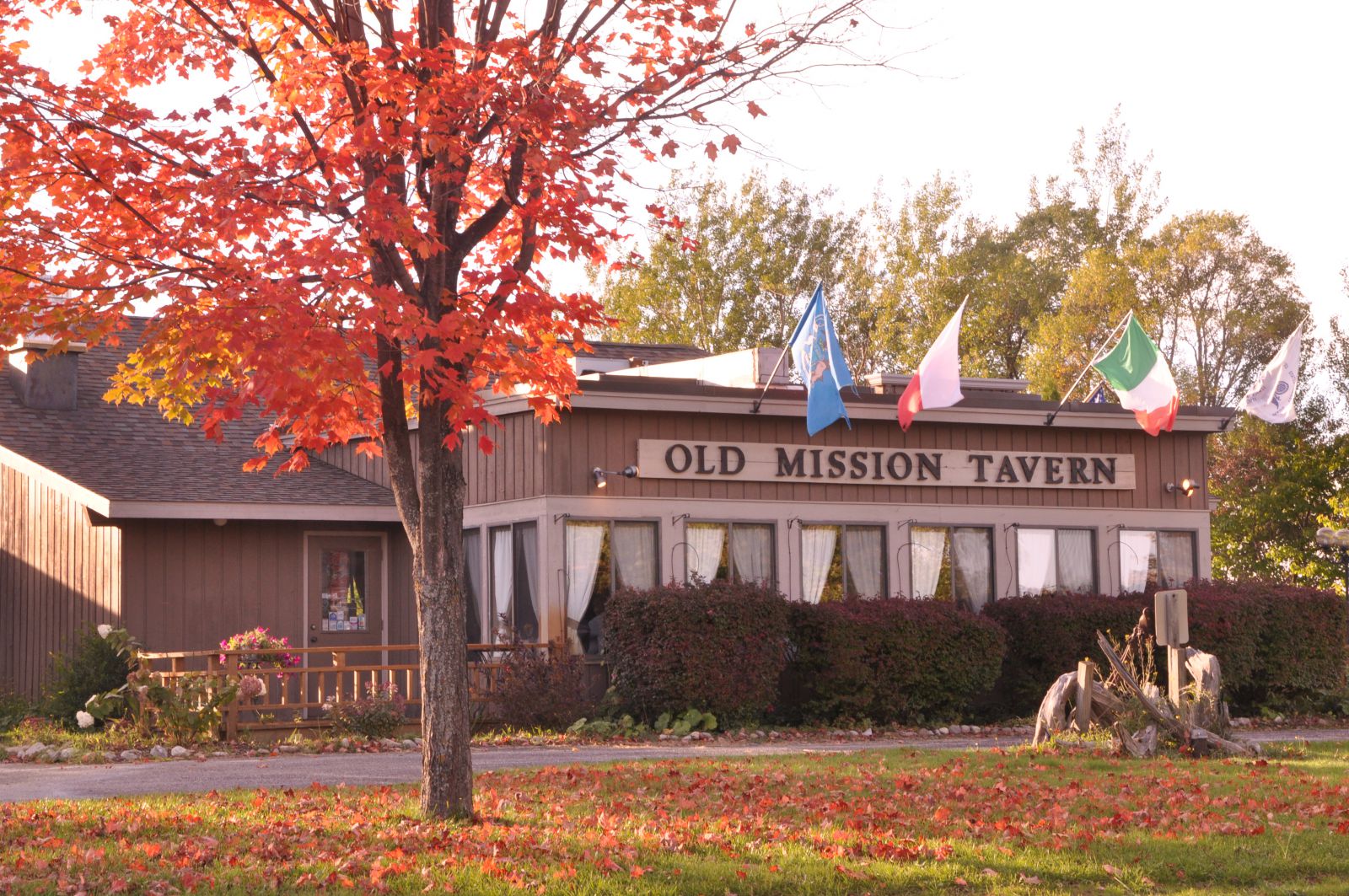
After stopping at five wineries on the Old Mission Peninsula and having drove from Bay Harbor after lunch, we had worked up an appetite.  Logistically while we were plotting out the day, we discovered this restaurant maybe half way up the peninsula and rather than driving past our hotel for the evening to dine in Traverse City, we decided to try the Old Mission Tavern that was a stand-alone restaurant with a vista of acres of vineyards.  The restaurant is about twenty-five years old and it has the feeling of Traverse City, before it was discovered by Chicago and has been forever changed.  Thankfully, so far the waterfront playground for Chicago has only been for a destination for foodies and “tasters/swillers” and when you talk to some of the locals, you feel that they are not keen on the gentrification of the area, but as long as the Asian Carp and some of the other detriments of Chicago stay in Illinois, the locals seem to be able to survive the rise of restaurant prices. 

There we were situated with views of the East and West Traverse Bays and the farmlands, it truly felt like we were up North.  The Old Mission Tavern had that rustic feeling that old Michiganders equate with the what the area used to be.  The restaurant was also interesting in that there was art work on display everywhere by local artists and they had a back room that was filling up as we got there for a big party, while we were having dinner.  We had ordered the Smoked Whitefish Dip with Garlic Rounds to start out with, and we were surprised that it was served hot, and I would say that it was the first time that either of us had this dish hot, it was interesting and a change of pace. My Bride had three blue lump Crab Cakes with Beurre Blanc, asparagus and rice.  I had Baby Back Ribs basted with a Cherry Barbecue Sauce (shades of the old Traverse City, the Cherry Capital of Michigan) and accompanied with Grilled Shrimp.  I was happy, because the meat fell off of the bones, as I have no desire to gnaw on a bone. 

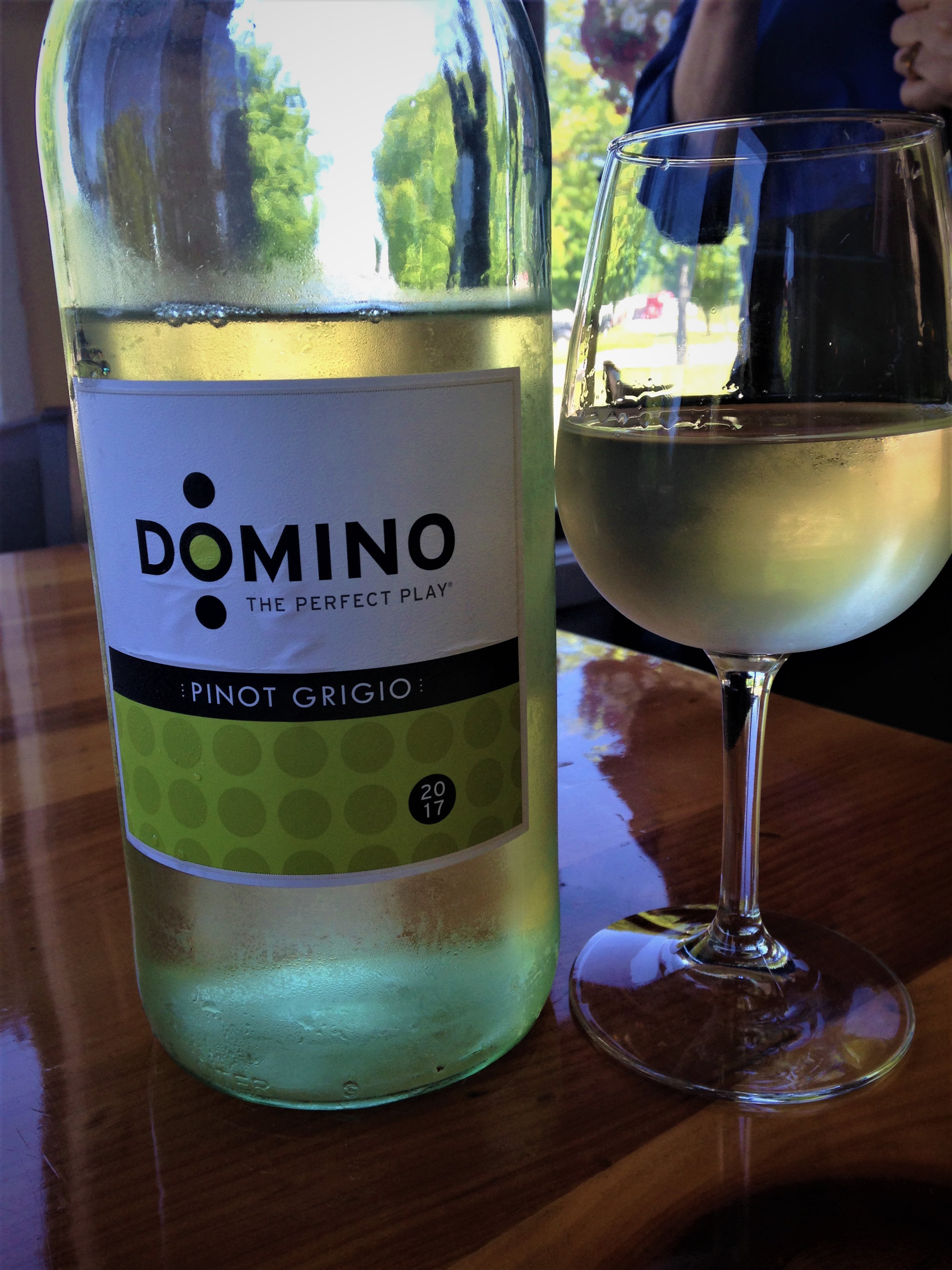
We had tasted so many different wines just prior to having dinner, that we had no desire to get a bottle of wine, even if we could take it home with us.  Of course, we were still going to have some wine, but we just wanted something light and we found it in some glasses of Domino Wines Pinot Grigio California 2017 from the Delicato Family Wines. They began growing grapes in 1924 and began making wines in 1935 and now they have eighteen different labels domestic and internationally.  This particular wine appears only to be offered in Magnums and perhaps the entire line is done this way to aid restaurants and catering companies to offer a series of easy drinking wines.  The wine was crisp and not too sweet and worked fairly well with our entrée dishes, even though it felt like we were cheating on the peninsula. 

Posted in Dining, Wine | Tagged , , , | 3 Comments

Bonobo Winery

Two brothers, Todd and Carter Oosterhouse, long time natives of Traverse City established Bonobo Winery four years ago.  The brothers are attempting to maintain the classic Up-North feel to the winery while bringing in the new chic concepts that have been evolving in the area.  They want to bring world class wines with a rustic setting, but with elegant tones.  They wish to blend the traditional, ecological and philosophical feelings of the community.  The nineteen-acre estate grows Pinot Gris, Pinot Blanc, Sauvignon Blanc, Chardonnay, Riesling, Pinot Noir and Cabernet Franc and they also have agreements with some of the local growers as well to boost the production. 

If you are like me, you might think that the winery has a unique name and it does and it is named after the Bonobo Conservation Initiative to preserve the Bonobos monkey, preserve the tropical rainforest and to try to empower local communities in the Congo Basin.  It is quite a goal for a couple of brothers in Traverse City.  The winery is following the trend of the other local wineries by having a couple of different wine clubs, having a small plate menu and they charge ten dollars for five tastings.  They do have a nice view and some outdoor lounge areas, if you want to get a larger glass of wine and just relax and admire the setting.  

Somehow, we ended up tasting six of the seven wines being offered that day and only one of the wines offered carried the America AVA, the rest were Old Mission Peninsula AVA.  The first four wines that we tasted all spent two months aging.  We were really going with the white wines at the winery and the first was the Pinot Gris 2018 and it was aged in Stainless Steel and offered a very pretty wine with a soft nose and Michigan apples in the finish, the production was 345 cases.  The Pinot Blanc 2018 was also Stainless Steel aged and offered Fuji apples and a bit of crispness and a production of 350 cases of wine.  The Chardonnay C 2018 offered some floral notes and lemongrass and was a nice glass of wine, and they made 250 cases of it.  The Rosé 2018 spent twenty-four hours on the lees and then two months in Stainless Steel and this was made from Pinot Gris and offered a very distinct finish of pear and they made 620 cases.  The Chardonnay Select 2017 was aged for seven months in neutral French Oak and offered some hints of butterscotch and it was very easy to drink, though not as dry as I would have preferred.  Our hostess decided that we were rather serious, since we were taking notes, photographing and came by ourselves and not in a party bus, so she wanted us to try the new wine.  We were there on a Friday and the wine was just bottled Sunday of the same week.  The Bonobo Red America AVA 2018 was a fun wine that offered some red fruit, a bit of vanilla and some pepper.  The wine was forty percent Merlot from Saugatuck, Michigan, forty percent Cabernet Franc from the estate and twenty percent Cabernet Sauvignon from Walla Walla, Washington.  The juice was first aged separately for two months in Stainless Steel and then blended and aged for an addition eight months in French Oak. There were 465 cases produced.  You could feel some pride about the winery even in the tasting room, where sometimes you encounter individuals just going through the motions, and we liked that. 

Posted in Wine | Tagged , , , , , , , , , , | Leave a comment

Tabone Vineyards

For the last couple of years, I have had a request from a friend, that I grew up with from the old neighborhood that I should make it a point to go to Tabone Vineyards.  I know a lot of people that don’t drink wine as their beverage of choice, but I guess by now they know that I am rather partial to wine for myself.  Tabone Vineyards is located in Old Mission Peninsula just north of Traverse City.  They have been growing grapes there for about twenty years and in 2014 they established themselves as a winery, instead of growing the grapes for other wineries. 

One of the first things you notice when you arrive at Tabone Vineyards is the Maltese Cross symbols, and when I was a kid, just outside of my immediate neighborhood in Detroit, one could find a concentration of Maltese families, including their own newspaper, the things that I remember.  As I was trying to get myself situated for the tasting, I mentioned the friend that recommended that I go to the winery, but the name was lost on the hostess that was taking care of us, and I decided not to press the issue.  I guess I better stick to blogging, because I do not have the tenacity to be a newspaper journalist from the old days.  Once again, the tasting was priced at eight dollars for five samples, and there was the suggestion of getting a Cheese and Charcuterie Plate as well as the offer to buy a club membership, and we declined on both offers and we nursed the five tastings between the two of us.

The winery offered twelve different wines to try, and we had to pick out five wines to try; and all the wines were estate grown.  The first wine that we tried was the Bubbly Riesling 2016 and the wine spent eighteen months in what they called “bottle conditioned” and there was no residual sugar.  This was a very crisp and dry sparkling Riesling, and I believe my first one in this category.  I have some problems with real dry wines, but I did pick up some apple tones with this wine.  The next wine that we tried was the Chardonnay 2016 and this was their “unoaked” wine that was aged for eighteen months in Stainless Steel.  This was a nice fruit forward wine and some good acidity, so that you would want another glass.  The next wine that we tried was the Chardonnay Oaked 2016 and I was told that this wine had twelve months in Stainless Steel with some Oak Chips and then six months in Oak Barrels.  I was surprised that this wine offered more citrus and some terroir compared to the Unoaked version.   We then tried the Semi-Dry Riesling 2014 that was aged in Stainless Steel.   I got some pear and some terroir from this wine.   The last wine that we tried, and it was offered in two different versions, but we were touted to try the Red Wine 2016 as compared to the Red Wine 2017.  Here we had some more of the old school Michigan Red wine with a blend of Baco Noir, Marechal Foch and DeChaunac and aged for six months in Hungarian Oak.  It had a little bit of cherry and a lot of the spice that is prevalent for this wine.   I liked this wine for some barbequed food. 

Posted in Wine | Tagged , , , , , , , , , | 2 Comments

Mari Vineyards

Marty Lagina founded Mari Vineyards in 1999 with the desire to plant varietals that one does not associate with Michigan like Nebbiolo, Sangiovese and others along with Cabernet Franc and Merlot.  He had friends come and help him the first weekend of planting and before anyone realized what had occurred the first seven rows were a mish-mash of varietals, before the other rows were planted properly.  In 2006 the first vintage of what they now consider their flagship wine was made aptly named Row 7 and the grapes are unknown and unidentified.  There is now sixty acres planted and identifiable, so the moral of the story is do not let friends, no matter how well-intentioned help you plant your estate without the proper supervision. 

The grand opening of the winery was 17 June, 2016.  Also, that year they also showcased the wine cave that they had carved into the side of a hill underneath where the tasting room and wine facility is now located.  It is actually the only wine cave in Michigan and created with the concept of having the perfect location for storing wines as they age, just like what is found back in Europe.  If you go to their website you can actually watch a time-lapse video of the wine cave being created.  The first vintage was in 2004, so by now they have some history and experience in winemaking.  They are also famed in the region for their Nellaserra Hoop Houses, which are free standing hot houses erected over certain parts of the vineyards to give certain varietals a little longer growing season.  They were actually interested in the fact that I was taking notes for a blog, in spite of the touring busses and limousines ferrying the partiers that wanted to get drunk.  They had thirteen wines that were being offered, plus they also insisted that I try the Row 7, that was not being offered.  Their price for a sampling was similar to the other locations at five tastes for eight dollars.  Excluding Row 7, there are currently twenty varietals growing on the estate.  The building that houses the tasting room is beautiful and they offer special tours and special treatments if you book ahead.  This old Raconteur is not that clever at planning anymore and we like being treated like a stranger.

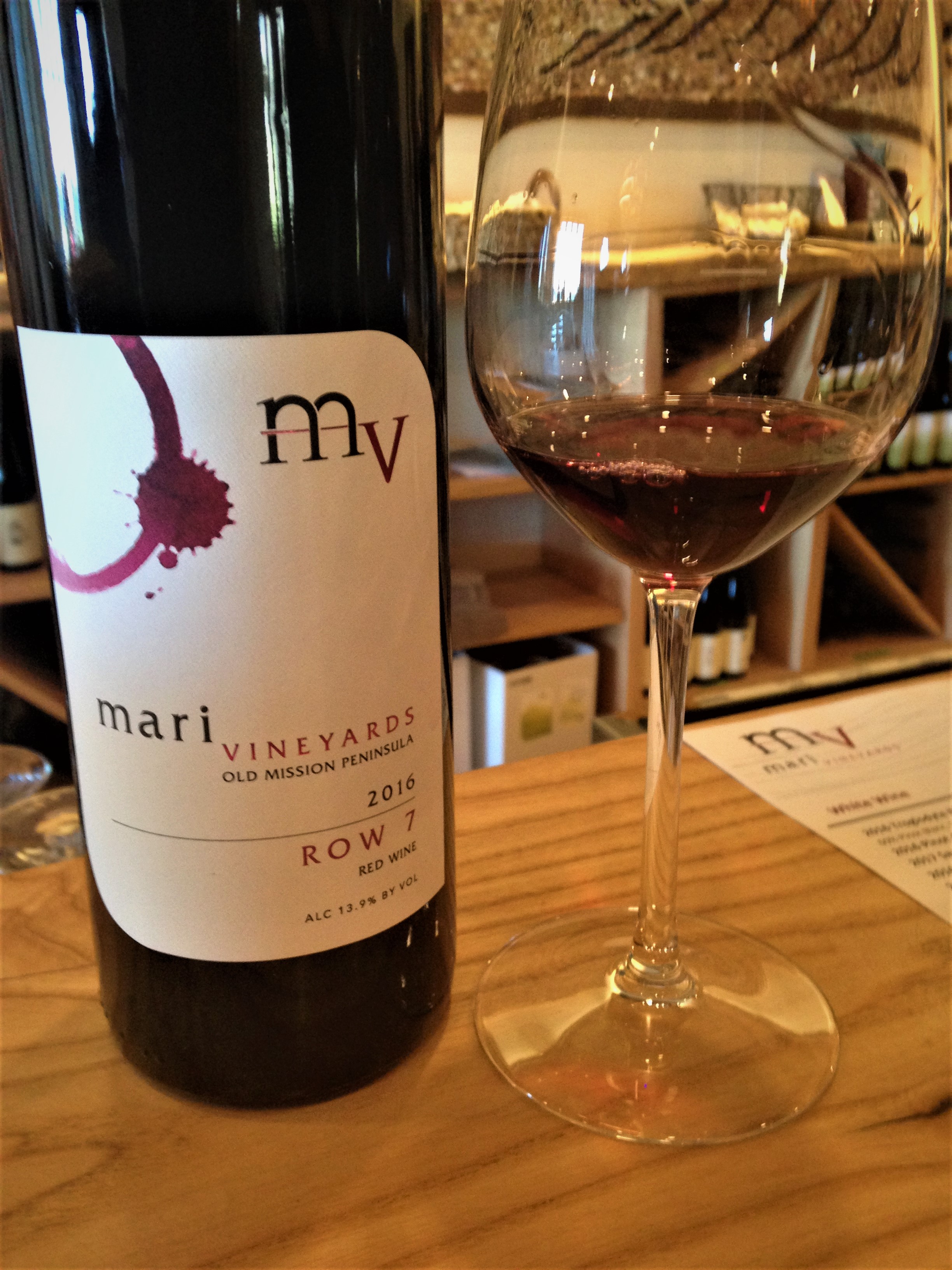
The first wine that we tasted was Troglodyte Bianco 2016, a Friuli-inspired wine and according to our hostess the favorite wine of the staff.  This wine was a blend of sixty percent Pinot Blanc, twenty-five percent Gruner Veltliner and the balance was Sauvignon Blanc.  The three varietals were aged separately, with the Pinot Blanc and the Gruner Veltliner in Stainless Steel and the Sauvignon Blanc in German Oak.  The three juices were then blended and aged on the lees for eight months in barrels and then one month in the bottle before release.  One would think that this would be an aromatic bomb, but it was very understated with herbs and spice present form the nose to the finish; it was a very nice drinking wine.  The next wine was the Gewurztraminer 2016 and it has been a while since I have had a Michigan version of this grape that I so enjoy.  This wine was aged for nine months on the lees in German Oak and then one month in Stainless Steel.  I found the spices to be there but soft with assurances that they are expected to develop in the next year or so; I was noticing Juniper, Allspice and Nutmeg, while our hostess mentioned Vanilla, I did not catch that.  The Scriptorium Riesling 2016 was their half dry Riesling and the fruit was harvested from three different vineyards on the estate.  This was the sweetest of the white wines, but hardly cloying and I think it would be interesting with Barbequed and Smoked Ribs.  We then switched over to the Cabernet Franc 2017, as if my Bride would pass on tasting a Cabernet Franc, but then you already know that.  These vines were planted in 1999 as part of the initial plantings and this wine was aged for eighteen months in oak.  The wine promised some red berries and chocolate and was a tad sweeter than what I expected, but it had a nice long mellow finish.  The last wine that we tried from our book of tasting was the Praefectus 2017 which was a blend of seventy-five percent Cabernet Franc and the balance was Cabernet Sauvignon.  The Cabernet Franc was aged in neutral oak and the Cabernet Sauvignon was aged in new oak and they rested for about twenty-five months.  For being right out of the bottle it delivered some rich currant suggestions and smooth tannins, making it a very easy drinking wine by itself or with dinner.  After our allotment of wine tasting, I guess our hostess decided that with my taking all of my scribbled notes that I must really be into the wines for more than the buzz, the limousine and bus tasters were into, offered us one more wine to try that was not on the printed sheet or on the website for purchase, but alluded to in the history of the winery.  She poured us, and I might say it was better than a tasting pour, was the mysterious Row 7 Red Wine 2016.  According to lore the vines that were planted on the first seven rows in the Jamieson Vineyard were Syrah, Nebbiolo, Sangiovese, Cabernet Franc, Cabernet Sauvignon and a couple of white grapes that were not recorded at the time.  This wine was aged for twenty-five months in French Oak and delivered a big wine, almost bigger than expected.  It was the perfect wine to end our time at Mari Vineyards.  

Posted in Wine | Tagged , , , , , , , , , , , , , , , | 2 Comments

Hawthorne Vineyards

I had heard about Hawthorne Vineyards; I think before they had bottled a wine.  A relative of the owner Bruce Hawthorne had mentioned the winery several times to me when he was buying clothes.  Too many salesmen talk, when they should be listening, but I was intrigued about the winery, because I was amazed that there was the potential of a new winery on Old Mission Peninsula, but then again there are probably more in the works and in reality this peninsula is really much bigger than it looks on the map.  This winery is about four miles away from Traverse City, but where the tasting room is situated, it is probably the most secluded and one of the most beautiful vistas on the peninsula and as a bonus, one cannot see the traffic below.  According to the staff, the winery was started in 2005, and the estate was an eighty-acre farm with grapevines, cherries and plums and they began with twenty-six acres devoted to vinifera with more to come.

The winery at the moment has small capacity, and the beautiful tasting room building can also be leased for special events.  The tasting room fee was seven dollars, but I think that I turned off the person behind the counter, because my Bride and I share a tasting together, because we are there to taste wines and not to get hammered and there is that potential when you go to enough wineries in a day.  I think that our hostess also lot interest, because I was not interested in booking a VIP tasting tour or even ordering a charcuterie plate, as there was no chance of upselling.  I am also glad that I had a writing pad of paper in my sport coat to take notes, as there was no printouts or tech sheets available.  I also felt like a social pariah when busses started arriving with groups that were there just to drink basically anything put in front of them, without asking any questions.  I guess our hostess didn’t think that we were having a good time, because we were studying the wines and asking questions, even though I told them that I write a blog and that I was not looking for a free tasting. 

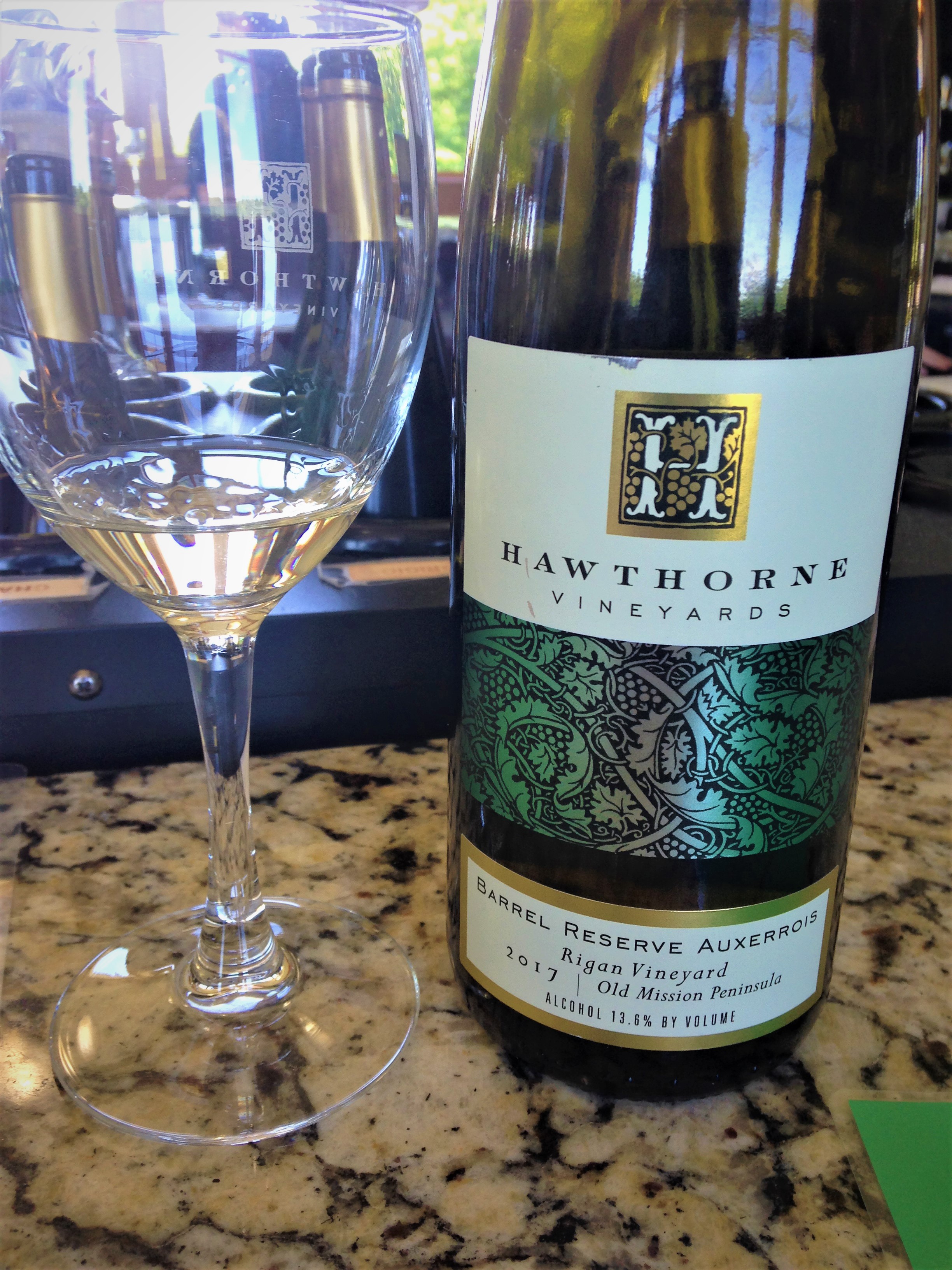
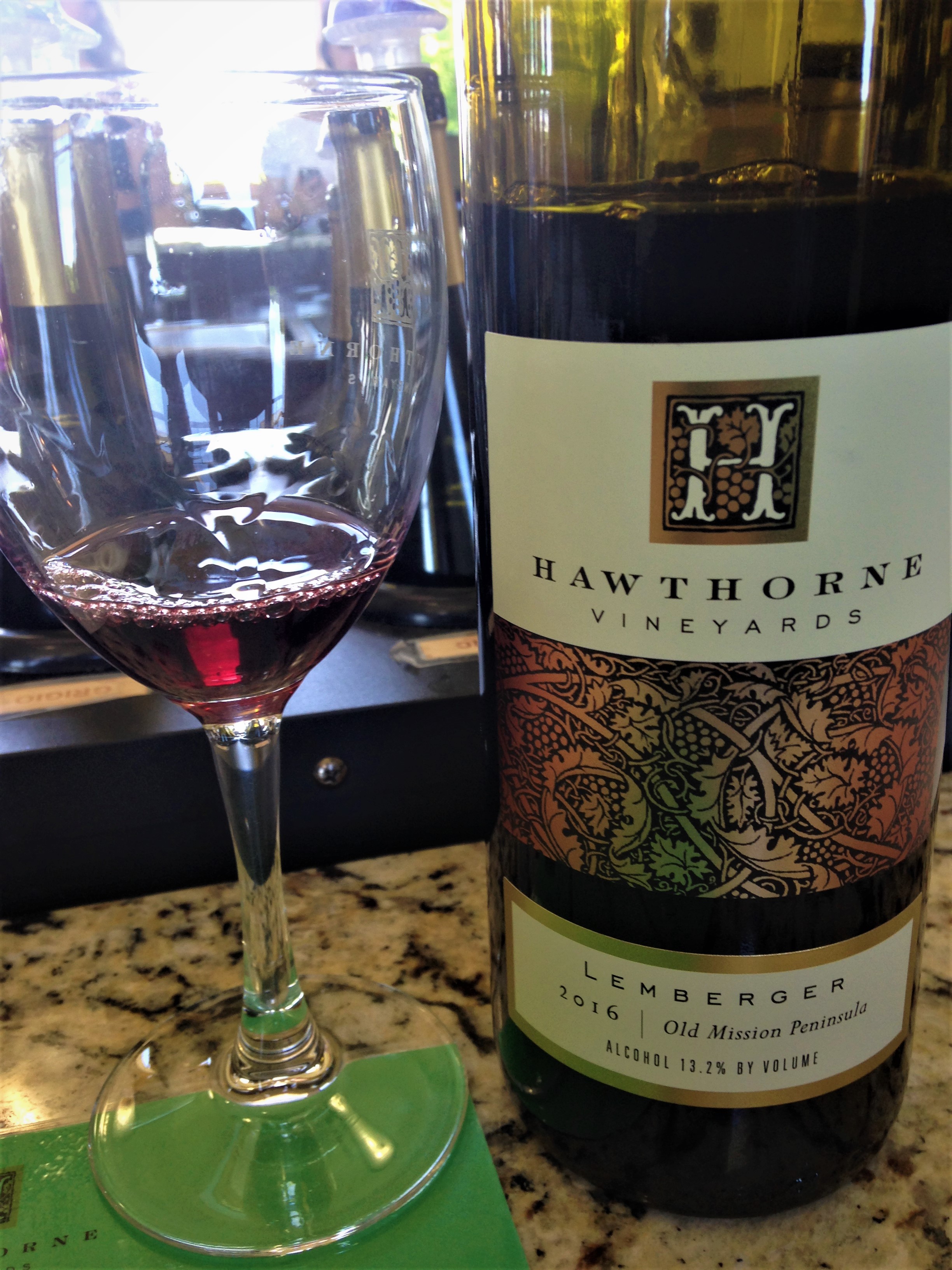
The first wine that we tried was the Barrel Reserve Auxerrois Rigan Vineyard Old Mission Peninsula AVA 2017.  Auxerrois is a varietal that has many names, but it is most famous in Alsace where the best versions offer shades of honey in a nuanced glass of wine.  This wine was a good introduction to the winery, because this potentially difficult grape to grow was not flabby and offered some crispness to the finish.   The wine was aged for eight months in neutral French Oak barrels and there were two-hundred-forty-five cases produced.  The second white wine that we tried was the Barrel Reserve Chardonnay Old Mission AVA 2016 and it was a delightful Chard.  Almonds came to mind in my notes with some zesty fruit and some spice, which I found very interesting, because the wine was aged on the lees for seventeen months in French Oak.  There was a production of one-hundred-eleven cases made.  The first red wine of the tasting was the Lemberger Old Mission Peninsula AVA 2016 and a great wine in its own right.  Lemberger is probably more known by its German name Blaufrankisch and is one of the key red wine grapes for Austria.  This was a good wine, and I think for drinking within the year to appreciate the black pepper and spices with a nice touch of heat to the finish.  The wine was aged for nineteen months in French Oak, and half was new.  The last wine that we had at the tasting was the Cabernet Franc/Merlot Old Mission Peninsula AVA 2015 and it was fifty-four percent Cabernet Franc with the balance in Merlot.  This wine was aged for thirty-three months in French Oak and delivered some plum, some spices and a touch of Vanilla.  I enjoyed the tasting and the wines, but I felt that I was getting the “bum’s rush” for the “drinkers and the swillers.”

Posted in Wine | Tagged , , , , , , , , , | 1 Comment

Black Star Farms

Last year when Black Star Farms was awarded the Best Wine at the 2018 Canberra International Riesling Challenge for their Arcturos Dry Riesling 2017 all of my Social Media sites were bombarded as to whether or not I had tried this wine, and it was to the negative, but that I knew of their reputation and I was going to make it a point to visit them once again.  I guess part of it, is that I am always writing about Michigan in one way or another.   The other reason is because we had just tasted their Arcturos Sur Lie Chardonnay 2016 and their Arcturos Cabernet Franc 2013 and I think my Bride wanted to get a case of each, she was totally enamored with both of the wines that we had with dinner at the Inn at Bay Harbor.

In 1998 Black Star Farms purchased Sport Valley Farm which was a one-hundred-twenty-acre equestrian facility, and the stylized black star was part of the architectural décor in the main house.  In their Twentieth year, they were honored to receive the 19’th Annual Canberra International Riesling Challenge (CIRC) -Best Wine of the 2018 Challenge and only the second time an American wine came out on top.  There were 567 Rieslings from six countries (Australian, New Zealand, USA, Germany, France and the Czech Republic).  The Black Star Farms Arcturos Dry Riesling 2017 scored 98 points, in addition to taking home Best Dry Riesling and Best American Riesling.  In fact, all six of the Riesling wines that Black Star Farms submitted took home medals, showing a consistency across vintages and styles.  The fruit is sourced from both of the proprietor’s vineyards and from local grower partners in both the Old Mission Peninsula and Leelanau Peninsula.  The winery has three series; the premium Arcturos, A Capella and the Leorie Vineyard labels for sparkling and fruit wines.

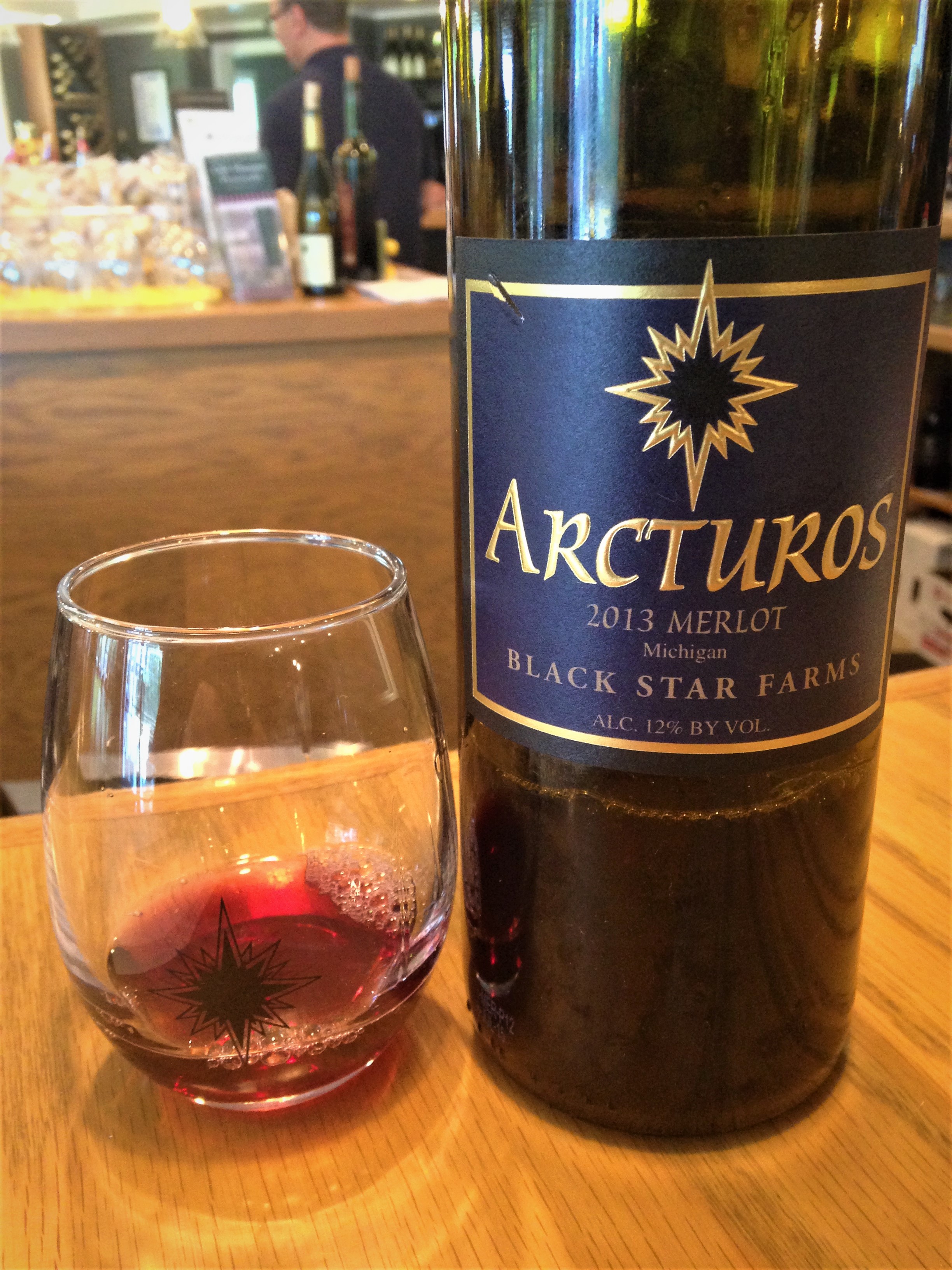
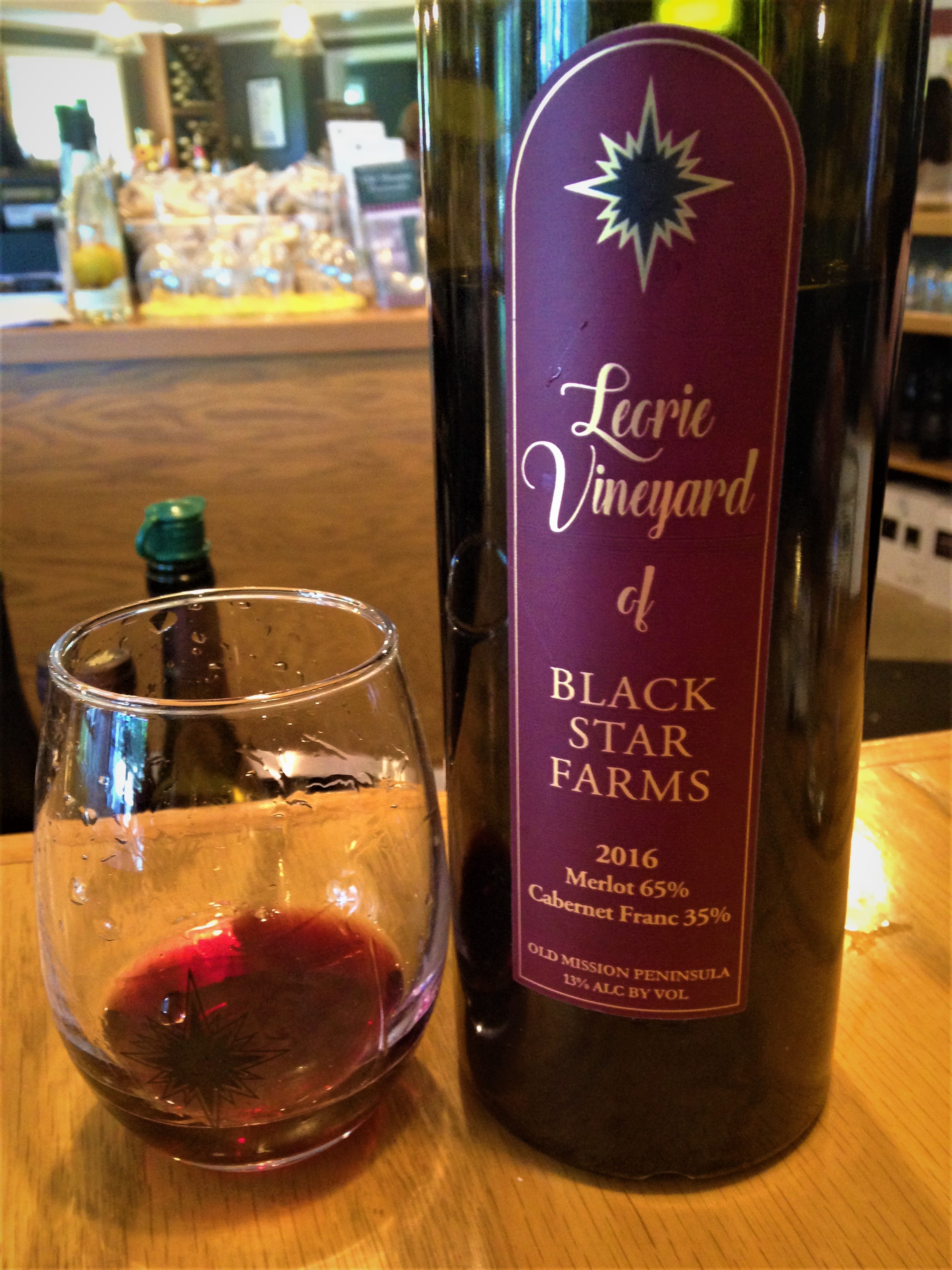
At the tasting room, they were offering forty-three different wines and distillery products.  We started off with the Arcturos Sauvignon Blanc 2017 which showed stone fruit, grapefruit and a zesty acidity, it was very refreshing.  We then tried the Arcturos Dry Riesling 2017 and I can’t believe that I forgot to take a photo of this special wine during the tasting, but since we bought it, I can offer a photo of it; and it offered ripe fruit of apricot and pears with a nice long dry crisp finish and it made me change my thoughts on Michigan Riesling wines from my early days, and I guess that is my fault for not being more open year after year.  They were touting this wine to cellar for ten to twelve years.  We then tried the Arcturos Sur Lie Chardonnay 2017, a beautiful example of a Stainless-Steel Chardonnay showing a flinty terroir, with a nice smooth finish.  This wine was touted for cellaring for about ten years and I think that another year or two will help this wine mellow even more.  The Arcturos Pinot Blanc 2016 showed both apple and lemon zest, and it was smooth, but not one of our favorite wines of the tasting.  We then tried the Vintners Pinot Noir which was a blend of 2015 and 2016 and this was fruit forward with traces of vanilla from oak barrel aging.  The Arcturos Merlot 2013 offered some great dark fruit and a lot of spice, really a nice Merlot wine and I am very partial to Merlot.  The Arcturos Cabernet Franc 2016 offered some red and dark fruit with a lot of spice and a nice long finish.  This wine was touted to cellar for ten years and I would agree with that.   The last wine of the tasting was the Leorie Vineyard Merlot and Cabernet Franc 2016 from the Old Mission Peninsula AVA.  This was a blend of sixty-five percent Merlot and the balance of Cabernet Franc and showed deep red and dark fruit with some traces of chocolate and a nice long finish.  A beautiful wine with an aging potential of thirty years.  Even though we did not get the wines that we were originally hoping for, we did end up plenty of wine and we even joined their wine club, because we had such a good time and assistance from a very knowledgeable employee which made the tasting all that much better. 

Posted in Wine | Tagged , , , , , , , , , , , , | Leave a comment

Traverse City Thoughts

If one were to ask me where the center of the wine industry is in Michigan, I would have to immediately say Traverse City.   If you were to go back in time perhaps twenty years ago, you would have not got the same response, in fact, people would look at you askance.  There was some bulk wine industry left over from Prohibition, and there were pockets of some serious growers and winemakers.  Back then Traverse City was the Cherry Capital of Michigan and they had a Cherry Festival every July, and they still do.  Cherries permeated the entire area, and there were butchers and chefs that even created ground round recipes using cherries for a very moist burger.  And naturally there were cherry pies, cherry ice cream, candies, pastries, sauces etc.  It has also become a foodie haven and the caliber and quality of the restaurants even in the outlying communities have upped their game. 


Old Mission Peninsula

Wineries have taken over much of the agriculture in the Traverse City region and whole orchards have been torn out and replanted with vines.  The region is on the 45’th Parallel, which is where some of the great wines of Europe are on, and this was not lost on the early pioneers.  At first Cold-Hardy varietals were planted, but slowly, but surely some of the classic wine varietals have been planted and nurtured.  I think Riesling was one of the first and it started off as a sweet wine, but it has evolved into a sweet wine and a dry wine industry and with great accolades, that were slow to start, but now there is greater acceptance.  Now it is not unusual to find Pinot Grigio, Chardonnay, Cabernet Sauvignon, Pinot Noir, Cabernet Franc and Syrah wines, as well as blends and there are still some of the Cold-Hardy varietals still being marketed.  Michigan is actually the fourth largest grower of grapes in the United States of America, but that also includes grapes for table fruit, jellies, jams, juice and other uses besides wine. 

Leelanau Peninsula

With Traverse City being almost a five-hour drive (legally), it is not a destination that we can easily jump into the car and go to.  A curious situation has arisen over the years that we have been going there for wine.  In the old days, a winery might only offer a couple of different wines and they were really thrilled to have visitors.  As the number of wineries increased the dedication and passion increased, and when you did a tasting, the people manning the counters would love to discuss production information and the nuances of the wines and if you showed interest in wines the tastings might even get more elaborate with information and suggestions.  There usually wasn’t even a charge for tastings, especially if you bought some wine.  Then the tasting rooms started getting elaborate and beautiful, Ma & Pa Kettle were replaced by Madison Avenue.  Where maybe in the old days you were poured some water and given some oyster crackers to cleanse your palette, now they want to upcharge you with cheese and charcuterie plates, if not a trip to their gourmet dining room.  Some of the wineries have plastic sheets that you take a crayon and circle your five choices, so that the sheet can be wiped cleaned for the next “taster” and thankfully I take a note pad in my sport coat to record my thoughts.  On top of that, I guess one of the problems with a booming economy is that the help now being hired to man the counters seem to have no idea about what they are pouring, and if you ask, God forbid, they may have to look something up or call some that is knowledgeable.  Tastings are by the numbers now and for the most part it is by rote and when you stop them to take a photograph, it throws the server off of their set patter.  Another curious side business is small tour busses that take people to assorted wineries with some destinations are just for a taste of wine and then on to another location, maybe it is good to keep that many drunks off of the road, as some “tasters” seem more intent on getting drunk, then tasting wine.  Then there are the bachelor and bachelorette parties that are shuttled from winery to winery just to have a good time.  I love the concept, but it sure is hard to do serious tasting, when the focus seems to be on the partiers, who I would venture have no interest in buying wine, just trying to get drunk on one-ounce pours.  Maybe it will eventually settle down, or they will do like some wineries have already done and establish a counter or a table just for the drinkers and keep them away from the tasters and potential buyers.  We went to five new wineries and two repeat wineries and my notes will be forthcoming. 

Posted in Uncategorized | Tagged , , | Leave a comment