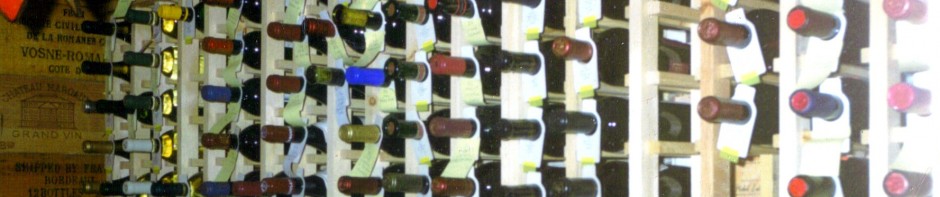
While we were all enjoying another fine wine tasting at The Fine Wine Source in Livonia, Michigan the crowds as always grow, even though we are supposed to block our times, that tends to get a little loose, as those that came in at one time, want to retry a couple of the wines before placing an order and others come in a little earlier to get a jump-start, while some just have the good fortune of coming in without any knowledge of the tasting, but are handed a glass.

The time group that I was with proceeded on with the tasting with Chateau Haut Marbuzet Saint-Estephe 2022, and as I was checking my notes I have this wine from the 2000 vintage in my cellar. The estate was founded in the 18th century, but has received notice since 1952 when it was acquired by Herve Duboscq and is now produced by H. Duboscq et Fils. The estate is located between Chateau Montrose and Cos d’Estournel and is about forty hectares of gravel, clay and limestone soils with a view of the Gironde, with vines that average about thirty years in age. The property was one of the original Crus Bourgeois name in 1932 and promoted to Crus Grand Bourgeois Exceptionnels in 1978; and confirmed as one of the nine Crus Bourgeois Exceptionnels in 2003, the winery is regarded as being comparable to many of the Cru Classe wines. The wine is a blend of fifty percent Merlot, forty percent Cabernet Sauvignon, five percent Cabernet Franc and five percent Petit Verdot. The fruit is picked as late as possible, and vinification occurs in large oak vats for Initial Fermentation and for Malolactic Fermentation and then the wine is aged for eighteen months in all new French Oak. The deep ruby-red wine offered immediate notes of oak and then black cherry and blackberry, hibiscus, chocolate and pepper, spices and minerals. On the palate this creamy textured wine displayed tones of the dark fruits and smokiness and a dash of espresso, blended with rich dusty tannins culminating to a long count finish of full fruit and terroir.

The next wine was Chateau Haut-Bages Liberal Pauillac 2022 under the watch of Claire Villars Lurton who was awarded the Revue du Vin de France Winemaker of the Year in 2024. The winery is a certified organic and biodynamic Bordeaux producer and is a Fifth Growth from the 1855 Classification of the Medoc and Graves. The winery began in the 18th Century and was named after the Liberal family, negociants who owned the property and helped establish the reputation. The name of the property is first for the Liberal family and the topographical lay of the land “Bages” is a large plateau in Pauillac; and it is located between Chateau Latour and Chateau Pichon Baron. At one time the wine was made at the neighboring Chateau Pontet-Canet, when both properties were owned by the Cruse family, and it was sold in 1983 to the Taillan Group, headed by Jacques Merlaut. Since 2000, Merlaut’s granddaughter Claire Villars- Lurton has owned and managed the property with her husband under the G&C Lurton group. The estate is thirty hectares on deep gravel over a limestone base. The wine is a blend of eighty percent Cabernet Sauvignon and thirteen percent Merlot; and the fruit is hand-harvested. Vinification begins in a mix of Stainless-Steel vats and concrete vats, and fermentation on skins for about twenty-one days. The wine is then aged for sixteen months in a mix of forty percent new French Oak, forty percent once used and twenty percent in ovoid concrete tanks and amphorae. The dark ruby-red wine offered notes of black cherry, cassis, currants, pencil shavings (graphite) and cocoa. On the palate this full-bodied wine displayed tones of dark fruit and dusty tannins, with good acidity, balance and a long count finish of fruit and terroir.
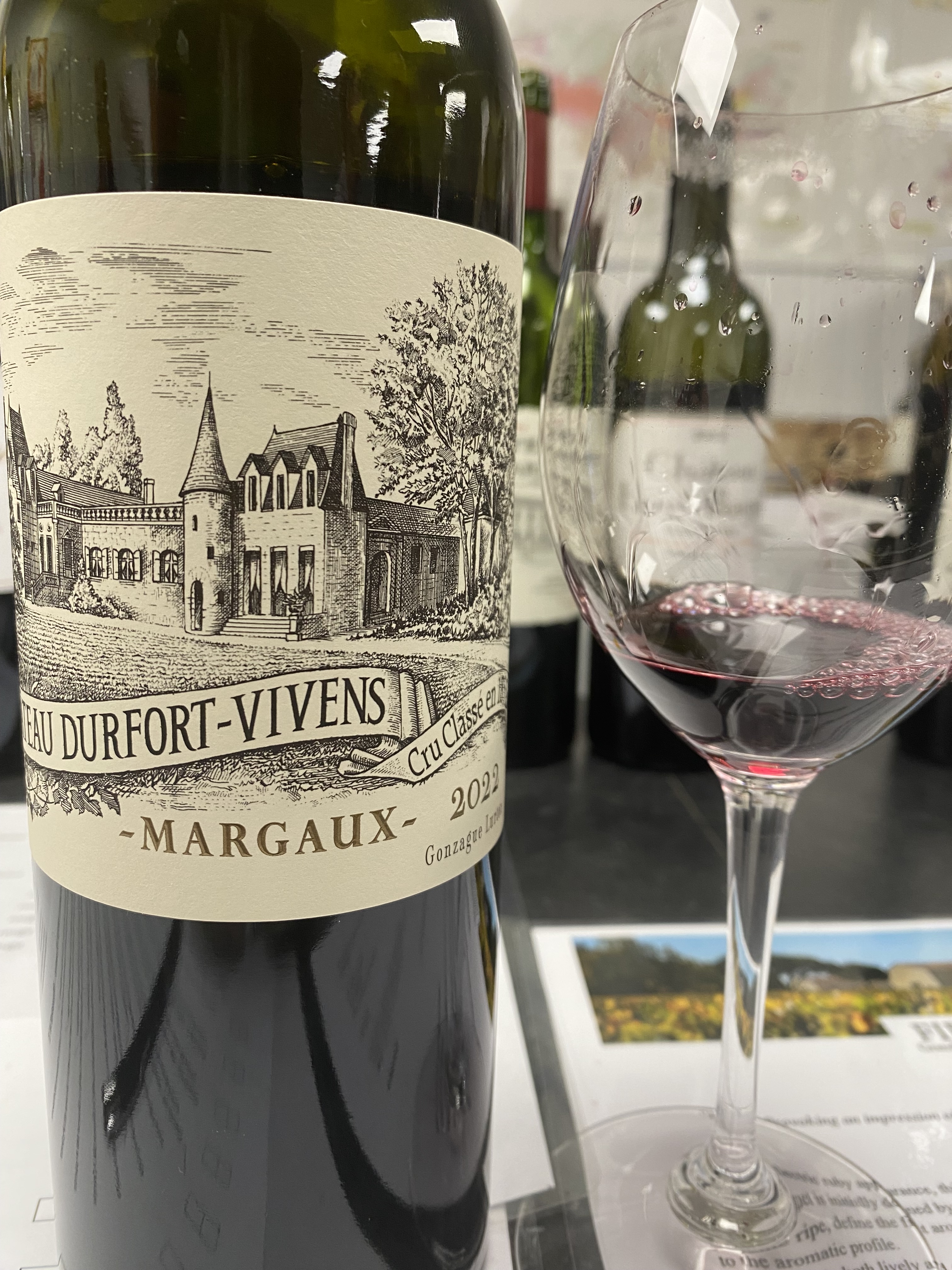
We then enjoyed Chateau Durfort-Vivens Margaux 2022, a Deuxiemes Crus (Second Growths) from the 1855 Classification of the Medoc. The estate was one that was visited by Ambassador Thomas Jefferson, before he became the President of the United States who rated the chateau just under Lafite, Latour, and Margaux. Like many other estates after the French Revolution, the chateau had many different owners until it was purchased by the Lurton family in 1937, who also at the time had a stake in Chateau Margaux. In 1962, Lucien Lurton bought the estate and in 1992, his son Gonzague took over, who revamped the cellars and converted the estate to organics and biodynamics. They now have a range of wooden and concrete vats sized to specific vineyard parcels. The estate is fifty-five-hectares of vineyards planted on deep gravel soil over a sand and clay base. This wine is a blend of eighty-four percent Cabernet Sauvignon and sixteen percent Merlot. The fruit was hand-harvested during three selective passes. Initial Fermentation was done with indigenous yeasts, with twenty-one days of maceration with pumping-over done daily. The wine was then aged for eighteen months using seventy percent new French Oak and thirty percent in amphorae. This was a deep ruby-red wine offering notes of black fruit, cigar box, cocoa, spices and minerals. On the palate this full-bodied wine displayed tones of black fruit, well-balanced, blended with tight tannins and a nice long count finish of fruit, terroir and a dash of spice; needs a few more years in the cellar.

 The Wine Raconteur
I think you enjoyed it a lot. Well shared 💐
Priti,
Thank you very much, and yes, the tasting was wonderful.
– John
https://notionpress.com/write_contest/details/1559/ashalata. Hi I have taken part in a short story competition please support me with 50 points through the link. Thank you 🙏😊