I was very surprised and elated after tasting six dry wines at my local wine shop The Fine Wine Source in Livonia, Michigan when they poured three famed after dinner wines. One German and two from France. I have to admit that as I am maturing, I am appreciating after dinner wines, especially when they are not cloying.
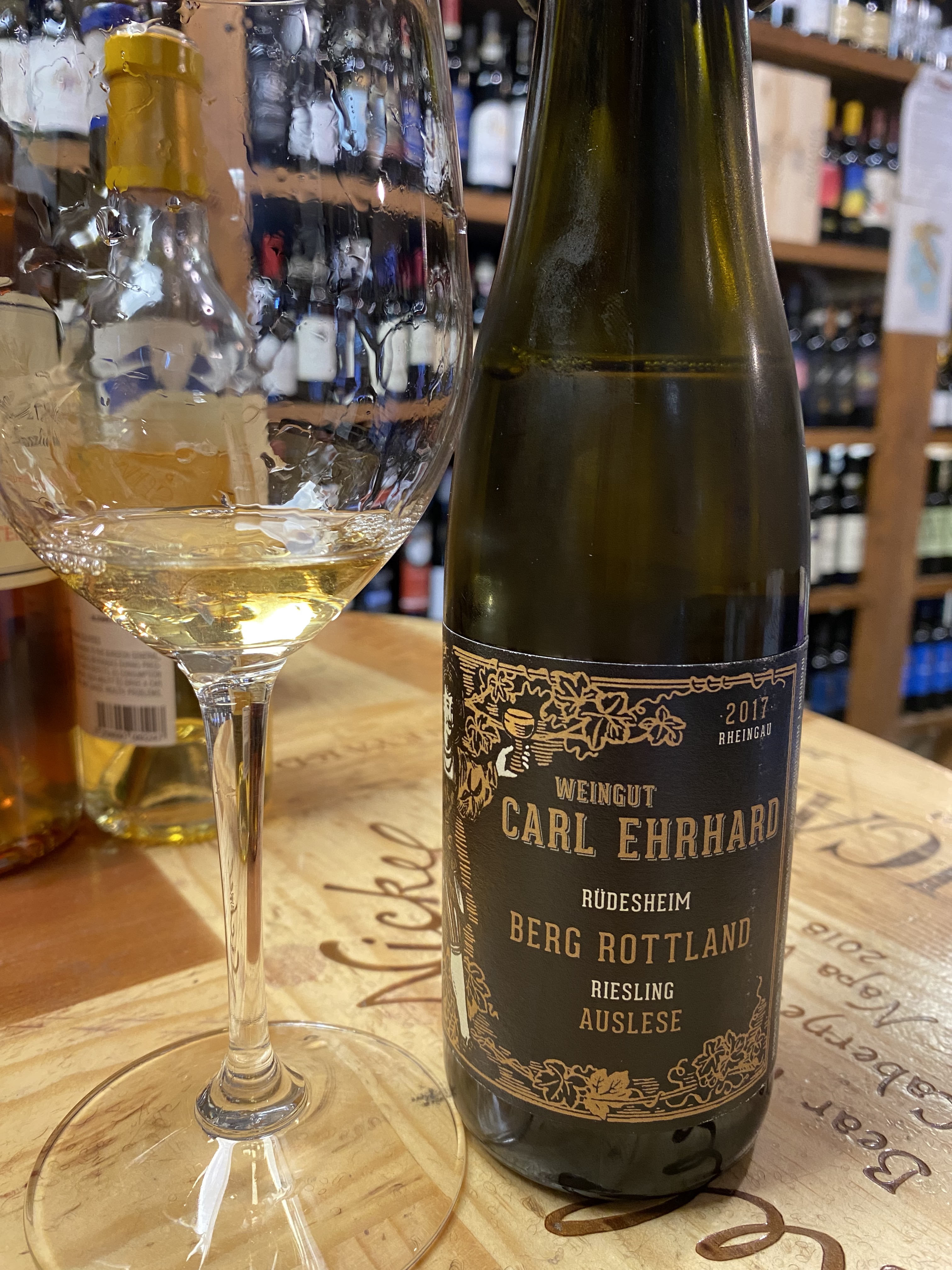
The German wine was Weingut Carl Ehrhard Rudesheimer Berg Rottland Riesling Auslese 2017 from the Rheingau. The Rheingau was first settled by Celts, followed by the Romans in the First Century. Rudesheim is a town on the northern banks of the Rhine River and there are seven vineyards rated by the VDP as Grosse Lage (First Growths) and the best are west of the town with on the steep slopes with southern exposure and Berg Rottland is one of them. Here is one of the steepest slopes and the soil is slate, quartzite, gravel, and scattered loess. Weingut Carl Ehrhard is an historic family estate and winery founded in 1815 and is now organic and biodynamic. All fruit is hand-harvested, Initial Fermentation occurs spontaneously from indigenous yeasts in large neutral oak barrels. The juice remains in the barrels on their lees for over a year, and they like to release the wine seventeen months after harvest with no fining or filtering. The wine had a nice golden color and offered notes of ripe peaches and apricots, white florals, and honey. On the palate a rich full-bodied wine that had tones of ripe fruit, a touch of citrus with balanced acidity and a long finish of honey and terroir.

I then had a wine, that I have never had before, in fact, I wasn’t even aware of it. I guess I live a sheltered life. I had a chance to try Chateau de Fargues Sauternes 2006 from Chateau d’Yquem and I heard it referred to as “d’Yquem Jr.” Chateau de Fargues has been with the Lur Saluces since 1472 and today they only produce one wine, a classic interpretation of Semillon and Sauvignon Blanc from its vineyards around the village of Fargues at the center of the appellation. Originally, they produced both red and white wines at the twenty-five-hectare estate, but in 1928, they replanted for only white on clay-gravel soils over a layer of clay and hardpan soil. The first vintage was produced in 1943, and released in 1964. The fruit is hand-harvested and sorted to separate the “noble rot” from the “gray rot” and each day’s selection is pressed and fermented in oak barrels, with about thirty percent new). Racking takes place four times a year and the wine is tasted to see if they have a vintage year, and if so, the wine continues aging in oak for thirty months, with an additional six in the bottle. There were no vintages for 1972, 1974, 1992, and 2012. While Chateau d’Yquem was the only and still only Grand Premiere Cru, Chateau de Fargues was absent from the 1855 classification for Sauternes and Barsac, since they only started producing in 1943. While the Lur Saluces family had the chateau for three-hundred-years before they bought Chateau d’Yquem, and then recently sold it in 1999, the two estates were always under the same strict quality standards hence the “d’Yquem Jr.” This beautiful amber colored wine offered notes of sweet tropical fruits, florals, jasmine, saffron, and some “sous-bois.” On the palate a full-bodied wine with layers of candied fruits, quince, figs, saffron, and honey, beautiful acidity and a nice long finish caramel and terroir.

Then we had Chateau d’Yquem Sauternes 2021 and I have never had a young wine from them before, so I was intrigued. The winery is the only Premiere Grand Cru of Sauternes and has maintained that status ever since. The estate was owned by the Kind of England in the Middle Ages and has produced late-harvest wines since the late 1500s. The Lur Saluces family had ownership from 1785 until 1999, when it was sold to LVMH. The one-hundred-three-hectare estate is located on the highest hill in Sauternes, planted on coarse gravel over a clay subsoil, which encourages “noble rot.” The wine is seventy-five percent Semillon and twenty-five percent Sauvignon Blanc. The fruit is hand-harvested and it takes about 6 weeks and multiple passes to get each berry at optimum level, and each basket is only an hour away from the winery and each day’s harvest is in a separate new oak barrel to undergo Initial Fermentation and maturation. After eight months the wine in each barrel is tasted to determine if it will continue in the process, those that make the cut are aged for an additional twenty months, with each barrel getting topped off every two weeks, and racked fifteen times to remove heavy lees, the lighter lees are removed during fining. Nine times in the last century, the entire year is sold anonymously in bulk, if the wine doesn’t achieve the expectation. This new vintage was the color of honey and offered notes of pineapple, pear, and tangerine, along with florals, cedar, and almonds. On the palate there were tones of fresh ripe fruit, candied lemon and candied orange and a nice long finish of honey and terroir. I was interested in trying to decide what flavors would develop and acquire complexity as the wine ages and deepens in color; only time will tell.

 The Wine Raconteur