While I was at The Fine Wine Source in Livonia, Michigan there were three recent wines that they wanted me to try, from a horde from a long-retired restaurant, that had been stored away and forgotten about. It is not a collection one would expect to find.

The first wine that I tried was Chateau Mazeris Canon-Fronsac 1981. Chateau Mazeris has had a presence since 1769 when the chateau was built and they have developed twenty-three hectares for the pursuit of winemaking. The family of Cournaud is in the fourth generation at the estate. Canon-Fronsac goes back to when Fronsac was a duchy of Cardinal de Richelieu in the 17th Century who introduce the wines to the royal court at Versailles. The original appellation in 1939 was the Cotes de Canon Fronsac and later in 1964 shortened to Canon-Fronsac, for still, dry red wines. The region is west of Libourne, while Saint-Emilion and Pomerol are east of Libourne. While the district has some of the alluvial soils by the Dordogne, most of the soils are more sandstone and limestone which helps the vines in hotter weather. The wine is basically eighty percent Merlot and twenty percent Cabernet Franc. The fruit is traditionally harvested in the morning to preserve the freshness. Initial Fermentation and maceration are for about four weeks in concrete tanks with thermoregulation. The wines are then aged for twelve months in vats and partially in French Oak barrels. This forty-three-year-old wine was still a garnet red, but with a brown cast and offered slight notes of fruit and spices. On the palate, one could see that the tones of fruit were showing its age, still drinkable, but not noteworthy.

The next wine that was poured was Chateau Brame-Les-Tours Saint-Estephe 1979. My curiosity was piqued as Saint-Estephe is one of the Communes of the Medoc that I don’t encounter that often. Chateau Brame-Les-Tours is part of the larger Chateau Laffitte-Carcasset. Chateau Laffitte-Carcasset was established in 1759 in a section of central Saint-Estephe known as Le Carcasset. In 1781 it was bought by Jean Laffitte and took on his name over the centuries. I could not find much about the estate, though it seems to be held in high esteem for their wines. For a forty-five-year-old wine this wine was still deep garnet in color and offered some notes of fruit, though faint. On the palate the wine was totally mature, but lacking the vibrancy that the Saint-Estephe wines that I have encountered usually offer, though I could sense that there was still a bit of savory tones left to this proud wine.
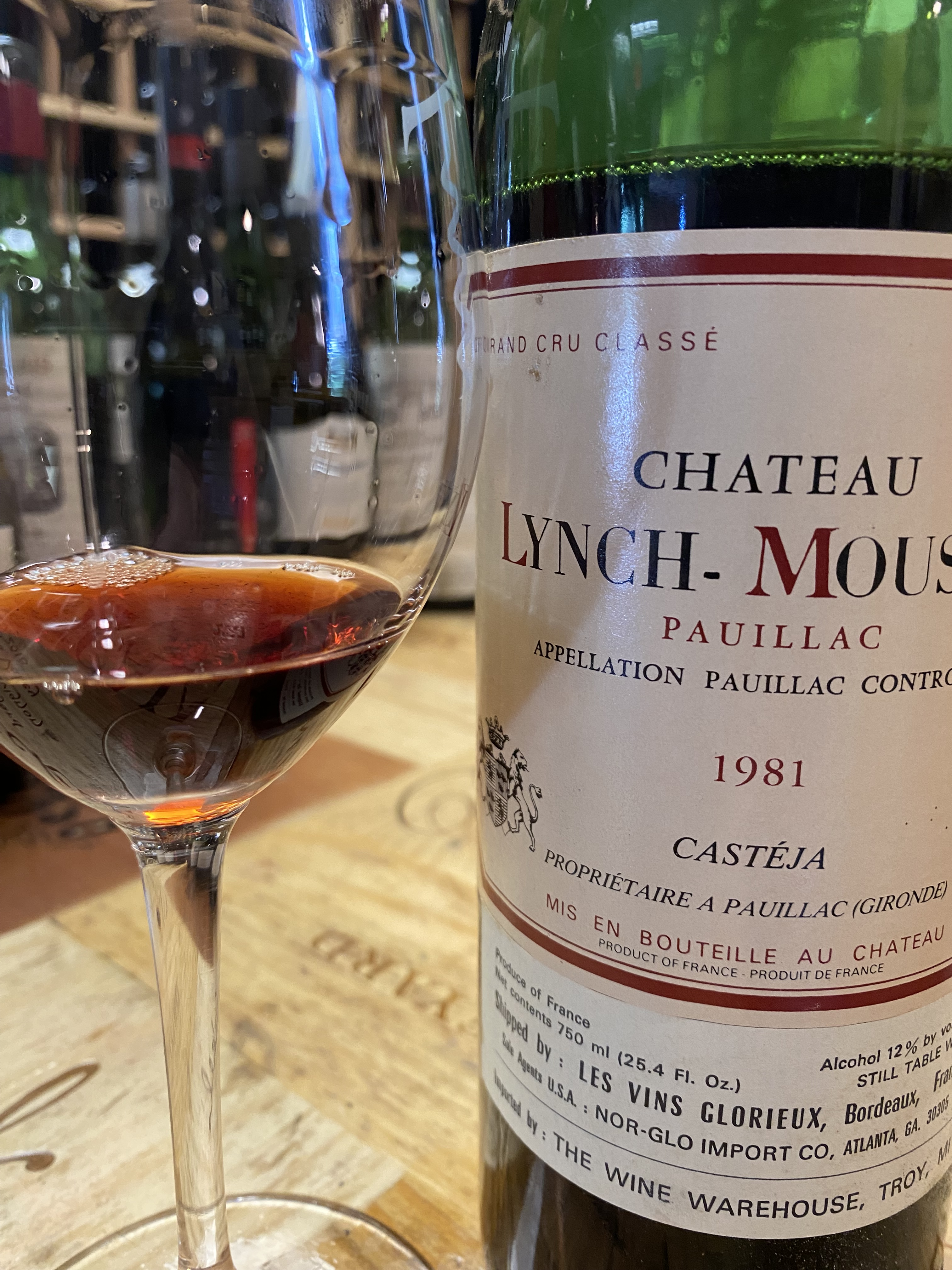
The last of the aged trio was Chateau Lynch-Moussas Pauillac 1981, a Fifth Growth from the famed Classification of the Medoc of 1855. Chateau Lynch-Moussas was once part of the large estate of Comte Lynch (and a former hunting lodge) that was divided in two in 1824, the other part became Lynch-Bages. The chateau was founded in the 18th Century by a member of the Lynch family. The “Moussas” name dates back to the 16th Century The property was purchased in 1919 by the Casteja family, who at the time also owned Duhart-Milon, and a member of the family has been in charge of the property since, though it is now part of the Borie-Manoux portfolio. The estate is about fifty-five hectares of vines planted on silica and gravel over limestone; and planted around seventy-five percent Cabernet Sauvignon and twenty-five percent Merlot. The wine is aged for about eighteen-months in oak, of which about half is new. At an age of forty-three this wine still had a nice garnet color and still some notes of dark fruit. On the palate it was a very mature wine with a blending of the tannins, fruit, and the acidity all becoming one. Of the three wines, this wine had held its own the best, and I know that I have a few that are of this era or older that I should open and taste as well.

 The Wine Raconteur
What a great chance to taste the older vintages! Enjoyed your notes, too. I also would’ve expected a little more from the St, Estephe but am glad the third wine brought some joy. Thanks for sharing your thoughts!
Lauren,
I wasn’t sure how this tasting would evolve, but it was a pleasure to have the chance.
– John
🙂🍷This wine also looks very tasty.
Thank you very much, and I am sorry that I do not use fancy descriptors, but I still try to describe the wines.
– John