I had just touched on the beginning of our dinner at Alpino Detroit in Corktown, after we had toured the renovated Michigan Central Station. I was happy to have read that when Alpino Detroit was being designed they eliminated the communal tables, as I didn’t think that a restaurant that had the potential of being on the pricier side should avoid having private tables.
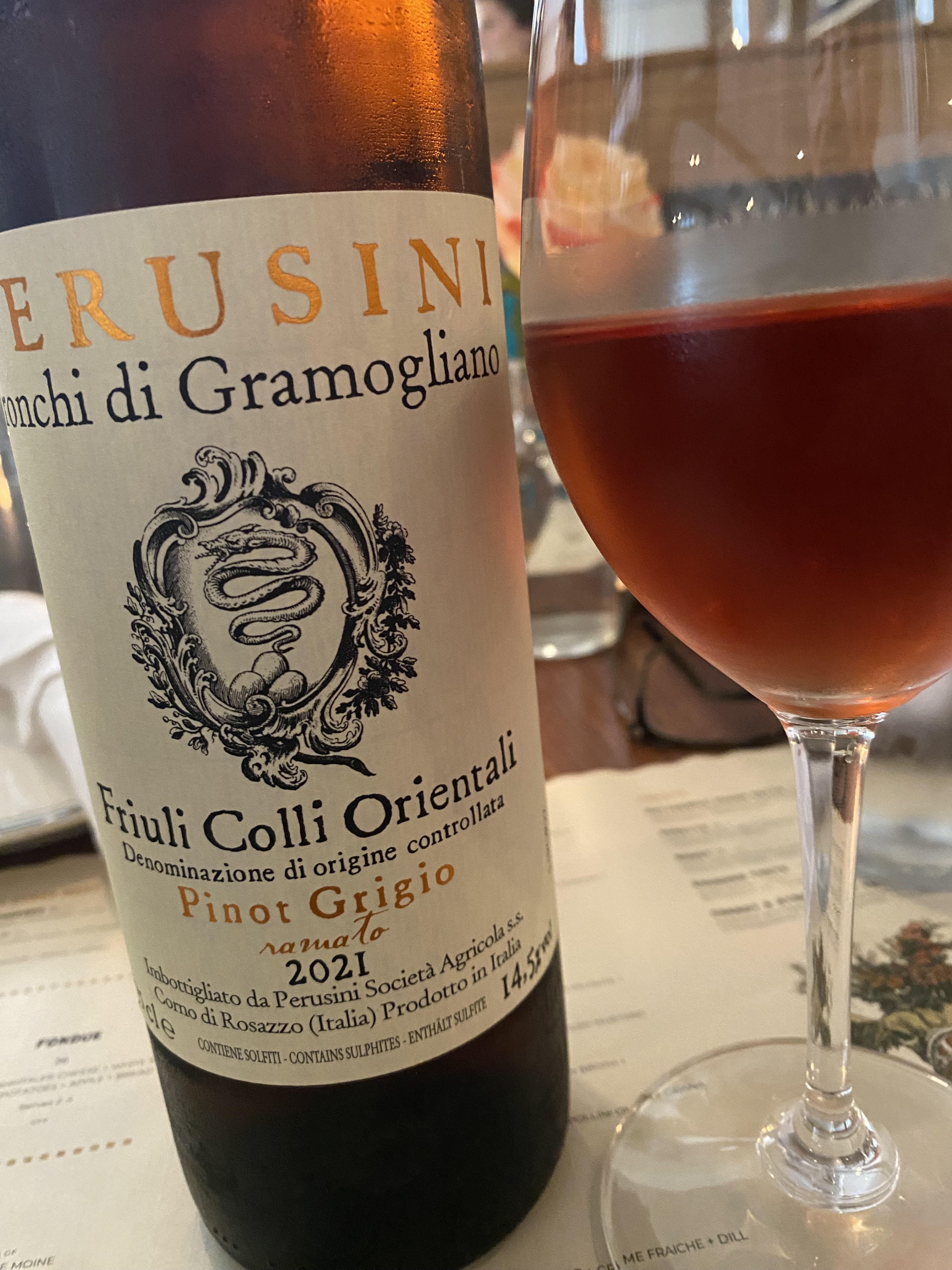
The second small plate that we ordered and divided between the two of us was the Gurkensalat, which is German for “cucumber salad” and the dish was Persian Cucumbers, Pickled Shallots, Crème Fraiche, Dill, and Marigold. It was refreshing and reminded me of the summer salads my mother made when I was a boy. I was still in cooling-off mode, and while I normally don’t have wine with a salad, since it wasn’t a vinegar-based dressing, I thought I would try something different, that they had listed as an “Orange” wine, which seems to be a bit of a rage, but over the course of the last couple of years I have shown restraint. I had the Perusini Ronchi di Gramogliano Ramato Colli Orientali del Friuli 2021 from Perusini Societa Agricola s.s. Perusini is one of the fifty members registered as an historical winemaker, as he tried to preserve native vines during the “fashion of the French wines” in the last century. Giacomo Perusini, grandfather of the present owner, was responsible for the selection and planting in the Colli Orientali. The family tradition has continued at the estate on the hills of Gramogliano edging on the Judrio River, which marked the border between Italy and Austria until 1918. The area originally known as Colli Orientali del Friuli from 1970, became Friuli Colli Orientali (Eastern Hills of Friuli) in 2011; and known mostly for its white wines. The soil is known as Flysch di Cormons, alternating layers of marl and sandstone. The vineyards due to the altitudes are terraced. The wine comes from Pinot Grigio vines planted on the top of Mount San Biagio and has a north-eastern exposure. The unique color is obtained by a five-day cryomaceration, a pre-fermentation cold maceration process in a nitrogen saturated environment. This eliminates the use of chemical preservatives without oxidation. During a four-day period, with the lack of alcohol, the gentle extraction from the berries creates the unique color and the distinct flavors and nose. The Initial Fermentation takes twelve days at low temperature to maintain the freshness of the juice. The coppery colored wine with brick color toning offered notes of strawberries and tropical fruits. On the palate it was a full-bodied wine with great tones of the fresh fruit promised by its nose, and finished with a good medium count of minerals (terroir). Without the wine carte or label, I would not have thought this wine was a Pinot Grigio, as it was unique and totally interesting.
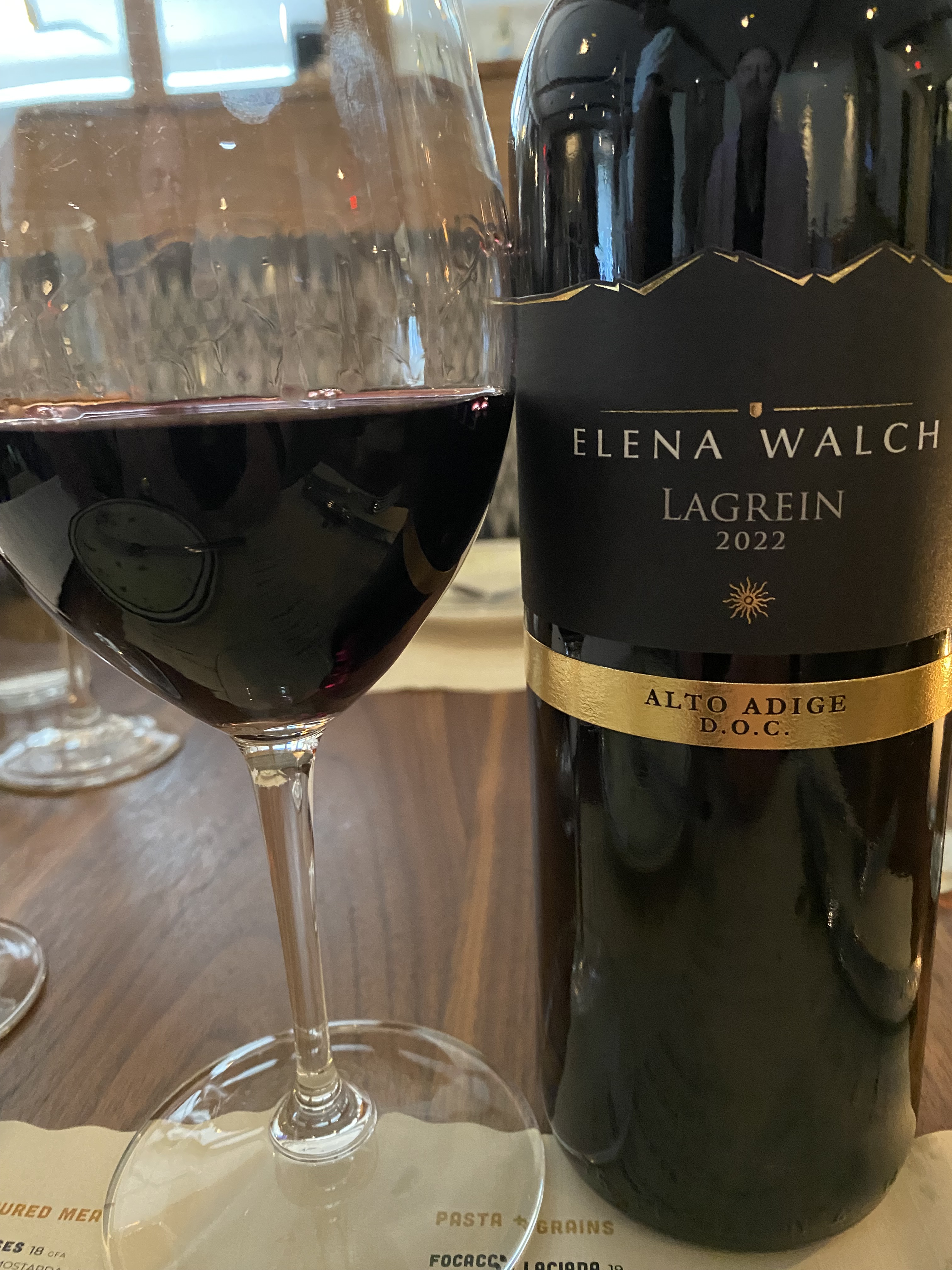
My Bride surprised me and had the Diots au Vin Blanc, French Pork Sausages, with White Savoie wine, Onion Broth, and a Mustard Rouille and a side of Rotkraut or Braised Red Cabbage. I had the Wienerschnitzel, a Breaded Veal Cutlet, Morel Rahmsauce (a German Cream Gravy with Morel Mushrooms), topped with a Shaved Cremini Mushroom salad with a Pickled Mustard Seed Vinaigrette. We definitely were sharing each other’s choices. We then had Elena Walch Lagrein Alto Adige 2022, and Alto Adige is the most northerly wine region of Italy and famed for Pinot Grigio, Lagrein and Schiava. Elena Walch has fifty-five hectares of vineyards around Alto Adige. Elena Walch was an architect by trade and married into one of oldest wine families of the region, and now her daughters are representing the fifth generation of managing the family business. Lagrein is considered a native of the region, as it has been recorded as far back as the 16th Century. It exemplifies the north-Italian acidic structure that is admired and noted in the finer wines. The fruit is hand-harvested from calcareous soils with clay and sand. Traditional temperature-controlled Initial Fermentation for about ten days in Stainless Steel tank, followed by Malolactic Fermentation in French and Slavonian oak barrels, followed my maturation in large wooden barrels. The wine is a deep garnet red and offered notes of wild berries, cherries, spices, and cocoa. On the palate, I was pleased with a fresh, full-bodied wine that blended distinct tannins with red fruit, good acidity, and a finish beckoning another sip.
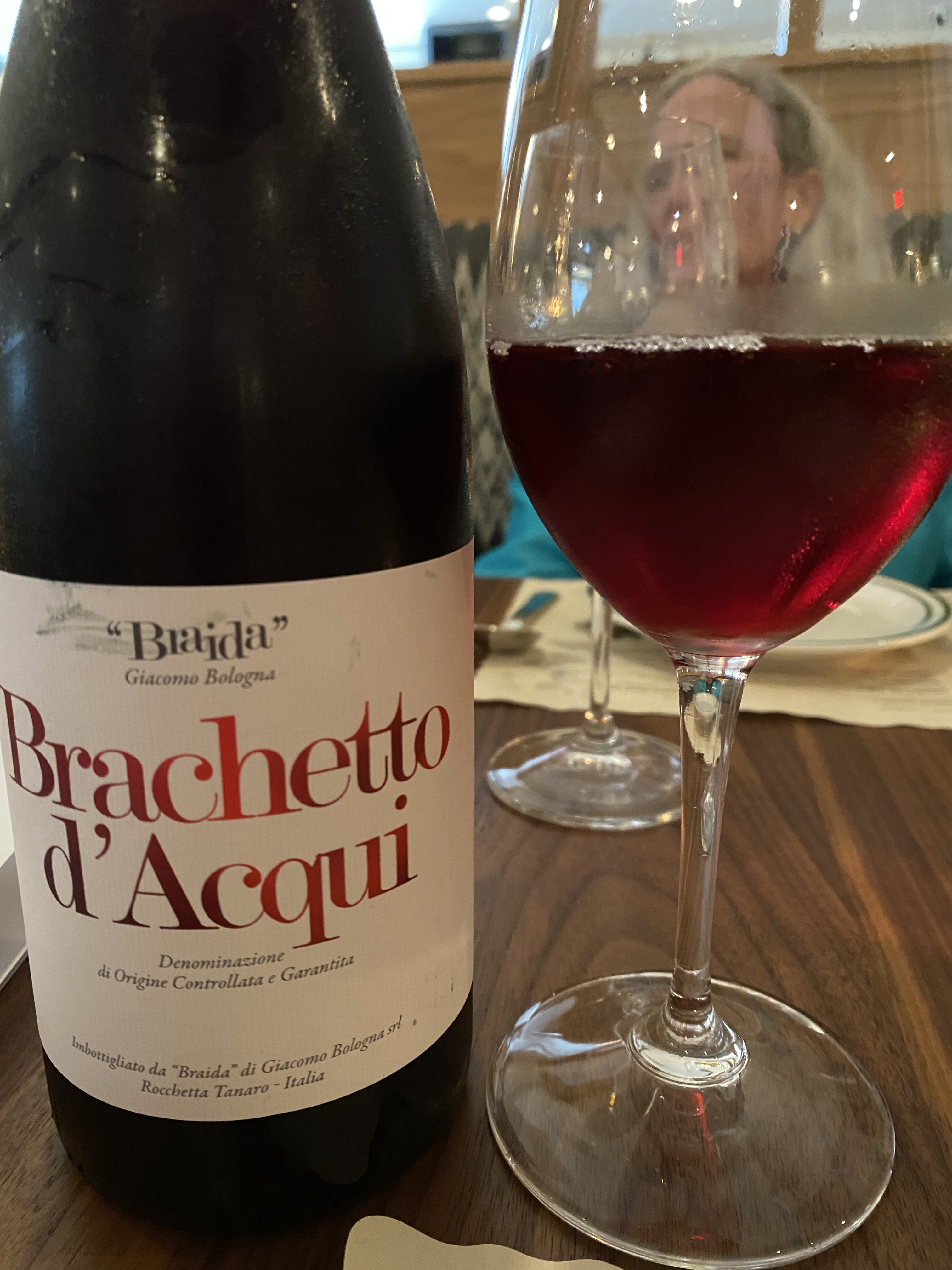
We should have finished, but the evening was delightful and the restaurant was filling up quite quickly. I saw a dessert that also reminded me of my mother, a Rhubarb Tarte on Shortbread, Zabaione Mousse (a sweet and frothy custard), Braised Rhubarb, and Sweet Pistachio Pesto. We shared the dessert and we shared a glass of Giacomo Bologna Braida Brachetto d’Acqui DOCG 2022 from the Piedmonte. Giacomo Bologna Braida is an estate in Monferrato and is associated with Barbera wines; and they also produce other red wines, white wines and two dessert wines. The current estate dates back to 1961 when Giacomo Bologna inherited vineyards from his father, including his nickname “Braida;” his son and daughter now run the estate. In 1967, they began making Brachetto d’Acqui, sometimes known as Acqui, and this particular wine received its DOCG in 1966, for frizzante, spumante, passito and a rosé (2017), as long as the wine is made using the Brachetto grape variety. There are twenty-six communes that can use this designation. Brachetto is a black skinned grape, that is normally not blended, and in the past, there were some attempts to make a dry wine, but since the designation status, those wines are preferred. The wine is produced by macerating the must with the grape skins for two days, to get the deep color. After the fermentation is completed, the wine is aged in the bottle for three months or more, before being released. The ruby red wine with fine frizzante perlage offers notes of raspberries, strawberries, and roses in a bold aromatic manner. On the palate, the delicate frizzante accentuates the fresh fruit flavors, a very soft and a nice medium count finish of fruit.

 The Wine Raconteur